
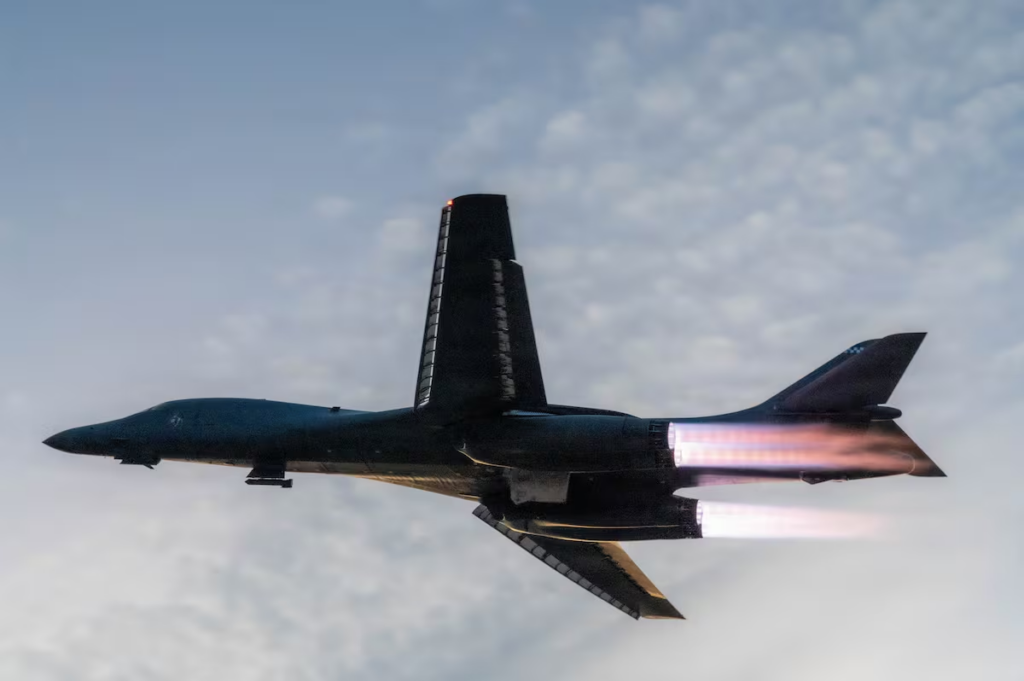
A U.S. strategic bomber has landed in the United Kingdom as tensions surrounding the Iran conflict continue to intensify. A 146-foot B-1 Lancer bomber arrived at RAF Fairford on Friday evening (March 6), following a decision by the British government to allow the United States to use certain UK military bases during the ongoing Iran crisis.
The deployment comes amid mounting political pressure in London and Washington after Donald Trump and several UK lawmakers criticized Keir Starmer for initially limiting U.S. access to British bases to defensive operations.
While the United Kingdom has allowed U.S. aircraft to operate from its territory, the government has stressed that it will not directly participate in strikes against Iran, highlighting the delicate balancing act London is trying to maintain as regional tensions surge.
Why the B-1 Lancer Bomber’s Arrival in the UK Matters
The arrival of the Rockwell B‑1 Lancer at RAF Fairford signals a significant escalation in U.S. military readiness linked to the Iran conflict.
The B-1 Lancer is one of the United States’ primary long-range bombers. Though originally designed for nuclear missions during the Cold War, it is now primarily used for precision conventional strikes.
Key capabilities of the B-1 bomber
- Range: More than 7,400 miles without refuelling
- Payload: Up to 75,000 pounds of weapons
- Speed: Supersonic capability
- Mission type: Long-range strike, maritime operations, and close air support
RAF Fairford has historically served as a key forward base for U.S. bomber deployments in Europe, especially during crises involving the Middle East or Russia.
Why the US Is Using Bases in the United Kingdom
The United States often uses British air bases to support global operations, given the close military partnership between the two countries.
RAF Fairford, in particular, has become a temporary hub for U.S. bomber task force deployments, enabling aircraft to launch missions to Europe, Africa, or the Middle East.
Strategic advantages of UK bases
- Geographic positioning
The UK sits between North America and the Middle East, making it an ideal staging point. - Advanced infrastructure
RAF Fairford has long runways capable of supporting heavy bombers. - Political reliability
The U.S. and UK maintain one of the world’s closest defence partnerships. - Operational flexibility
Bombers stationed in Britain can deploy rapidly to multiple theaters.
Despite these advantages, the British government has drawn a clear political line: the UK is not formally joining the war.
Why Prime Minister Keir Starmer Faced Criticism
Prime Minister Keir Starmer has come under pressure both domestically and internationally for what critics described as a cautious response to the Iran crisis.
Earlier in the week, the British leader defended his government’s decision not to join U.S. or Israeli offensive operations.
However, critics—including Donald Trump and several members of the UK Parliament—argued that limiting U.S. access to British bases only for defensive missions could slow military responses.
Starmer’s position reflects a familiar dilemma for British leaders during major U.S. conflicts: support the United States without being drawn into another large-scale Middle Eastern war.
What Role Al Udeid Air Base Plays in the Conflict
A key element of U.S. military operations in the Middle East is Al Udeid Air Base, the largest American military installation in the region.
The base serves as the forward headquarters of United States Central Command (CENTCOM).
Why Al Udeid is strategically important
- Hosts around 10,000 U.S. military personnel
- Serves as a hub for air command and control operations
- Supports surveillance, reconnaissance, and intelligence missions
- Enables aerial refuelling and combat strike coordination
Because of its location in Qatar, Al Udeid allows the United States to rapidly project airpower across the Middle East, including operations involving Iran.
How Iran Typically Responds to US Airstrikes
Iran has historically responded to American or Israeli military actions through a combination of direct retaliation and indirect pressure tactics.
Common Iranian responses include:
- Missile strikes targeting military facilities
- Drone attacks through regional proxy groups
- Naval harassment in the Persian Gulf
- Cyber operations against infrastructure or defence networks
Iranian leaders often frame these responses as retaliation against aggression, positioning Tehran as acting defensively rather than initiating conflict.
However, each retaliatory step increases the risk of a broader regional confrontation.
Could the Conflict Expand Beyond Iran?
Military analysts warn that the presence of U.S. bombers in Europe and bases across the Middle East creates a network capable of sustained operations if the conflict escalates further.
Several factors could widen the war:
- Strikes on Iranian territory triggering large-scale retaliation
- Attacks on U.S. bases in the Gulf
- Escalation involving Iran-aligned militias in Iraq, Syria, or Lebanon
- Disruption of global shipping routes in the Persian Gulf
The situation remains highly fluid, with diplomatic channels working in parallel to military preparations.
The UK’s Delicate Balancing Act
For the United Kingdom, the current approach attempts to strike a balance between strategic alliance and political restraint.
London has:
- Allowed U.S. use of certain British bases
- Maintained military coordination with Washington
- Avoided direct participation in strikes against Iran
This approach reflects growing public skepticism in the UK toward involvement in new Middle Eastern wars following conflicts in Iraq and Afghanistan.
What to Watch Next
The deployment of U.S. bombers to Britain suggests the Pentagon is preparing for multiple operational scenarios.
Key developments to monitor include:
- Additional U.S. bomber deployments to Europe
- Iranian military responses to recent strikes
- Diplomatic efforts aimed at de-escalation
- The role of regional bases such as Al Udeid
Whether the conflict expands or stabilizes will depend largely on how both sides manage retaliation cycles in the coming days.
TL;DR
- A U.S. B-1 Lancer bomber has landed at RAF Fairford in the UK amid escalating Iran war tensions.
- The UK allowed the United States to use some bases, but is not joining offensive strikes against Iran.
- The move follows criticism from Donald Trump and UK lawmakers of Prime Minister Keir Starmer.
- Al Udeid Air Base in Qatar remains the key command hub for U.S. air operations in the Middle East.
- Analysts warn the situation could still escalate depending on Iran’s response.