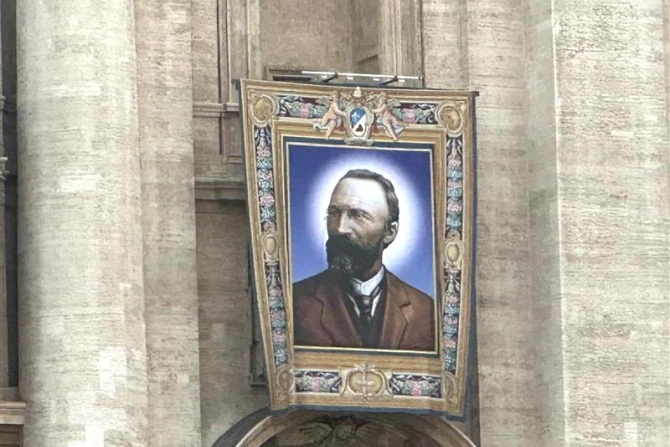
More than 700,000 people gathered in St. Peter’s Square this October to witness a canonization that has left even seasoned Vatican watchers astonished. On October 19, 2025, Pope Leo XIV officially declared Bartolo Longo, once a Satanic priest, a saint of the Catholic Church.
For many, it’s a story of radical redemption, a man who went from invoking demons to building one of Italy’s most sacred shrines. But beneath the awe lies a deeper question: what does Longo’s transformation say about faith, forgiveness, and the Church’s evolving understanding of sin and sanctity?
Who was Bartolo Longo before sainthood?
Bartolo Longo was born in 1841 in Latiano, Italy, into a devout Catholic family. A promising law student, he began his career in Naples during a period of intense political and religious upheaval.
But personal tragedy changed everything. Following his father’s death, Longo spiraled into despair, disillusioned with the Church and drawn toward the occult, a movement gaining traction among Italy’s disenchanted intellectuals at the time.
He immersed himself in séances, occult literature, and secret rituals. Some reports, including those cited by the Daily Mail, claim he was even “ordained” as a priest of Satan. His descent was marked by physical and mental torment until one night, as the story goes, he heard his late father’s voice whisper, “Return to God.”
That moment became the turning point in his life.
The road back to faith
Shaken and terrified, Longo turned to a trusted friend, Professor Vincenzo Pepe, who warned him he was “on the road to madness.” Seeking help, Longo met Dominican priest Father Alberto Radente, a man known for guiding lost souls back to the Church.
Under Radente’s counsel, Longo went through a long process of confession, repentance, and fasting. He renounced his ties to Satanism, embraced celibacy, and committed himself to a life of service.
By 1871, he was formally accepted into the Dominican order as a lay member, taking the name “Brother Rosario.” His devotion to the Virgin Mary would soon define the rest of his life.
Why the Vatican canonised a former Satanist
Longo’s conversion was only the beginning. Over the next several decades, he worked tirelessly to repair the spiritual damage he believed he had caused.
He founded the Shrine of Our Lady of the Rosary in Pompeii, now one of the most visited Marian shrines in the world. He also established schools and orphanages for children of prisoners, often using his personal wealth and legal training to fund charitable work.
He became a vocal critic of spiritualism, even attending one last séance to publicly renounce it, declaring, “I renounce spiritualism; it is nothing but a web of lies and deception.”
His death in 1926 marked the end of a life that had come full circle, from darkness to divine purpose.
When Pope Leo XIV declared him a saint in 2025, he described Longo and six others as “witnesses who kept the lamp of faith burning through grace and repentance.”
What makes Bartolo Longo’s story so unique?
Unlike most saints, Longo’s path to holiness began at the very edge of damnation. His life challenges the conventional image of saintly purity, instead emphasizing transformation, a core Christian idea often overshadowed by idealized depictions of sanctity.
Historians and theologians see his canonization as a bold move by the Vatican. It signals a renewed focus on redemption in an age where moral failings are often treated as irreversible.
“Bartolo Longo represents hope for those who believe they’ve gone too far to be forgiven,” says Father Marco Rossi, a Vatican historian.
This narrative, from self-destruction to salvation, also serves as a counterpoint to modern cynicism about organized religion. It reasserts the Church’s message that no one is beyond grace.
How the Church decides who becomes a saint
Canonization, the official process of declaring someone a saint, is complex and can take decades, even centuries.
The process generally includes:
- Verification of a life of virtue or martyrdom
- Miracles attributed to the person’s intercession (usually medically unexplained healings)
- Approval by the Pope after a theological and historical review
In Longo’s case, the Church recognized two miracles linked to his prayers, one involving the healing of a sick child and another tied to the survival of an earthquake victim in Pompeii.
By approving his sainthood, the Vatican essentially affirmed that no past sin, no matter how grave, outweighs a lifetime of repentance and service.
The symbolism of Longo’s canonisation today
At a time when the Catholic Church faces criticism for its handling of past scandals, Bartolo Longo’s sainthood carries deep symbolic weight. It repositions the Church as a vessel of forgiveness rather than judgment, a stance that may resonate strongly with disillusioned believers.
It also underscores the Church’s effort to connect with a generation grappling with anxiety, moral relativism, and the search for meaning. Longo’s story offers a reminder that faith can begin in the most unlikely places, even in rebellion.
“From Satanist to Saint: The Life Timeline of Bartolo Longo”
1841: Born in Latiano, Italy
1860s: Becomes involved in occult practices
1871: Converts, joins the Dominican order
1876: Founds Shrine of Our Lady of the Rosary, Pompeii
1926: Dies in Pompeii
2025: Canonised by Pope Leo XIV
TL;DR (Summary)
Bartolo Longo’s life reads like a spiritual thriller, from Satanic priest to saint. His journey, marked by despair, redemption, and relentless charity, culminated in canonization on October 19, 2025. The Vatican’s decision highlights a powerful message: even the most lost souls can find their way back to grace.