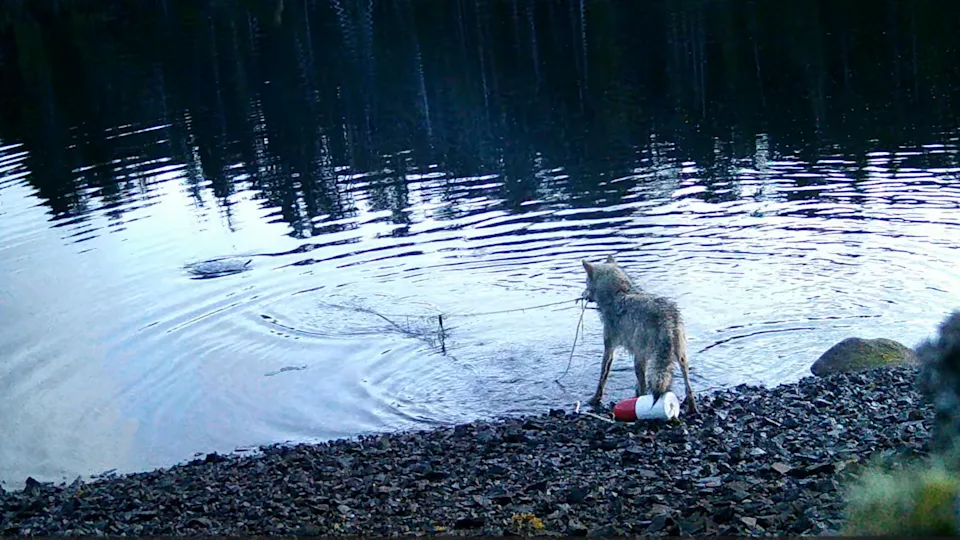
The first documented case of a wolf using a rope to retrieve a crab trap is reshaping scientific understanding of predator intelligence and problem-solving. The incident, captured on video on the central coast of British Columbia, shows a female coastal wolf pulling a buoy to shore, grabbing the attached rope, and dragging a submerged trap until she can access its bait.
This surprising behaviour offers new insight into animal cognition, tool use in non-primates, and how wildlife interacts with human activity in coastal ecosystems. It also raises questions about cultural transmission among wolf populations and the ecological impacts of invasive species.
What exactly happened during the wolf-crab trap encounter?
Researchers and members of the Heiltsuk Nation, an Indigenous community in British Columbia, had deployed crab traps to help control the invasive European green crab. These traps were placed at varying depths, from shallow tidal zones to deeper waters.
Over time, traps began showing unexplained damage. At first, scientists believed bears or wolves might be responsible, but deep-water traps were considered inaccessible to land predators. These animals do not dive, so researchers assumed something else—possibly an otter or a seal—was interfering.
To solve the mystery, the team installed cameras near the traps.
Instead of a marine mammal, the footage revealed a female wolf swimming ashore with a floating buoy in her mouth. She dropped it, inspected the attached rope, and began pulling systematically. After hauling the trap to a shallow zone, she opened it and ate the bait: a piece of herring.
Kyle Artelle, a co-author of the study, said the team was “amazed” by the behavior because it involved multiple sequential steps, something rarely documented in wolves.
This was not random curiosity. The wolf displayed clear intent, pausing to monitor the rope and waiting for the trap to appear from the water.
What makes this tool’s use so significant?
Tool use in wildlife is often associated with primates, dolphins, or certain birds like crows. Wolves have long been admired for their social coordination and hunting strategies, but physical tool manipulation has not been observed—until now.
This case matters because:
• It expands the known cognitive abilities of wolves
• It suggests wolves can adapt to human-created environments
• It challenges assumptions about how predators interact with marine systems
• It raises questions about learned vs. instinctive behavior
The sequence of actions the wolf performed qualifies as tool use because she manipulated an external object (rope) to achieve a goal (accessing food). This is similar to how humans use tools to extend reach, apply force, or retrieve objects.
Scientists believe she may have originally learned the technique by watching humans deploy traps or encountering a rope during low tide. Understanding how animals learn these behaviors is essential to studying cultural transmission across generations.
Why were these crab traps set, and what role does the Heiltsuk Nation play?
The traps belong to the Heiltsuk Nation, whose stewardship of the region stretches back thousands of years. Their conservation program aims to control the European green crab, an aggressive invasive species that damages eelgrass beds, harms juvenile fish habitat, and threatens coastal biodiversity.
European green crabs reproduce quickly and disrupt ecosystems that Indigenous communities depend on for food security and cultural practices. By placing traps in both shallow and deep waters, the Heiltsuk Nation works to limit the species’ spread while monitoring ecological health.
The wolf’s behaviour indirectly highlights an ongoing challenge: human interventions to protect ecosystems can sometimes create new interactions between wildlife and human-made tools.
A graphic comparing native vs. invasive crab species would fit well in this section.
How did researchers determine this was a deliberate, problem-solving action?
The video captured more than simple opportunism.
A chain of cognitive behaviors was visible:
• Identifying the buoy as a visual cue
• Bringing it ashore to create leverage
• Locating and gripping the rope
• Pulling in a coordinated, stepwise manner
• Watching the rope end carefully for movement
• Dragging the cage to a location where it could be opened
Each step required decision-making rather than instinct alone.
Artelle noted that this was “problem-solving exactly the way humans do it,” because the wolf could not see the trap but still understood the mechanism linking rope tension and trap retrieval.
A behaviour like this suggests an ability often categorised as “insight learning,” the sudden understanding of a solution without trial-and-error attempts.
Could wolves teach each other how to use ropes or tools?
Marc Bekoff, an animal behaviour expert, suggests that future research should explore whether this skill could be culturally transmitted. Wolves are highly social and rely on learned behaviour passed through packs.
There are several mechanisms by which this behaviour could spread:
Social learning
Younger wolves could watch adults manipulate ropes or human fishing gear and adopt the technique.
Imitation and emulation
Wolves might mimic the steps, pulling, tugging, and dragging, even if they do not fully understand the cause-and-effect relationship initially.
Environmental reinforcement
If wolves repeatedly encounter crab traps or similar setups, they might independently discover the technique.
This creates an unusual intersection between wildlife behavior and marine conservation: human tools unintentionally becoming part of an animal’s learned behavioral repertoire.
How common is tool use in non-primate mammals?
Compared to primates, elephants, dolphins, and certain bird species, tool use among terrestrial carnivores is rare. Wolves typically use teamwork, strategic movement, and vocal communication—not physical manipulation of objects.
Examples of tool use in non-primate mammals include:
• Sea otters using rocks to crack open shells
• Dolphins use sponges to protect their snouts while foraging
• Bears rolling logs into rivers to trap fish (documented in certain populations)
• Elephants using branches to swat flies
The wolf’s behaviour now joins this list, pushing scientists to reconsider the boundaries of cognitive complexity in predators.
A visual timeline of major documented animal tool-use milestones could enhance reader understanding.
What does this incident reveal about the relationship between wolves and marine ecosystems?
Coastal wolves in British Columbia are already known for their unique ecological niche. They swim between islands, hunt salmon, scavenge whale carcasses, and traverse beaches daily. Their diet can be up to 85 percent marine-based in certain regions.
The rope-pulling behaviour shows that:
• Wolves are responsive to human presence and fishing infrastructure
• Marine resources are critical to their survival
• They can exploit artificial objects in creative ways
This raises management questions. If wolves begin regularly targeting traps, conservation programs may need to adapt their approach. At the same time, understanding wolf ingenuity can help scientists better design equipment that minimises disruption.
Why this discovery matters for science, conservation, and public understanding
This single event has implications far beyond one wolf and one trap.
1. It challenges scientific assumptions
Deep-water traps were considered unreachable based on the belief that predators wouldn’t attempt retrieval from shore.
2. It broadens the definition of animal intelligence
Wolves join a short list of species with documented tool-use abilities.
3. It emphasizes the importance of Indigenous-led conservation
The Heiltsuk Nation’s monitoring efforts made the discovery possible.
4. It highlights the ecological threat of invasive species
Efforts to control European green crab populations remain vital.
5. It encourages further interdisciplinary research
Behaviourists, Indigenous knowledge holders, ecologists, and marine scientists all have roles in understanding this interaction.
TL;DR: What you need to know
• A wolf was filmed pulling a crab trap to shore using a rope, marking the first recorded tool use by the species.
• The trap belongs to the Heiltsuk Nation, part of a program to control invasive European green crabs.
• Scientists initially believed only marine animals could access deep-water traps.
• The wolf’s behaviour shows deliberate problem-solving and multiple coordinated actions.
• Future research may explore whether this technique spreads through wolf populations.