
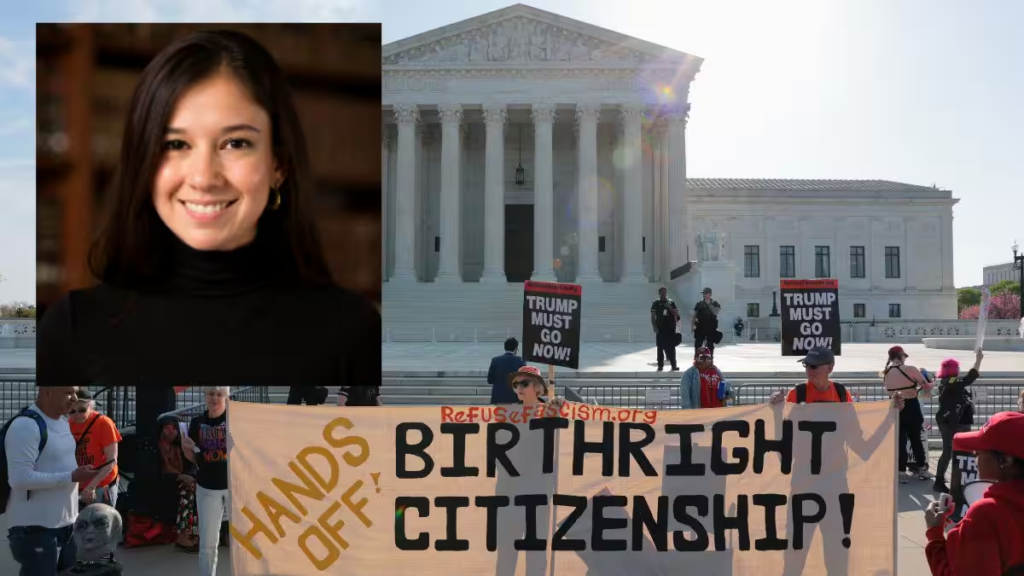
At the center of one of the most consequential constitutional battles in recent U.S. history is a relatively low-profile but influential legal mind. Smita Ghosh has emerged as a key figure challenging Donald Trump’s executive order aimed at restricting birthright citizenship, a principle long considered foundational to American identity.
Her work is not just about opposing a policy. It is about defining what citizenship means in the United States and whether that meaning can be narrowed by executive action.
What is Trump’s citizenship order, and why is it controversial?
The legal battle centers on an executive order that seeks to reinterpret birthright citizenship, a right rooted in the 14th Amendment.
The constitutional principle at stake
The 14th Amendment guarantees the following:
- Anyone born on U.S. soil is a citizen
- Citizenship is not dependent on parental immigration status
This principle, often referred to as “jus soli” (right of the soil), has been upheld for over a century.
Why the order is being challenged
Critics, including Smita Ghosh, argue that:
- The executive branch cannot override constitutional guarantees
- The order undermines long-standing legal precedent
- It could fundamentally alter immigration and civil rights policy
The case has already drawn scrutiny from the Supreme Court of the United States, signaling its national importance.
Who is Smita Ghosh?
Despite her growing prominence, Smita Ghosh is not a household name. Her influence lies in legal scholarship and appellate advocacy rather than public visibility.
A specialist in constitutional law
Smita Ghosh works as an appellate counsel, focusing on:
- Constitutional interpretation
- Legal history
- Civil rights law
Her expertise makes her particularly relevant in cases where historical meaning shapes modern law.
A scholar of citizenship history
Beyond the courtroom, Ghosh has written extensively on the evolution of citizenship in the United States.
Her research explores:
- Pre-14th Amendment legal frameworks
- Early court decisions, including 19th-century cases
- The original intent behind citizenship protections
In a recent analysis, she argued that the 14th Amendment was designed to affirm existing rights, not restrict them. This directly challenges the interpretation behind Trump’s order.
How Smita Ghosh is challenging the executive order
Ghosh’s legal strategy is rooted in history as much as in law.
Using constitutional history as a legal tool
Her argument emphasizes that:
- Birthright citizenship predates the 14th Amendment
- The amendment codified, rather than created, the principle
- Any attempt to narrow it contradicts its original purpose
This approach positions the case as a question of interpretation, not just policy.
Framing the case beyond politics
Rather than focusing solely on political implications, Ghosh and other attorneys are:
- Grounding arguments in legal precedent
- Highlighting historical continuity
- Challenging the limits of executive power
This strategy is designed to resonate with courts, where historical interpretation carries significant weight.
Why her role matters in the broader immigration debate
Ghosh’s involvement reflects a larger shift in how immigration battles are being fought in the U.S.
A growing role for Indian-American legal voices
She is part of a broader group of Indian-American lawyers shaping high-stakes legal debates.
Their influence highlights:
- The growing role of diaspora communities in U.S. law
- Increased diversity in constitutional litigation
- Cross-cultural perspectives on rights and identity
A case that could redefine citizenship
Legal experts say the outcome could have far-reaching consequences:
- Redefining who qualifies as a U.S. citizen
- Reshaping immigration policy
- Affecting millions of families
This is not just a legal dispute. It is a test of how the Constitution is interpreted in modern America.
What happens next?
The case is expected to move through the federal court system, with the possibility of a landmark ruling by the Supreme Court.
Key questions the court may consider
- Can an executive order reinterpret a constitutional guarantee?
- What is the original meaning of the 14th Amendment?
- Should historical context outweigh modern policy concerns?
The answers could set a precedent for decades.
TL;DR
Smita Ghosh, an Indian-American appellate lawyer and legal scholar, is playing a key role in challenging Donald Trump’s executive order on birthright citizenship. Her arguments rely on constitutional history, positioning the case as a defining moment for how the U.S. understands citizenship.