
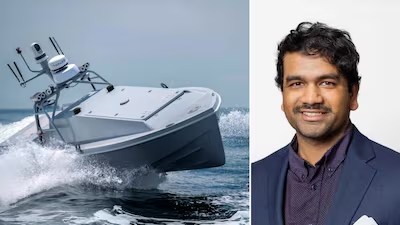
At a time when immigration and foreign talent remain politically charged issues in the United States, an Indian-American technology executive has found himself at the center of a major US military operation in one of the world’s most volatile regions.
The US Navy recently used an autonomous drone boat to rescue two crew members after an AH-64 Apache attack helicopter crashed near the Strait of Hormuz during heightened tensions involving Iran. The unmanned vessel, called the Corsair, was developed by Texas-based defense startup Saronic Technologies — co-founded by Indian-American engineer Vibhav Altekar.
The mission marked a significant milestone for the Pentagon: the first known use of an autonomous surface vessel to recover military personnel during an active operational scenario.
What Happened Near the Strait of Hormuz?
The Apache helicopter reportedly went down near the Strait of Hormuz, a strategically critical maritime chokepoint through which roughly one-fifth of the world’s oil supply passes.
According to reports, the US Navy deployed the Corsair autonomous drone boat to recover the pilot and co-pilot from the water. The rescue was carried out remotely, highlighting how artificial intelligence and autonomous systems are increasingly becoming part of real-world military operations — not just experimental defense programs.
The incident occurred amid escalating tensions involving Iran in the Gulf region, where the US has expanded surveillance and naval deployments in recent years.
What Is the Corsair Drone Boat?
The Corsair is an autonomous surface vessel designed for military and defense operations. Built by Saronic Technologies, the vessel is part of the US Navy’s broader push toward AI-enabled warfare systems.
Corsair Specifications
The vessel reportedly includes:
- Length: 24 feet
- Top speed: Up to 35 knots
- Range: More than 1,000 nautical miles
- Payload capacity: Around 1,000 pounds
- Fuel system: Diesel-powered
- Navigation: AI-enabled autonomous operation
The Corsair operates under the US Navy’s Task Force 59 initiative, a program focused on integrating unmanned systems into naval operations across the Middle East.
The Pentagon has increasingly invested in autonomous maritime platforms as part of a strategy to reduce operational risks to personnel while expanding surveillance, reconnaissance, logistics, and rescue capabilities.
Why This Rescue Matters
Military analysts say the rescue operation demonstrates how autonomous systems are moving beyond testing environments into frontline operational use.
Traditionally, sea rescue missions in conflict zones require:
- Manned helicopters
- Naval patrol boats
- Human-operated recovery teams
Using an autonomous vessel changes the equation by:
- Reducing risk to additional personnel
- Speeding up deployment in dangerous waters
- Allowing operations in contested maritime zones
- Expanding around-the-clock operational capability
The rescue could become a case study for future US military doctrine involving unmanned rescue and support systems.
What Is Saronic Technologies?
Saronic Technologies is a defense technology startup headquartered in Austin, Texas. Founded in September 2022, the company focuses on autonomous maritime systems designed for military applications.
The company’s founding team includes:
- Dino Mavrookas, a former Navy SEAL
- Vibhav Altekar
- Doug Lambert
- Rob Lehman
According to the company’s public profiles, Saronic has secured a production contract reportedly worth $392 million with the US Navy for autonomous surface vessels.
That scale of investment reflects a broader Pentagon trend: partnering with smaller defense-tech startups instead of relying exclusively on traditional defense giants.
The Rise of Defense Tech Startups
Companies like Saronic are part of a new generation of defense firms building:
- Autonomous systems
- AI-driven surveillance platforms
- Drone technologies
- Maritime robotics
- Machine-learning-based battlefield tools
This shift mirrors developments in Silicon Valley, where software-driven defense innovation has accelerated rapidly over the past decade.
Who Is Vibhav Altekar?
Vibhav Altekar serves as the Chief Technology Officer (CTO) of Saronic Technologies and leads many of the company’s core engineering initiatives.
According to the company website, Altekar oversees:
- Forward Deployed Engineering
- Product Development
- Special Programs
- Software Engineering teams
His work focuses heavily on:
- Autonomous navigation systems
- Machine learning
- Maritime perception systems
- Command and control architecture
- Systems integration
- AI-enabled defense software
Altekar studied electrical engineering at the University of California and has reportedly spent much of his professional career working on projects connected to the US Department of Defense.
Industry observers describe him as part of a growing generation of immigrant-origin engineers helping shape next-generation US defense technologies.
Why the Story Is Drawing Attention
The rescue mission has attracted attention for several reasons beyond the military operation itself.
1. Immigration Debate Meets National Security
The story arrives amid heated political debates in the US around:
- Skilled immigration
- H-1B visas
- Foreign-born engineers in sensitive industries
- National security and technology leadership
Indian-origin executives already play major roles across Silicon Valley, but their growing presence in the US defense-tech ecosystem has become increasingly visible.
2. AI Warfare Is Becoming Operational Reality
The Pentagon has discussed AI-enabled military systems for years. But real-world deployment in active rescue missions signals a major shift from experimentation to operational use.
This incident may strengthen arguments for expanding autonomous military platforms across:
- Naval patrol operations
- Search-and-rescue missions
- Logistics
- Reconnaissance
- Mine detection
3. The Strait of Hormuz Remains a Global Flashpoint
The rescue also underscores the continuing strategic importance of the Strait of Hormuz, one of the world’s most sensitive waterways.
Any escalation involving Iran in the region can affect:
- Global oil markets
- International shipping
- US military deployments
- Energy security
That makes technological advancements in maritime defense especially significant.
What Happens Next?
The Pentagon is expected to continue increasing investment in autonomous naval systems as geopolitical tensions rise across key maritime regions.
If missions like this prove successful, AI-powered surface vessels could become standard tools for:
- Personnel recovery
- Coastal surveillance
- Escort missions
- Fleet support operations
For Saronic Technologies and Vibhav Altekar, the high-profile rescue may also elevate the company’s standing in the rapidly expanding defense-tech sector.
As warfare increasingly blends software, AI, and unmanned systems with traditional military hardware, engineers and startup founders are becoming as strategically important as conventional defense contractors.