
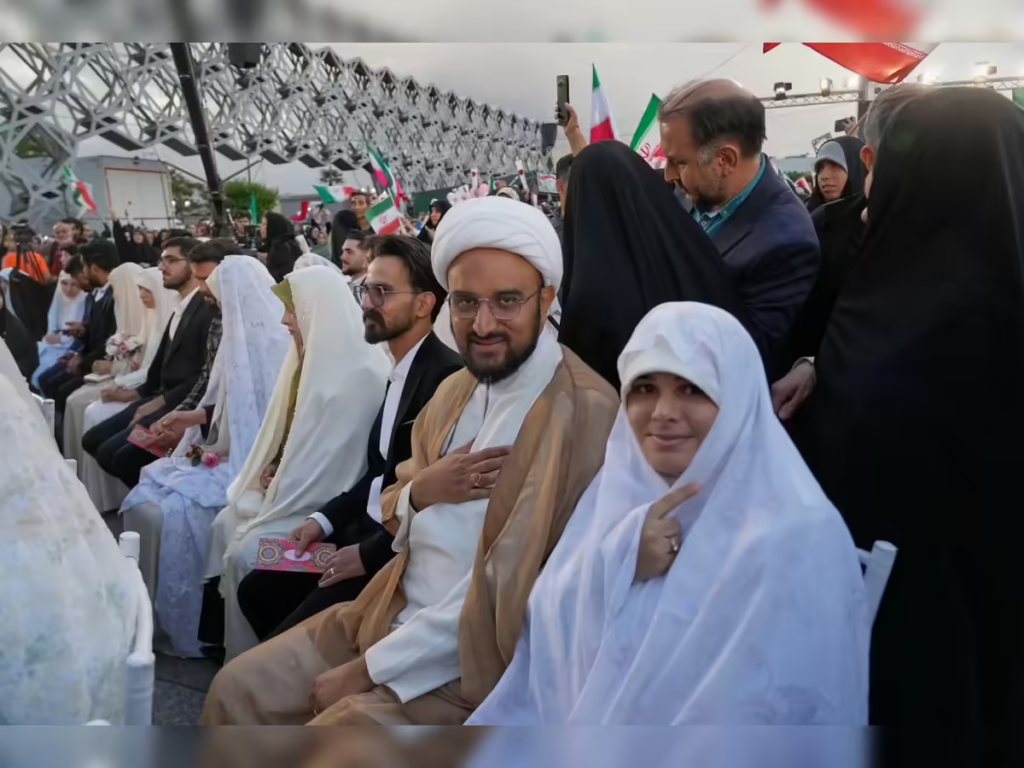
In the middle of escalating conflict with the United States, Iran has staged a striking display of patriotism, religion, and wartime symbolism: mass public weddings for couples pledging readiness to sacrifice their lives for the country.
The ceremonies, held Monday in central Tehran, blended celebration with militaristic imagery in a scene that looked part state rally, part religious ritual, and part wartime propaganda theater.
More than 100 couples reportedly participated in Imam Hossein Square, according to Iranian media cited by CBS News and local outlets.
Brides in white dresses rode through the capital in military vehicles mounted with machine guns. Giant portraits of Iran’s leadership loomed over the ceremonies. State television broadcast the event nationwide.
The message was unmistakable:
Marriage, sacrifice, and national resistance are being fused into a single wartime narrative.
What exactly happened at the ceremonies?
Weddings staged in central Tehran
The events took place in Tehran amid ongoing tensions and military exchanges between Iran and the United States.
According to Iranian media reports:
- Hundreds attended the public ceremonies
- Couples rode in decorated military jeeps
- Clerics officiated the weddings
- State television aired the ceremonies nationally
- Officials framed the events as patriotic acts tied to wartime unity
Images circulating online showed:
- Flower-covered military vehicles
- Newlyweds posing beneath missile displays
- Massive portraits of Supreme Leader Mojtaba Khamenei
- Public crowds gathered in support
Why are these weddings happening now?
A morale campaign during wartime
Iranian authorities appear to be using the ceremonies as part of a broader effort to:
- Boost public morale
- Reinforce national unity
- Encourage sacrifice narratives
- Frame the war as both patriotic and spiritual
State-linked media described participants as having volunteered for “self-sacrifice” schemes connected to the war effort.
The symbolism matters deeply in Iran’s political culture.
Since the 1979 Islamic Revolution, the Iranian state has frequently connected:
- Religious devotion
- Martyrdom
- National resistance
- Family values
- Military sacrifice
During the Iran-Iraq War in the 1980s, similar themes were heavily promoted through state media, murals, school programs, and public ceremonies.
What does “self-sacrifice” mean in this context?
The exact structure of the reported “self-sacrifice” registration program remains unclear.
However, Iranian state rhetoric often invokes the concept of:
- Defending Islam
- Protecting national sovereignty
- Embracing martyrdom if necessary
In Iran’s political language, “sacrifice” can refer to:
- Military volunteering
- Civil defense participation
- Ideological loyalty during wartime
The ceremonies appear designed less as military recruitment events and more as symbolic declarations of collective resilience.
Why military vehicles and missiles were part of the weddings
The visual staging was highly deliberate.
The symbolism behind the imagery
Military vehicles, armed escorts, and missile displays served multiple purposes:
- Demonstrating state power
- Associating marriage with national duty
- Linking personal life to wartime patriotism
- Broadcasting defiance toward external enemies
The result was a surreal blend of:
- Romance
- Religion
- State propaganda
- Militarized nationalism
One viral social media clip showed couples riding through Tehran in military jeeps beneath rows of missiles, creating imagery that many online compared to dystopian cinema or wartime propaganda spectacles from earlier eras.
How ordinary Iranians appear to view the ceremonies
Public reaction inside Iran appears mixed.
Some support the events
Supporters see them as:
- Patriotic
- Spiritually meaningful
- A display of resilience during war
- Proof that life continues despite conflict
One bride quoted by Iranian media said:
“Certainly, the country is at war, but young people also have the right to marry.”
That sentiment reflects a broader reality:
Even during crises, ordinary life does not stop completely.
Others view the ceremonies skeptically
Critics online questioned:
- Whether participation was fully voluntary
- The use of propaganda during wartime
- The militarization of civilian rituals
- The blending of personal milestones with state ideology
As with many state-organized public events in Iran, separating genuine participation from political theater can be difficult.
Why this story is drawing global attention
The images have spread rapidly because they compress several major global anxieties into a single visual:
- War
- Nationalism
- Religion
- AI-era propaganda
- State-controlled symbolism
- Public spectacle
The visuals feel cinematic, but they also reveal something serious about modern information warfare:
Governments increasingly use emotionally charged imagery to shape morale during conflict.
Iran’s leadership appears keenly aware that viral symbolism can travel globally faster than official speeches.
The larger political backdrop
The ceremonies come amid:
- Continued US-Iran military tensions
- Leadership uncertainty after the reported death of Ali Khamenei
- Regional instability across the Middle East
- Growing pressure on Iran’s political establishment
The state appears determined to project:
- Stability
- Popular support
- Ideological continuity
- Readiness for prolonged confrontation
That helps explain why weddings, of all things, became part of the wartime messaging machine.
TL;DR
- Iran held mass public weddings in Tehran during its conflict with the US
- Couples reportedly pledged readiness for wartime sacrifice
- The ceremonies featured military vehicles, missile displays, and state media coverage
- Iranian authorities framed the events as symbols of patriotism and national unity
- The weddings reflect a broader attempt to merge religion, nationalism, and wartime morale-building