New York City Mayor-elect Zohran Mamdani’s recent White House visit produced one of the strangest political anecdotes of the year. But behind the now-viral moment lies a revealing story of how Donald Trump continues to reshape political performance, public spectacle, and the boundaries of democratic dissent.
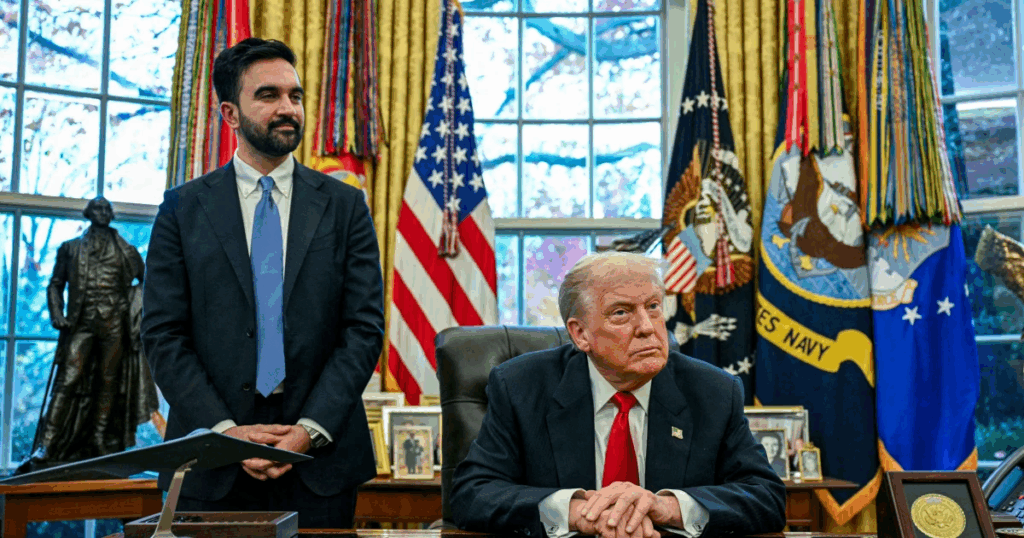
Mamdani, a democratic socialist known for his sharp critiques of the president, walked into the Oval Office last week expecting tension. Instead, he found something stranger: a glossy coffee-table book titled “UFC at the White House,” apparently previewing the mixed martial arts event Trump plans to stage on the South Lawn during America’s 250th anniversary celebration.
The moment went viral for its oddity, but it also highlights a broader pattern. Trump continues to collapse politics, entertainment, and personal branding into one seamless arena. Meanwhile, Mamdani’s effort to maintain ideological distance, even in the middle of a cordial meeting, positions him as a rising figure navigating a landscape dominated by Trump’s political spectacle.
This article explores what the moment means, why it matters, and what it reveals about the future of political communication in the United States.
What did Zohran Mamdani actually see at the White House?
During his appearance on “The Adam Friedland Show,” Mamdani described sitting in a waiting area before his meeting. On the table in front of him were numerous coffee-table books. One of them immediately stood out.
It was a fully produced visualization of a UFC octagon installed on the South Lawn of the White House. Mamdani recalled flipping through the pages in disbelief, noting that the book was not filled with images of fighters but rather architectural renderings of the planned 2026 event.
He told the host he had “no idea” the White House was preparing to host a mixed martial arts fight card next year. The concept sounded surreal until he remembered that Trump himself had teased the event months earlier as part of the United States’ semiquincentennial celebrations.
For Mamdani, the sight was a jarring reminder that, under Trump, the executive mansion is as much a stage set as it is a seat of political power.
Why the UFC detail matters
The UFC book is not just an amusing footnote. It symbolically fuses two threads central to Trump’s political identity:
- His long-standing relationship with the UFC and its leadership
- His strategy of turning political milestones into a televised spectacle
By including the octagon visualization in a White House coffee-table book, the administration signals that the event isn’t merely a policy decision or a celebration. It’s branding. It’s merchandising. It’s political theater built for cameras and clicks.
For a critic like Mamdani, seeing this in person sharpened the surrealness of his White House experience.
How Mamdani’s critique of Trump continues despite their cordial moment
Days after the meeting, Mamdani reiterated his view that Trump is a “fascist” and a “despot” during an NBC interview. Despite the unusually warm handshake moment that earlier went viral, Mamdani made it clear he has not softened his political stance.
On NBC’s Meet the Press, he was asked directly whether he still believed Trump is a threat to democracy. He answered without hesitation:
“Everything that I’ve said in the past I continue to believe.”
This is a striking contrast to the friendly energy on display during their joint White House press interaction—an exchange that Trump seemed to enjoy.
The viral moment that drew attention
During their public remarks, a reporter asked Mamdani whether he still viewed the president as a fascist. Before Mamdani could answer, Trump interrupted:
“That’s OK. You can just say it. That’s easier. I don’t mind.”
The remark went viral because it displayed an unusual form of political jiu-jitsu. Trump preempted criticism, embraced the label with a shrug, and made the situation oddly comedic. Mamdani appeared momentarily disarmed, and social media lit up with reactions ranging from amusement to disbelief.
This moment showcased what Trump has perfected over the years: a blend of showmanship, brazenness, and counterintuitive humor that defuses criticism by absorbing it.
Why this exchange matters for American politics in 2025
The Zohran Mamdani White House moment matters for three reasons:
- It illustrates the increasingly blurred line between political governance and entertainment culture.
- It tests how rising progressive leaders navigate Trump’s media-dominant ecosystem.
- It highlights the persistent divide between political performance and political principle.
1. The Trump-era performance of politics
Trump’s decision to host a UFC fight at the White House, coinciding with his 80th birthday, underscores how his administration continues to merge statecraft with spectacle.
This is not new. Trump has always used the aesthetics of entertainment to drive political messaging. But staging a combat-sports event on the South Lawn pushes this fusion to new extremes.
2. A case study in how progressives navigate Trump’s stage
Mamdani’s position is uniquely challenging. He is both a critic of Trump and a politician now operating on a national stage. His viral moment with Trump showed just how quickly the president can recast even adversarial interactions into friendly optics.
For progressives, the challenge is maintaining ideological clarity without losing ground in Trump’s show-driven environment.
3. Public perception versus political conviction
The cordial meeting and the viral exchange could have created the impression that Mamdani was backtracking. His NBC interview clarified that this is not the case.
Mamdani’s strategy appears to be:
- meet diplomatically
- communicate clearly
- maintain ideological consistency
This duality may become a blueprint for other leaders navigating a Trump-dominated media environment.
What the moment reveals about the future of political communication
The “UFC at the White House” anecdote is instantly memorable because it captures the tension at the heart of American politics today.
On one hand, it shows how Trump’s presidency continues to lean heavily into spectacle. On the other, it reveals how political opponents must now adapt to an environment where symbolism and performance carry as much weight as policy or debate.
Expect more spectacle ahead
The semiquincentennial in 2026, paired with Trump’s milestone birthday, almost guarantees more show-driven political events.
Expect more viral political clashes
The Trump-Mamdani moment is unlikely to be an outlier. Cameras are everywhere. Every handshake, interruption, smirk, or joke is a potential viral clip.
Future political encounters—especially between Trump and young, outspoken progressives—will likely continue this pattern.
Expect ideology to collide more with entertainment culture
Mamdani can call Trump a fascist. Trump can laugh it off. Both statements exist simultaneously in the public arena. The ideological divergence and the performative camaraderie do not cancel each other out; they coexist as part of America’s conflicted political narrative.
TL;DR summary
- During a White House visit, Zohran Mamdani spotted a strange UFC coffee-table book showing plans for a South Lawn MMA event in 2026.
- Mamdani later reiterated that he still views Trump as a “fascist” and a “despot,” despite their cordial public exchange.
- A viral moment occurred when Trump encouraged Mamdani to just say the word “fascist” instead of explaining it to reporters.
- The incident highlights how Trump blends governance with entertainment and how progressive leaders must navigate this spectacle-driven political environment.
- The moment signals a broader trend where political ideology and media performance increasingly coexist in the same frame.