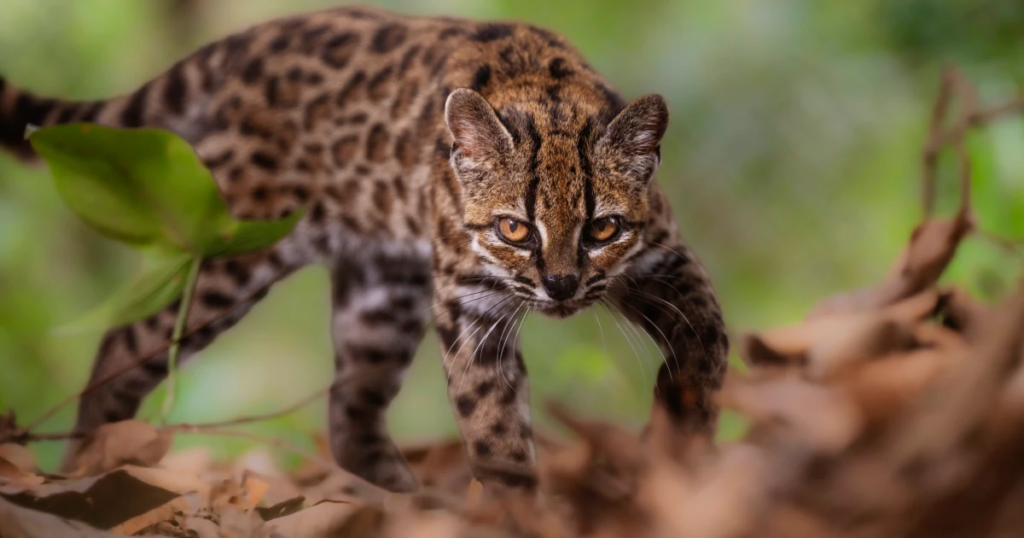
A tiny spotted cat hiding in Bolivia’s cloud forests has just received a scientific identity, marking the first formal description of a new living cat species in more than a century. Named Leopardus tilcayo, or the tilcayo tiger cat, the elusive feline lives in the Yungas region on the eastern slopes of the Andes. Researchers identified it as a distinct species after comparing genetic material from 38 wild cats across South America. The findings were published in Current Biology on September 17, 2026.
The discovery is especially remarkable because the animal was not found in some unexplored corner of the planet. One of the first known specimens had been living for years in a wildlife sanctuary after a local family initially mistook it for a domestic cat.
What does the tilcayo look like?
The tilcayo is considerably smaller than many domestic cats.
It measures roughly 46 centimeters from head to body and weighs about 1.4 kilograms. Its light-brown coat is covered with irregular dark rosettes, while its rounded ears and slender build give it the appearance of a miniature leopard.
The cat belongs to the tiger cat group, a collection of small spotted felines that live across South America.
What made identifying the tilcayo so difficult is that these animals are “cryptic” species. They can look extremely similar despite being genetically distinct, meaning photographs alone may not reveal where one species ends and another begins.
A “weird cat” leads scientists to a discovery
The story began in 2016 when Bolivian biologist and National Geographic Explorer Paola Nogales-Ascarrunz received a call from a wildlife sanctuary.
A local man had found a kitten near a forest road and taken it home, believing he had found a domestic cat. After keeping it for about a year, he realized that the animal was wild and turned it over to Senda Verde Wildlife Sanctuary.
Nogales-Ascarrunz initially thought the animal was a tiger cat already known to science. But its markings did not quite match reference images, particularly those of Brazilian tiger cats. That discrepancy eventually prompted a much deeper investigation.
DNA revealed a hidden branch of the cat family tree
The decisive evidence came from genetics.
The research team analyzed complete genomic data from 38 members of the Leopardus genus, including 26 tiger cats sampled across their South American range and eight museum specimens.
The results showed that what had long been treated broadly as the tiger cat group actually contains five genetically distinct species. Leopardus tilcayo represented a previously unrecognized fifth lineage.
The researchers estimate that the tilcayo lineage separated from other tiger cats around 1.4 million years ago.
That is not a recent split in evolutionary terms. The cat had already been following its own evolutionary path for an immense stretch of time before scientists formally gave it a species name.
Scientists have known surprisingly little about it
The discovery comes with a major scientific caveat: there may be very few tilcayos known to researchers.
The team’s current information comes from only two live individuals, along with a small number of camera-trap records. One of the known animals is a 10-year-old male now living at Senda Verde Wildlife Sanctuary.
Scientists still do not have reliable estimates of the species’ total population, geographic range or reproductive behavior.
Early evidence suggests the cat may be primarily nocturnal, while remains found in scat indicate that small rodents could form part of its diet. Researchers say considerably more fieldwork is needed to establish how the animal actually lives in the wild.
The discovery changes the tiger cat family tree
The tilcayo is not the only taxonomic surprise in the new research.
The study recognizes five distinct tiger cat species, including several lineages that were previously treated differently in scientific classifications. The researchers also identified a new subspecies in Peru’s Yungas, named Leopardus tigrinus antisuyo.
This matters because species classification is not just about names.
When researchers determine that what was thought to be one widespread species is actually several separate evolutionary lineages, estimates of population size, habitat and conservation risk can change dramatically.
A species that once appeared relatively widespread may turn out to have a much smaller range than previously believed.
Why the Yungas forest matters
The tilcayo’s habitat is the Yungas cloud forest, a mountainous region where the Andes meet the Amazon basin.
These forests are exceptionally rich in biodiversity, but they are also vulnerable to human pressures including deforestation, agricultural expansion and mining.
The discovery therefore arrives at a critical moment for conservation.
Scientists cannot protect a species effectively if they do not know it exists or mistakenly group it with another animal that has different habitat needs and population trends.
Could the tilcayo already be endangered?
It is too early for researchers to give the new species a definitive conservation status.
The existing IUCN Red List treatment of tiger cats does not yet separately assess the newly recognized tilcayo lineage. The researchers have submitted their findings to the IUCN, which is expected to consider the five lineages separately in a future review.
Depending on the size and distribution of the wild population, the tilcayo could face a substantially different risk profile from other tiger cats.
That is precisely why establishing its identity matters.
How can a new cat remain hidden for so long?
Unlike lions, tigers and leopards, small wild cats are notoriously difficult to study.
Many are solitary, nocturnal and inhabit dense forests where camera traps may capture only fleeting glimpses. Close physical similarities between species make visual identification even harder.
Genetic sequencing is changing that equation.
Modern genomics can reveal evolutionary divisions that decades of field observations and museum comparisons could not resolve. In the tilcayo’s case, DNA turned a cat that looked familiar into an entirely new species.
A century-long gap in feline discovery
The description of Leopardus tilcayo is being hailed as the first new living cat species formally described in more than 100 years.
The comparison refers to the scientific naming and description of a previously unrecognized living feline species, rather than the first time scientists have ever found an unknown cat-like population. The last comparable addition dates to the pampas cat in 1923, according to accounts of the new research.
That makes the tilcayo an extraordinary reminder that even among mammals as familiar as cats, evolution still has hidden chapters.
The animal itself may have been known to local communities for generations. Science simply had not yet recognized the lineage.