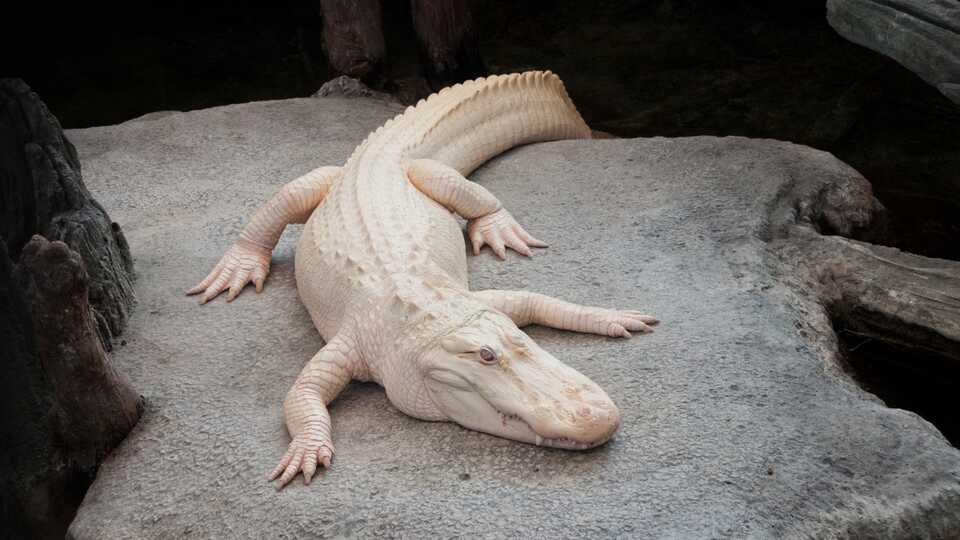
Claude, the California Academy of Sciences’ beloved albino alligator and one of San Francisco’s most recognizable residents, has died at age 30. His passing closes the chapter on a reptile who became far more than an aquarium attraction. Claude was an icon, an ambassador for misunderstood species, and a rare scientific marvel whose life offered insight into the fragile biology of albinism in the animal kingdom.
The academy announced his death on Tuesday after weeks of veterinary monitoring, reduced appetite, and treatment for a suspected infection. His loss has sparked grief across the Bay Area and among fans worldwide who regarded him almost as a local myth made real.
This article explores Claude’s life, his unique biology, the circumstances surrounding his death, and, most importantly, the question many are asking: What is the usual lifespan of albino alligators, and how did Claude defy the odds?
Who was Claude, and why was he so significant?
Claude was born in 1995 in Florida with a condition so rare that only a handful of alligators in the world share it: complete albinism. Without melanin, his skin gleamed an unearthly white, his eyes appeared pink, and his vision was severely compromised. In the wild, such animals rarely survive infancy.
Claude defied that fate.
He arrived at the California Academy of Sciences in 2008 and became the ghostly centerpiece of the Steinhart Aquarium. For 17 years, he drew millions of visitors who saw in him not just a reptile, but a personality—calm, slow-moving, and strangely charismatic. His unusual appearance inspired children’s artwork, viral photos, and even dedicated birthday celebrations, including his widely shared 30th “hatch day” in September.
Visitors often described him as serene, regal, or gentle. For many locals, he was as iconic to San Francisco as the sea lions at Pier 39 or the bison in Golden Gate Park.
What made Claude’s biology so rare?
Understanding albinism in alligators
Albino alligators lack melanin—the pigment that protects skin and eyes from sunlight. This leads to several challenges:
- Extreme sensitivity to ultraviolet light
- Impaired depth perception and low vision
- Higher susceptibility to infections
- Vulnerability to predators due to a lack of camouflage
In wild swamps or marshes, these conditions are usually fatal early in life.
Claude survived because he lived in a controlled, carefully protected habitat. His caretakers used custom lighting designed to shield his skin, habitat features to reduce stress, and diets crafted for his unique physiology.
Why albino alligators rarely reach adulthood
Survival challenges include:
- Sunburn and skin damage from UV exposure
- Difficulty hunting due to compromised eyesight
- Increased risk of injury from other alligators
- Higher susceptibility to disease
This is why Claude’s long life became a scientific case study in how environment and intervention can dramatically extend the lifespan of genetically fragile animals.
How long do albino alligators usually live?
This is the primary question raised after Claude’s passing.
Typical lifespan of non-albino alligators
- In the wild: 30–50 years
- In captivity: 60–80 years
The oldest known captive alligators have reportedly reached their 80s.
Lifespan of albino alligators
Albino alligators rarely live long enough to study their natural lifespan. Documented individuals rarely survive more than a few years in the wild.
In controlled environments, however, specialists estimate:
- 20–35 years is common
- 40+ years is possible with exceptional care
Claude’s 30-year lifespan places him near the upper end of what albino alligators can achieve in captivity, especially given the heightened vulnerabilities linked to albinism.
His longevity is widely considered a triumph of husbandry, environmental design, and ongoing veterinary attention.
What led to Claude’s death?
The academy reported weeks of declining appetite—often the earliest sign of health problems in reptiles. He was moved behind the scenes for care and treated for what veterinarians suspect was an infection.
A full necropsy by UC Davis veterinarians will determine the cause more precisely. Necropsies for rare animals are essential because they help:
- Identify underlying health vulnerabilities
- Improve medical protocols for other albino reptiles
- Inform long-term captive care standards
- Advance research into pigment-related genetic conditions
Given Claude’s age, health history, and biology, experts suggest a combination of age-related decline and disease may have been factors.
How did the academy care for Claude over the years?
Claude’s survival depended on meticulous planning and specialized environmental controls.
Key elements of his care
Lighting and UV protection
Traditional reptile enclosures were modified to prevent skin burns and cellular damage from sunlight. His team engineered lighting that balanced warmth with filtered exposure.
Habitat enrichment
His tank environment featured rotating obstacles, logs, and spaces designed to keep him curious and active.
Nutrition
Claude received a diet formulated for optimal bone and muscle health, compensating for the nutritional limitations sometimes seen in albino reptiles.
Behavioral monitoring
Keepers closely tracked his appetite, movement, social behavior, and resting patterns to detect health shifts early.
How are fans reacting to Claude’s death?
Tributes began pouring in within minutes of the announcement. Many visitors recalled childhood school trips where Claude was the highlight. Others shared photos taken over the years—some from the early days of smartphone cameras, others from recent hatch day celebrations.
Social media comments described him as:
- “The soul of the Steinhart Aquarium”
- “San Francisco’s quiet mascot”
- “Proof that nature still surprises us”
What does Claude’s legacy represent?
Claude’s life reshaped public perceptions of reptiles. Instead of viewing alligators as primitive, intimidating, or dangerous, visitors saw personality and vulnerability. His presence encouraged:
- Conversations about genetics and pigment disorders
- Deeper interest in conservation science
- Curiosity among children who later pursued biology
- Appreciation for animals that typically receive little affection
He became a bridge between science and public emotion—an ambassador not just for alligators but for misunderstood species everywhere.
TL;DR summary
- Claude, the iconic albino alligator at the California Academy of Sciences, has died at 30.
- Albino alligators rarely survive in the wild due to sun sensitivity, poor vision, and health risks.
- Captive alligators often live 60–80 years, but albino individuals typically reach 20–35.
- Claude’s long life reflects extraordinary care, custom-designed habitats, and regular monitoring.
- Fans and the academy are mourning his loss, with a public memorial planned.