
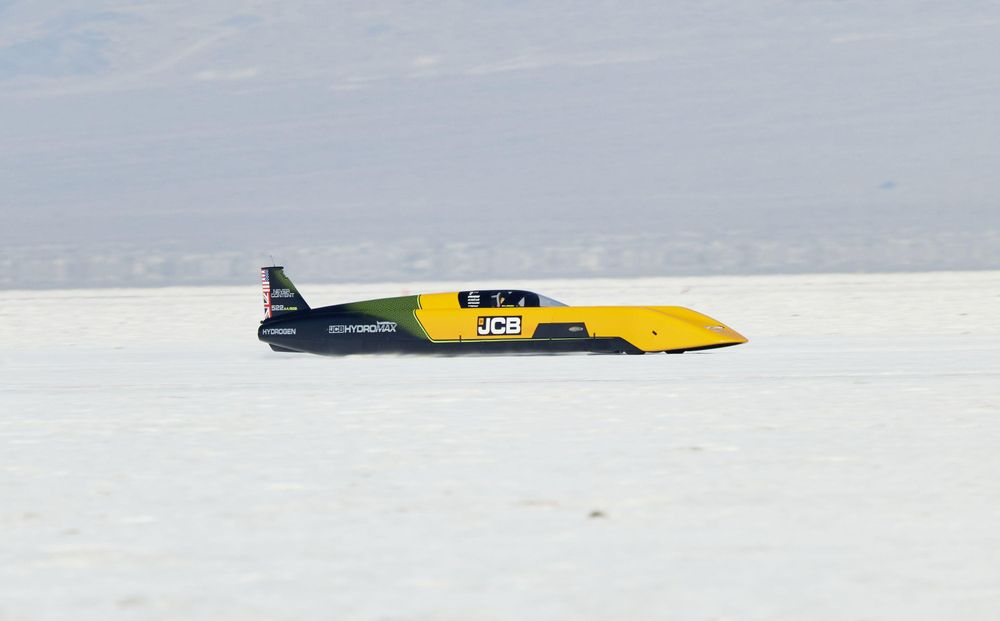
JCB, the British construction-equipment maker better known for excavators and backhoes, has ventured into record-breaking territory with the Hydromax, a hydrogen-powered combustion car that reached an average of 653.9 km/h at Utah’s Bonneville Salt Flats.
Driven by Wing Commander Andy Green, the Hydromax reached 644.74 km/h on one run and 663.26 km/h on the second. The average of the two runs produced a speed of 653.9 km/h, or about 406.3 mph. The Fédération Internationale de l’Automobile, or FIA, had announced before the attempt that it would officiate JCB’s effort.
The result is significant because the Hydromax does not use a hydrogen fuel cell to generate electricity. Instead, it burns hydrogen inside internal-combustion engines derived from JCB’s production technology.
How fast did the JCB Hydromax go?
The Hydromax recorded two runs that were used to establish the average speed required for the record.
The first run reached 644.74 km/h, followed by a second run at 663.26 km/h. Averaging the two produced the headline figure of 653.9 km/h, equivalent to approximately 406.3 mph.
That is considerably faster than the previous hydrogen-powered vehicle benchmark of 298.53 km/h, which had stood since BMW’s H2R set the earlier record in 2004, according to reporting on the Hydromax achievement.
JCB has therefore demonstrated that hydrogen combustion can deliver extremely high performance in a purpose-built vehicle.
Who drove the hydrogen-powered JCB car?
The Hydromax was driven by Andy Green, the British test pilot and former Royal Air Force officer who has a remarkable history with land-speed records.
Green drove JCB’s Dieselmax to a diesel-powered land-speed record of 350.092 mph in 2006. Twenty years later, he returned to Bonneville behind the wheel of the company’s hydrogen-powered successor.
Green is also the driver of Thrust SSC, the jet-powered car that reached more than 763 mph in 1997 and became the first land vehicle to officially exceed the speed of sound. JCB identifies him as the fastest man on Earth.
The Hydromax therefore represents Green’s return to a familiar setting with a very different propulsion technology.
What powers the JCB Hydromax?
The Hydromax uses two hydrogen internal-combustion engines.
JCB says the engines are based on production technology developed for its construction equipment and were tuned to produce about 800 horsepower each. The company’s materials put their combined output at around 1,600 horsepower.
That is an important distinction from the hydrogen vehicles most consumers encounter in discussions about clean transportation.
A fuel-cell vehicle converts hydrogen into electricity and then uses electric motors to turn the wheels. Hydromax instead injects hydrogen into modified combustion engines and burns it in a process more familiar from conventional piston engines.
The result combines a traditional engine architecture with a different fuel.
Why is JCB using hydrogen combustion instead of a fuel cell?
JCB has spent years developing hydrogen combustion technology, particularly for heavy equipment.
The company argues that hydrogen combustion can be useful in sectors where replacing conventional engines with batteries presents challenges related to weight, operating time, and charging infrastructure.
JCB began developing hydrogen combustion engines several years ago and has already introduced hydrogen-powered construction equipment. The Hydromax project is an extreme demonstration of the same basic technology.
The land-speed record does not prove that hydrogen combustion is the best solution for ordinary passenger cars. A purpose-built record vehicle operates under radically different conditions from a road-going SUV, excavator or family sedan.
But it does demonstrate the ability of the technology to deliver substantial power at extreme speeds.
How large is the Hydromax?
The Hydromax is approximately 9.75 metres long, or about 32 feet.
Its elongated shape is designed around the physics of high-speed land travel rather than the practical requirements of a conventional car.
At more than 650 km/h, aerodynamic drag becomes an enormous challenge. A large proportion of the vehicle’s engineering, therefore, focuses on keeping the body stable and minimising resistance as it moves across the Bonneville Salt Flats.
JCB says the Hydromax features a steel-frame chassis and a carbon-fibre monocoque sub-chassis for the driver. The company has also used extensive simulation and engineering work to optimise the car’s aerodynamics, suspension and traction systems.
Why does Bonneville matter for land-speed records?
The Bonneville Salt Flats in Utah have become one of the world’s most famous venues for land-speed racing because they provide an extraordinarily broad, flat surface.
That environment allows specialised vehicles to accelerate for long distances without the obstacles found on ordinary roads or racetracks.
The location also has a long history of record attempts involving piston engines, jets, rockets, electric motors, and other forms of propulsion.
JCB specifically chose Bonneville because of its connection to the company’s previous Dieselmax record and because the FIA planned to officiate its hydrogen record attempt there.
How does the Hydromax stay cool?
One of the more unusual engineering features of the Hydromax is its cooling system.
JCB’s development material says the vehicle uses ice rather than relying on a conventional cooling-air inlet for the record runs. The company has said roughly 250 kilograms of ice are required for each run.
The cooling challenge is enormous because the engines are producing around 1,600 horsepower while operating under extreme conditions.
JCB says the pistons require approximately one litre of cooling oil every second, while specially developed exhaust-valve technology handles the temperatures generated by hydrogen combustion. The company’s engineers also developed turbocharger systems capable of operating at extremely high rotational speeds.
This makes Hydromax as much an engineering laboratory as a record car.
How much hydrogen does the Hydromax use?
Despite its enormous power output, the Hydromax uses a relatively small amount of hydrogen during an individual record run.
JCB says the car consumes just over 2 kilograms of hydrogen during a full record run and produces approximately 18 liters of water.
The water is a product of hydrogen combustion, although hydrogen combustion can still produce nitrogen oxides under certain operating conditions. Therefore, describing the vehicle simply as “zero emissions” requires context.
At a land-speed record attempt, the amount and nature of emissions are very different from those of a conventional road vehicle, but hydrogen combustion is not identical to a fuel cell in terms of exhaust chemistry.
Why did JCB build a hydrogen speed record car?
The project is partly a technology demonstration.
JCB has invested heavily in hydrogen combustion as an alternative power source for construction machinery, an industry where large electric batteries can create practical challenges.
A record-breaking vehicle gives the company a highly visible way to demonstrate what its hydrogen engines can do.
The timing is also deliberate. JCB returned to Bonneville exactly 20 years after its Dieselmax established the company’s diesel land-speed record. The company says more than 150,000 hours of work have gone into the Hydromax program and its associated technology development.
That gives the project both an engineering purpose and a strong marketing dimension.
Is the Hydromax a practical hydrogen car?
Not in the conventional sense.
The Hydromax is a purpose-built streamliner engineered specifically for land-speed racing. Its dimensions, cooling system, aerodynamic design and specialised tyres make it fundamentally different from a vehicle designed to carry passengers on public roads.
Its achievement should therefore not be interpreted as proof that consumers will soon be driving 650-km/h hydrogen cars.
The more relevant takeaway is that JCB has demonstrated the performance potential of its hydrogen combustion technology under extreme conditions.
The company is ultimately interested in applications where hydrogen could power heavy machinery and other difficult-to-electrify equipment.
What makes the record important for hydrogen technology?
Hydrogen transportation has several competing technologies, including fuel cells, hydrogen combustion engines and hydrogen-derived fuels.
The Hydromax represents the combustion-engine route.
The advantage for a company such as JCB is that it can leverage knowledge and manufacturing capabilities associated with internal-combustion engines while changing the fuel from diesel to hydrogen.
JCB has already been applying this philosophy to construction machinery. The record car allows the company to push that technology to an extreme limit and demonstrate its performance publicly.
Whether hydrogen combustion becomes commercially important on a large scale will depend on factors that a land-speed record cannot answer, including hydrogen production, storage, distribution, cost, engine efficiency and emissions.
JCB has done this before
The Hydromax is not JCB’s first attempt to turn a construction-equipment company into a record-setting engineering operation.
In 2006, the company’s Dieselmax set an FIA world diesel land speed record of 350.092 mph at Bonneville with Andy Green behind the wheel. That record remains unbeaten in its category.
The company has also pursued speed records involving other kinds of construction equipment.
The Hydromax extends that tradition into hydrogen, replacing diesel with a fuel that JCB believes could play a larger role in heavy-duty applications.
What happens next for JCB’s hydrogen technology?
The real test for JCB begins after the record attempt.
A 653.9-km/h run proves that hydrogen combustion engines can produce enormous power in a carefully engineered environment. It does not by itself demonstrate that the technology can economically replace diesel engines across millions of construction machines.
JCB’s broader strategy is therefore more important than the speed figure.
The company is continuing to develop hydrogen combustion engines for construction equipment, where long operating periods, rapid refueling and high power requirements can make electrification especially challenging.
The Hydromax is the spectacular end of that development path, but its more practical legacy may be what engineers learn from the engines, cooling systems, fuel delivery and high-speed operation.
The bigger story behind JCB’s 653.9-km/h run
The Hydromax looks like a racing machine, but its significance lies in what sits beneath its streamlined body.
Two hydrogen-burning engines derived from JCB’s production technology have pushed a 9.75-meter vehicle to an average of 653.9 km/h across the Bonneville Salt Flats.
For Andy Green, it adds another chapter to a career built around land-speed records. For JCB, it is a high-profile demonstration of a technology the company hopes will have a much more practical future in construction.
The record does not settle the debate over hydrogen versus batteries or fuel cells. It does, however, make one thing difficult to ignore: hydrogen combustion is capable of producing serious performance.
And JCB, a company best known for yellow construction machines, has now demonstrated that capability at more than 400 mph.