
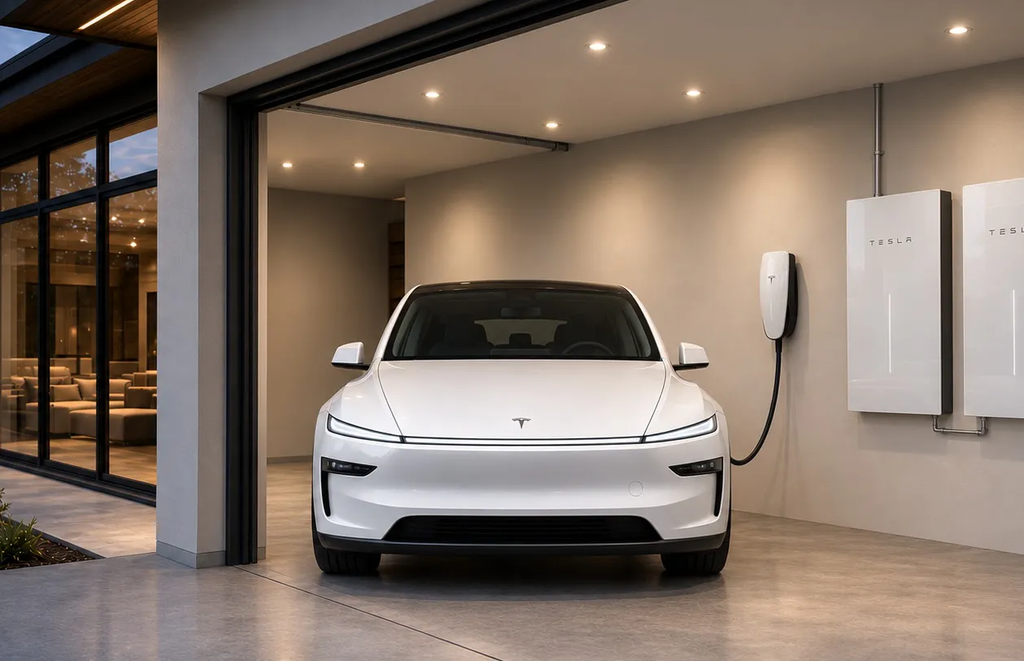
Tesla is expanding its vehicle-to-home technology beyond the Cybertruck, allowing eligible Model 3 and Model Y owners in the U.S. and Puerto Rico to use their electric vehicles as backup power sources during a grid outage.
The feature, called Powershare Home Backup, turns energy stored in a compatible Tesla’s battery into electricity for a home. The expansion is significant because the Model 3 and Model Y are Tesla’s higher-volume vehicles, potentially bringing vehicle-to-home backup to a much larger group of owners.
There are important restrictions, however. Tesla currently supports the Model 3 and Model Y with Powerwall 3, while compatibility with Powerwall 2 and Powerwall+ is still listed as coming soon. Tesla also says that not every existing Model 3 or Model Y is compatible with Powershare.
What is Tesla Powershare Home Backup?
Powershare allows energy stored in a Tesla’s traction battery to flow back into a home rather than only moving electricity from the grid into the vehicle.
During a power outage, a compatible system can use the vehicle as an additional energy source, potentially extending the amount of time a home can remain powered.
Tesla says Powershare can support everything from lights and outlets to larger household equipment, depending on the home’s electrical configuration and the amount of energy being consumed.
The technology effectively turns an EV into a very large backup battery that can be connected to a home’s electrical system.
That matters because EV batteries are substantially larger than many portable home batteries. Instead of buying a separate battery solely for emergency backup, homeowners can potentially use energy already stored in their vehicle.
Which Tesla vehicles now support home backup?
Tesla’s latest support documentation says Cybertruck, Model 3 and Model Y can participate in Powershare configurations.
For the Model 3 and Model Y, however, eligibility depends on the vehicle and the home-energy setup.
Tesla says all Model 3 and Model Y vehicles ordered in the U.S. and Puerto Rico on or after October 1, 2026 are capable of Powershare. Some earlier Model 3 and Model Y vehicles are also compatible, but Tesla does not guarantee support for every older vehicle.
Owners can check their vehicle directly by going to:
Vehicle → Software → Additional Vehicle Information
A compatible car should show the Powershare Support option.
Why aren’t all older Model 3 and Model Y vehicles compatible?
The limitation comes down to hardware.
Tesla’s vehicle-to-home system requires a compatible vehicle inverter capable of sending electricity back into the home’s electrical system. Tesla’s technical documentation identifies specific compatible inverter configurations for the Model 3 and Model Y.
As a result, a software update alone cannot necessarily turn every older Tesla into a home battery.
This is why Tesla has tied guaranteed compatibility to vehicles ordered from October 1, 2026 onward.
Powerwall 3 is currently the key requirement
For owners who already have Tesla’s home battery system, the new functionality is particularly interesting.
Tesla’s current documentation lists Powerwall 3 as compatible with Model 3 and Model Y Powershare Home Backup.
A compatible setup requires:
- A Powershare-capable Model 3, Model Y or Cybertruck
- A compatible Powerwall system
- A Tesla Universal Wall Connector or Gen 3 Wall Connector
- The vehicle, Powerwall and Wall Connector configured as required by Tesla
- Compatible software and Tesla app versions
Tesla says the Powerwall and Wall Connector need to be registered to the same site and paired appropriately for Powershare.
Tesla’s technical documentation also confirms that Powerwall 3 with a Universal or Gen 3 Wall Connector supports vehicle-to-home functionality with compatible Model 3 and Model Y vehicles.
What about Powerwall 2 and Powerwall+?
Owners of older Powerwall systems are not necessarily being left behind.
Tesla says Powerwall 2 and Powerwall+ systems can be installed for Powershare configurations, but the actual Powershare functionality for those systems is coming soon.
Tesla’s consumer-facing Powershare page likewise says Powerwall 2, Powerwall+ and Powerwall 3 will be compatible with Powershare vehicles, with compatibility enabled through an over-the-air update.
That means owners should not assume that an existing Powerwall 2 or Powerwall+ system can immediately use a Model 3 or Model Y as a backup battery.
How long can a Model 3 or Model Y power a home?
The answer depends heavily on the vehicle, trim and household electricity consumption.
Tesla currently estimates:
| Tesla vehicle | Estimated backup duration |
|---|---|
| Cybertruck | Over three days |
| Model 3 Standard | Up to two days |
| Model Y Standard | Up to two days |
| Model 3 Premium | Over two days |
| Model Y Premium | Over two days |
| Model 3 Performance | Over two days |
| Model Y Performance | Over two days |
These are not guarantees.
Tesla’s estimates are based on an assumed household electricity consumption level, and actual backup duration will depend on how much electricity a home uses, the vehicle’s state of charge and the configuration of the home energy system.
For example, a household running air conditioning, electric water heating and other high-demand appliances continuously could drain the vehicle much faster than a household powering only essential lights, refrigerators and outlets.
How does vehicle-to-home charging work?
The concept is relatively straightforward.
Under normal circumstances, electricity flows from the grid into the home and from the grid or charger into the EV.
With bidirectional charging, electricity can also flow in the opposite direction.
Grid → Home → EV
becomes:
EV battery → Home
When the grid goes down, the Powershare system can use the vehicle’s stored energy to supply the home.
Tesla says Powershare Home Backup can detect an outage and automatically begin supplying power in compatible configurations. For Cybertruck, Tesla quotes up to 11.5 kW of continuous power.
The exact capabilities of a Model 3 or Model Y setup depend on the home’s electrical configuration.
Tesla is entering a market that already has competition
Tesla is not the first automaker to make an EV battery available to a home.
Vehicle-to-home, or V2H, technology has been gaining traction across the auto industry.
Ford has promoted home backup through its F-150 Lightning and compatible home-energy equipment. General Motors has also developed bidirectional charging systems for compatible EVs. Hyundai and Kia have offered related bidirectional charging capabilities, while Nissan’s Leaf was an early example of an EV capable of sending electricity back toward the grid in certain markets.
The technology represents a broader shift in how automakers view EV batteries.
An electric vehicle does not have to be merely a transportation device. Its battery can potentially become part of a household’s energy system.
Why Tesla’s Model 3 and Model Y expansion matters
The biggest significance of the announcement may be the vehicles themselves.
The Cybertruck was previously Tesla’s headline vehicle for Powershare. But the Model 3 and Model Y have a much broader customer base.
Giving eligible owners the ability to use those vehicles for home backup could make bidirectional charging more mainstream.
It also creates an interesting economic proposition.
A homeowner could potentially have:
- Solar panels generating electricity during the day
- A Powerwall storing energy
- An EV storing substantially more energy
- The EV supplying the home when the grid fails
In that arrangement, the car becomes another component of the home’s energy infrastructure.
What are the limitations?
The technology is promising, but Tesla’s current rollout has several restrictions.
1. It is geographically limited
Tesla’s Model 3 and Model Y Powershare Home Backup rollout is currently tied to the U.S. and Puerto Rico. Tesla’s Model Y owner’s manual specifically says Powershare Home Backup is not available in Mexico.
That means Tesla’s international EV customers cannot yet assume the feature will be available in their markets.
2. Not every Model 3 or Model Y qualifies
Older vehicles may lack the required hardware.
Tesla explicitly says that some, but not all, Model 3 and Model Y vehicles produced before October 1, 2026 are Powershare-capable.
3. Powerwall compatibility is still evolving
Powerwall 3 currently supports the relevant Model 3 and Model Y configuration, while Powerwall 2 and Powerwall+ support is listed as coming soon.
4. The vehicle cannot provide unlimited power
The battery may hold a large amount of energy, but the home’s electrical system and the Powershare equipment determine how much power can actually be delivered at any given time.
Tesla also recommends working with a Certified Installer to determine which appliances and circuits can be backed up.
5. Backup time depends on consumption
Tesla’s “two days” or “over two days” estimates should not be interpreted as a universal guarantee.
A home that consumes substantially more than Tesla’s assumed average will use the vehicle’s stored energy faster.
What does this mean for the future of EVs?
Powershare points toward a broader change in how electric vehicles could interact with the power grid.
For years, the basic relationship was simple: the grid charged the car.
Bidirectional charging changes that relationship.
In the future, EVs could potentially:
- power homes during outages;
- store electricity generated by solar panels;
- reduce household electricity costs by shifting when energy is consumed;
- provide electricity to the grid during periods of high demand; and
- act as distributed energy storage across millions of vehicles.
Tesla already has a separate Powershare Grid Support feature, although its current availability is limited to Cybertruck owners participating in eligible programs.
That distinction is important. Home backup and grid support are not the same thing. Home backup keeps a particular property powered, while grid support involves sending energy back into the wider electricity system under an approved program.
Is Tesla’s EV battery becoming a home battery?
In a sense, yes — but with an important caveat.
A Tesla with Powershare can perform some of the functions of a stationary battery, but it remains primarily a vehicle. Its availability depends on whether the owner has the car at home, how much charge remains and whether the vehicle and home have the necessary hardware.
A Powerwall, by contrast, is permanently connected to the home’s energy system.
That makes the two technologies complementary rather than identical.
Tesla’s own documentation now explicitly describes Model 3, Model Y and Cybertruck vehicles as ways to extend home backup duration when paired with Powerwall.
The bigger shift is that Tesla is no longer treating the EV battery as something that only gets charged. It is increasingly becoming an energy resource that can be used after the car is parked.
The bottom line
Tesla’s expansion of Powershare Home Backup to the Model 3 and Model Y brings bidirectional charging to two of the company’s most important vehicles.
But the rollout is still limited.
Owners need a compatible vehicle, the right home-energy equipment, and a supported region. Powerwall 3 currently provides the clearest supported configuration, while Powerwall 2 and Powerwall+ compatibility is still pending. Older Model 3 and Model Y vehicles may also lack the necessary hardware.
Still, the direction is significant.
An EV battery that spends most of its day parked could increasingly serve a second purpose: keeping the lights on when the grid goes down.
For Tesla, that means the Model 3 and Model Y are becoming more than electric cars. They can also become part of the home’s energy system.