
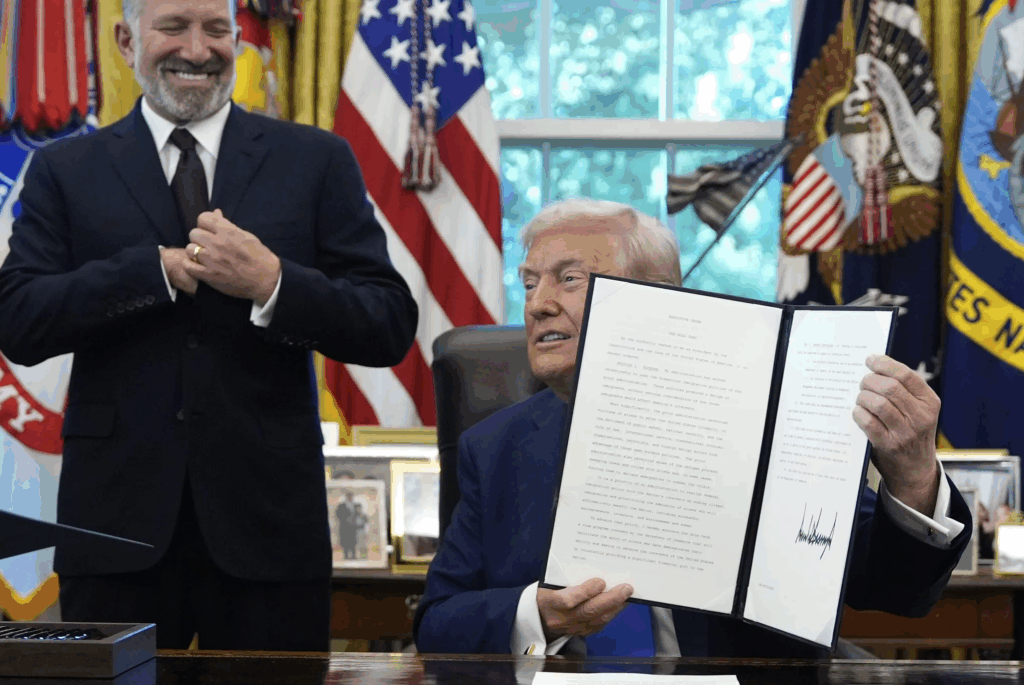
On September 19, 2025, President Donald Trump signed a proclamation that fundamentally reshapes the U.S. H‑1B visa system. The order imposes a $100,000 annual fee on each H‑1B visa application filed by companies. This marks one of the most radical shifts in U.S. immigration policy in decades, with direct consequences for U.S. businesses, Indian professionals, and global talent flows.
TL;DR
Trump has introduced a $100,000 yearly fee for companies sponsoring H‑1B visas. The move is designed to discourage large-scale use of the program and limit visas to the “most uncommon” talent. The change could significantly impact Indian workers, U.S. tech companies, and bilateral economic ties, while facing major legal and political challenges.
What the Proclamation Says
The H-1 B visa program enables U.S. companies to employ highly skilled foreign workers in specialized fields, including technology, healthcare, and research. Historically, application fees have been a few hundred to a few thousand dollars, depending on the type of petition. The new proclamation introduces:
- $100,000 annual fee per visa for employer sponsorships.
- Introduction of a “Gold Card” visa pathway granting permanent residency for $1 million (individual applicants) or $2 million (corporate sponsorships).
- A “Platinum Card” visa option at $5 million, allowing foreign nationals to spend up to 270 days in the U.S. without paying tax on overseas income.
Here’s a breakdown of how the system compares:
| Aspect | Previous System | New Proclamation |
|---|---|---|
| H‑1B sponsorship fee | ~$215 registration + other processing costs (several thousand dollars in total) | $100,000 per year per application |
| Who pays | Primarily employers, with manageable filing costs | Employers bear prohibitive fees, likely restricting use |
| Additional visa options | None at comparable cost | “Gold Card” ($1–2M) and “Platinum Card” ($5M) investor-style visas |
Why This Matters
The Trump administration argues that companies have misused the H‑1B program to replace U.S. workers with lower-cost foreign talent. The official reasoning is that raising the cost will:
- Limit visas to only the most specialized and “extraordinary” workers.
- Encourage companies to invest in training American workers.
- Reduce perceived exploitation of the visa program.
Critics, however, argue that this approach is overly blunt, economically harmful, and legally questionable.
Impact on U.S. Businesses
For American companies, especially in the tech and consulting sectors, this policy represents a massive new cost burden:
- Large tech firms may absorb costs but still reduce foreign hiring.
- Startups and mid-sized companies could be priced out of global talent altogether.
- Companies may increasingly outsource work abroad or hire remote international teams instead of relocating workers to the U.S.
This raises concerns about competitiveness, particularly in areas such as AI, biotech, and advanced engineering, where global talent plays a critical role.
Impact on Skilled Foreign Workers
Indian workers, who represent over 70% of H‑1B recipients annually, stand to be disproportionately affected. For many, the U.S. pathway is now financially inaccessible unless their employers are willing to bear the cost. The policy could:
- Severely restrict career mobility for Indian tech and engineering graduates.
- Reduce remittance flows back to India.
- Shift migration patterns toward Canada, the U.K., and other countries with more accessible skilled worker programs.
Legal and Political Reactions
The proclamation has already triggered debates about legality. Immigration law traditionally limits fees to cost-recovery levels, and many legal experts argue that a $100,000 fee goes far beyond what the executive branch can impose. Lawsuits from industry associations, immigration rights groups, and potentially foreign governments are expected.
Politically, the move has sharpened divides:
- Supporters see it as a step toward protecting U.S. jobs.
- Critics frame it as protectionist, harmful to U.S. innovation, and diplomatically disruptive.
Risks and Criticism
Several risks loom large:
- Innovation slowdown if companies cannot access global talent.
- Outsourcing surge as firms relocate operations abroad.
- Talent flight with skilled professionals choosing alternative destinations.
- Diplomatic strain with countries like India, where the impact will be most severe.
What to Watch Next
- Court rulings: Will the fee be upheld or blocked in federal courts?
- Industry response: Will companies absorb costs, cut back, or lobby for exemptions?
- Visa application trends: A sharp decline in H‑1B filings is expected in 2026.
- Diplomatic negotiations: India and other affected countries may push for relief or bilateral agreements.
How Indian Workers and U.S. Companies Should Respond
For Indian professionals, diversifying destination options is key. Canada, Australia, and parts of Europe continue to offer competitive skilled migration pathways. U.S.-focused professionals should:
- Stay updated on legal challenges that could alter or suspend the fee.
- Explore alternative visa categories, including investor-style pathways if financially feasible.
For U.S. companies, the challenge will be balancing talent needs with rising costs. Strategies include:
- Increasing remote hiring from abroad.
- Investing in domestic training programs.
- Joining collective lobbying efforts to push for revisions or exemptions.
Closing Thought
Trump’s $100,000 H‑1B visa fee represents more than an immigration tweak. It’s a profound policy experiment with the power to reshape global talent flows, corporate hiring strategies, and U.S.–India relations for years to come. Whether it survives legal and political scrutiny will determine if this is a short-lived disruption or a lasting transformation in the way America manages skilled migration.