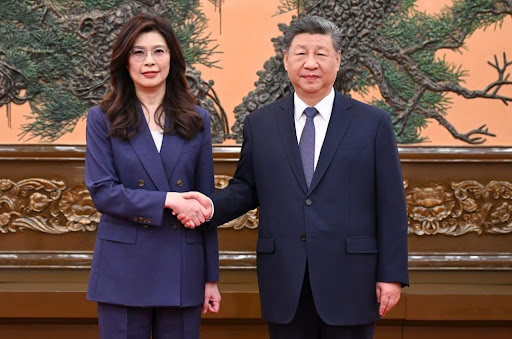
In geopolitics, symbolism often speaks louder than statements. A 14-second handshake between Xi Jinping and a senior Taiwanese opposition leader has become one such moment, revealing more about Taiwan’s internal fractures than any official communiqué.
At first glance, it looked like routine diplomacy. But in reality, it was a carefully staged signal, one that underscores how Beijing is navigating Taiwan’s political landscape without resorting to force.
What happened during Xi Jinping’s meeting with Taiwan’s opposition?
The meeting took place in Beijing’s Great Hall of the People, where Xi hosted Cheng Li-wun, a key figure from Taiwan’s opposition party, the Kuomintang (KMT).
The handshake itself lasted 14 seconds. Long enough to be noticed, short enough to remain ambiguous. But the setting told the real story.
Why the optics mattered
- The meeting happened at the heart of Chinese political power
- Protocol was firmly controlled by Beijing
- There was no attempt to present both sides as equals
Compare this with the 2015 meeting between Xi and Ma Ying-jeou in Singapore, where both sides used neutral titles and staged a sense of parity. This time, the tone was different. Less balance, more hierarchy.
Why the 14-second handshake is more than symbolism
Diplomatic gestures are rarely accidental. The extended handshake served multiple purposes.
Beijing’s message
- Taiwan is not politically unified
- There are factions open to engagement with China
- Dialogue can happen on Beijing’s terms
This is strategic storytelling. By engaging with the opposition rather than the sitting government, China reframes Taiwan not as a unified democracy resisting pressure, but as a divided political arena.
How the Middle East conflict created an opening
Timing added another layer to the moment.
With global attention focused on tensions in Iran and the broader Middle East, Washington’s strategic bandwidth has been stretched. That shift creates space for Beijing to act more assertively in its own neighborhood.
What analysts are watching
- Reduced US diplomatic focus on the Indo-Pacific
- China increasing political outreach instead of military escalation
- Subtle moves that reshape narratives rather than borders
This doesn’t mean military pressure has disappeared. In fact, Taiwan reported Chinese warplanes crossing the median line of the Taiwan Strait around the same time as the meeting.
The message is almost theatrical: diplomacy in the foreground, pressure in the background.
What this reveals about Taiwan’s internal divisions
The meeting didn’t just send a signal outward. It exposed tensions within Taiwan itself.
The Kuomintang’s internal split
The Kuomintang is not ideologically uniform.
- One faction favors strong ties with the US
- Another believes engagement with China is the path to stability
This divide complicates Taiwan’s broader strategy. While the ruling government emphasizes sovereignty and defense, parts of the opposition still lean toward dialogue with Beijing.
Why this matters now
Taiwan’s legislature, where the KMT holds influence, has been slow to approve a $40 billion defense package.
That delay raises questions:
- Is it political gridlock or strategic hesitation?
- Does engagement with China reduce urgency for defense spending?
- Or does it create vulnerabilities?
China’s dual-track strategy: pressure and persuasion
Beijing’s approach is increasingly layered.
The “carrot and stick” in motion
Carrot:
- Promises to resume tourism
- Easing trade restrictions
- Economic incentives packaged as cooperation
Stick:
- Military drills near Taiwan
- Airspace incursions
- Persistent signaling of force
This dual strategy allows China to shape both perception and pressure simultaneously. Engagement becomes a tool, not a concession.
Why the US factor looms large
The handshake also has implications beyond China and Taiwan.
With Donald Trump potentially engaging with Beijing in the future, China may be laying groundwork for broader negotiations.
What Beijing could be aiming for
- Show that cross-strait dialogue is active
- Strengthen its bargaining position with Washington
- Frame Taiwan as an issue with internal flexibility
Even if US officials don’t view opposition figures as official representatives, the optics still matter. In diplomacy, images travel faster than clarifications.
Is Taiwan’s “dialogue for stability” approach still viable?
For years, parts of Taiwan’s political spectrum believed that maintaining dialogue with China could ensure stability.
That assumption is now under scrutiny.
Critics argue:
- Dialogue can create asymmetric leverage
- China defines the terms of “peace”
- Engagement without safeguards may weaken Taiwan’s position
Supporters, however, say communication channels reduce the risk of conflict.
The debate is no longer theoretical. It’s unfolding in real time, in parliament, in policy delays, and in moments like that 14-second handshake.
The bigger picture: shaping narratives without conflict
What makes this moment significant is not what happened, but what it represents.
China didn’t fire a missile. It didn’t escalate militarily in a dramatic way. Instead, it used:
- Optics
- Timing
- Political engagement
to influence perception.
That’s a quieter form of power, but often a more enduring one.
TL;DR
- Xi Jinping’s 14-second handshake with a Taiwanese opposition leader carried strategic meaning
- The meeting highlighted divisions within Taiwan, especially inside the Kuomintang
- China used timing, amid Middle East tensions, to advance its political narrative
- The moment reflects a broader strategy combining diplomacy and military pressure