
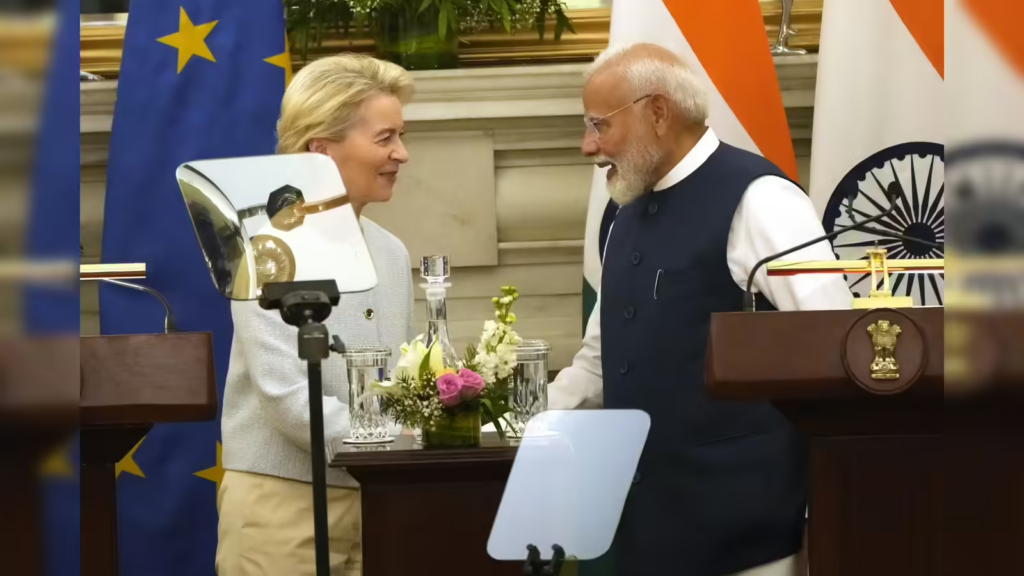
India and the European Union (EU) have signed a landmark Free Trade Agreement (FTA) today, a pact years in the making and now being hailed as the “mother of all trade deals.”
The agreement aims to eliminate or sharply reduce tariffs on nearly 97 percent of EU exports to India, while significantly improving market access for Indian goods across the 27-member EU bloc. Beyond geopolitics and trade volumes, the deal has a direct and tangible impact on everyday consumers in India.
As the agreement is phased in, several premium product categories—from luxury cars to gourmet food- are set to become noticeably more affordable.
Lower Duties on Cars: Luxury and Electric Vehicles Get a Boost
European automakers emerge as some of the biggest winners.
India has historically imposed import duties of up to 110 percent on fully built cars, making European luxury vehicles prohibitively expensive for most buyers.
Under the new FTA:
- Tariffs on a quota of 250,000 imported European cars will be reduced to 10 percent over five years
- Electric Vehicles (EVs) will see duties gradually fall to 10 percent by the tenth year
- Import duties on auto components will be fully eliminated within five to ten years
This is expected to make brands such as Mercedes-Benz, BMW, and Volkswagen far more competitively priced, while also accelerating the adoption of European EV technology in India.
Alcohol Duties Slashed: Wines, Spirits, and Beer to Get Cheaper
Perhaps the most immediately noticeable change will be felt at wine shops and bars.
Under the FTA:
- Duties on premium European wines fall from 150 percent to 75 percent at entry into force, and eventually to as low as 20 percent
- Spirits such as Scotch whisky, vodka, and gin will see duties reduced to 40 percent
- Import tax on European beer drops from 110 percent to 50 percent
Consumers can expect significantly lower prices for French wines, Italian prosecco, and premium European spirits, particularly in urban markets where imported alcohol is already in demand.
Gourmet Food and Olive Oil: European Pantry Staples Become Affordable
The agreement also brings major relief in the gourmet food segment.
Key changes include:
- Olive oil tariffs, previously at 45 percent, will be reduced to zero within five years
- Duties of up to 50 percent on processed foods—such as European cheeses, chocolates, biscuits, and fruit juices—will be eliminated
- Sensitive Indian sectors like dairy and sugar remain protected
In parallel, India and the EU are working on a Geographical Indications (GI) pact, which will protect iconic European food products from imitation in the Indian market, ensuring authenticity alongside affordability.
Pharmaceuticals and Medical Equipment: Lower Costs for Healthcare
While India is a global pharmaceutical hub, it still relies on Europe for several advanced medicines and high-end medical devices.
The FTA eliminates duties of up to 11 percent on:
- Specialized pharmaceuticals
- Medical equipment and diagnostic machinery
Lower import costs are expected to translate into cheaper advanced healthcare, benefiting hospitals, clinics, and patients—particularly in areas requiring cutting-edge diagnostic and treatment technology.
Industrial Machinery and Space Tech: Long-Term Gains for “Make in India”
Beyond consumer goods, the agreement strengthens India’s manufacturing ambitions.
Under the deal:
- Tariffs on machinery and electrical equipment fall from up to 44 percent to zero
- Duties on aircraft and spacecraft components drop from 11 percent to zero
By reducing the cost of high-end European machinery and capital goods, the FTA makes it easier and cheaper to set up advanced manufacturing units in India. Over time, this is expected to result in:
- More competitive domestic production
- Better-priced electronics and engineering products
- Stronger industrial growth aligned with the Make in India initiative
The Bottom Line
The India–EU FTA is not just a trade milestone, it’s a consumer-facing agreement with real price implications.
From luxury cars and premium alcohol to olive oil, medical equipment, and advanced machinery, the deal promises to reshape what Indians buy, how much they pay, and how the Indian industry evolves over the next decade.
As tariffs fall and trade expands, the “mother of all deals” could quietly transform everyday consumption—one import bill at a time.