
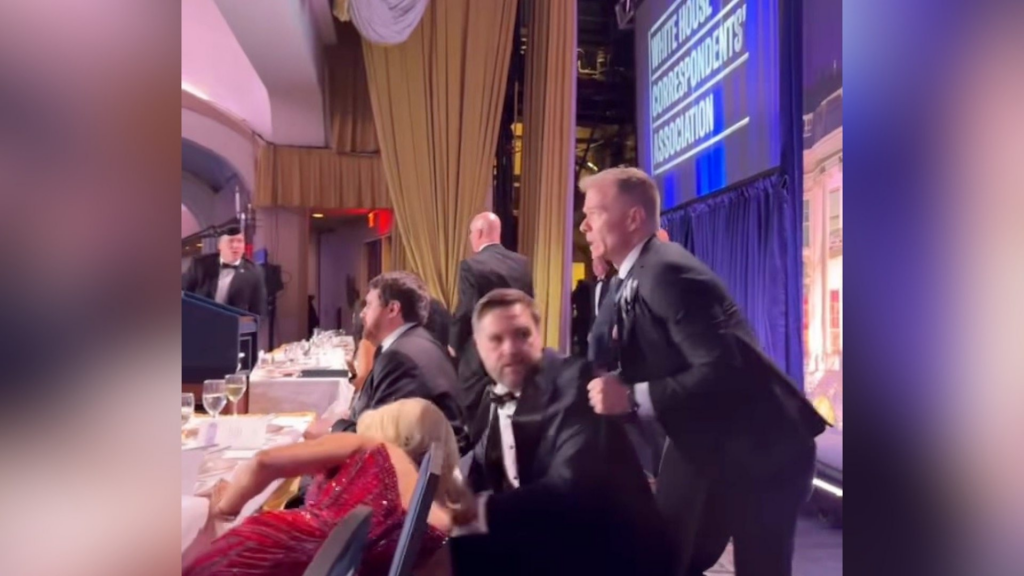
In the aftermath of the White House Correspondents’ Dinner (WHCD) shooting scare, one detail caught public attention: why was Vice President JD Vance evacuated faster than President Donald Trump?
The answer, according to Trump himself, is part protocol and part personal choice.
What did Trump say about the evacuation timeline?
Speaking to Norah O’Donnell on 60 Minutes, Trump acknowledged that his own actions slowed the evacuation process.
“I wanted to see what was happening,” he said, explaining that he hesitated as Secret Service agents attempted to move him to safety.
Trump added that he initially did not perceive the situation as immediately severe, describing the sounds as potentially similar to routine ballroom noise. That hesitation, even if brief, disrupted the otherwise rapid response.
Why was JD Vance moved out first?
The quicker evacuation of Vice President Vance comes down to standard Secret Service prioritization and execution.
1. Immediate compliance matters
According to Trump’s account, he did not immediately follow instructions, telling agents to “wait” while he assessed the situation. In contrast, agents were able to swiftly remove Vance without delay.
In high-risk scenarios, even a few seconds of hesitation can alter the sequence of protective actions.
2. Parallel security protocols
The Secret Service operates multiple protective units simultaneously. This means:
- One team secures the vice president
- Another focuses on the president
- Additional units handle threat neutralization
Vance’s extraction did not necessarily delay Trump’s—it simply happened faster because his movement wasn’t interrupted.
3. Situational awareness vs. urgency
Trump’s desire to understand what was unfolding reflects a common human instinct—but it conflicts with security doctrine.
Protective detail training prioritizes:
- Immediate removal from danger
- Minimizing exposure time
- Eliminating unpredictability
From an operational standpoint, pausing to observe is considered a risk multiplier.
What happened during Trump’s evacuation?
Trump described a moment that appeared chaotic on camera but followed standard emergency procedures.
“Go down on the floor”
As agents moved him, they instructed him to get low—effectively telling him to drop to the ground.
- Trump complied and went down
- First Lady Melania Trump followed suit
- Agents prepared to move them out in a low-profile position
When asked whether he was expected to crawl, Trump responded: “Pretty much.”
Why is this tactic used
Getting low reduces:
- Visibility to a potential shooter
- Risk of direct line-of-fire injuries
- Exposure during movement
What may look disorderly is often a controlled, rehearsed response to active threats.
How long did the response take?
According to the interview:
- Vance was moved within seconds
- Counterassault teams reached Trump in about 10 seconds
- Trump was evacuated roughly 20 seconds after the initial movement
In security terms, this is still considered a rapid response—despite appearing delayed relative to Vance.
What role did the suspect play in the incident?
Authorities have identified the suspect as Cole Tomas Allen, who allegedly opened fire after breaching security at the Washington Hilton.
He now faces serious federal charges, including the following:
- Use of a firearm during a crime of violence
- Assault on a law enforcement officer
One officer was reportedly shot but not seriously injured.
Note: Details about the suspect and motive are still under investigation, and reporting should be updated as verified information becomes available.
Why this moment matters beyond the headlines
The evacuation sequence offers a rare public look at how protective operations unfold under pressure.
1. Even small delays can matter
Trump’s hesitation highlights how quickly situations evolve—and how critical immediate compliance is during security incidents.
2. Optics vs. reality
What appeared “chaotic” on video was largely:
- Structured coordination
- Layered response teams
- Split-second decision-making
3. Security at public-political events is complex
The WHCD is not a traditional government venue. It combines:
- A hotel setting
- Media presence
- Political leadership
This hybrid environment creates unique vulnerabilities that differ from the White House or Capitol.
TL;DR
- JD Vance was evacuated faster because he complied immediately with the security agents.
- Donald Trump delayed his own evacuation briefly to assess the situation.
- Secret Service protocols prioritize speed, control, and minimizing exposure.
- What looked chaotic was a structured emergency response.
- The incident underscores the challenges of securing high-profile public events.