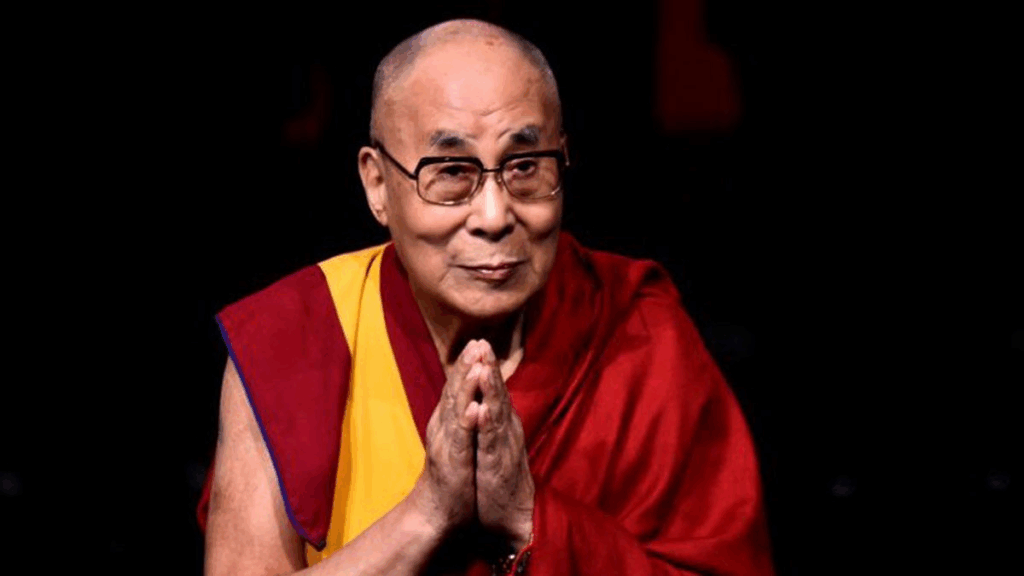
As the 14th Dalai Lama nears his 90th birthday, global attention is once again fixed on a deeply spiritual—and highly political—question: Who will succeed him, and how? For Tibetans, the search for the next Dalai Lama is a sacred tradition rooted in centuries of Buddhist belief. But for China, India, and the United States, it’s a geopolitical flashpoint with significant implications for the future of the region.
What is the traditional process of choosing the Dalai Lama?
Tibetan Buddhism holds that the Dalai Lama is the reincarnation of a line of enlightened beings who have chosen to be reborn to serve humanity. After the death of a Dalai Lama, senior monks begin a spiritual search for his reincarnation, guided by visions, signs, and sometimes oracles.
The current Dalai Lama, born Lhamo Dhondup in 1935, was discovered at the age of two. A government-appointed search team, following visions from high lamas, found him in a farming village in northeastern Tibet. He reportedly recognized the belongings of the previous Dalai Lama, affirming the belief that his soul had returned. By 1940, he was installed at the Potala Palace in Lhasa as the 14th Dalai Lama.
What does the Dalai Lama say about his own succession?
In a significant departure from past practice, the current Dalai Lama has said his successor could be born outside Chinese-controlled Tibet. In his 2025 book, Voice for the Voiceless, he stated he will release more details on his succession plans around his 90th birthday (July 6, 2025).
He has also emphasized that any reincarnation must be recognized based on spiritual authenticity, not political convenience. In recent speeches and writings, he has cautioned Tibetans against accepting any candidate “chosen for political ends,” particularly those selected by Chinese authorities.
To formalize the succession process, he established the Gaden Phodrang Foundation in 2015. This organization, composed of senior aides, is tasked with preserving the Dalai Lama’s spiritual legacy and will likely play a key role in identifying and recognizing his successor.
What is China’s position on choosing the next Dalai Lama?
Beijing insists that it holds final authority over the reincarnation of the Dalai Lama—a claim rooted in Qing dynasty-era rituals dating back to 1793, which involve drawing names from a golden urn. Chinese law mandates that reincarnations of “living Buddhas” must be approved by the government, and it has made clear that the next Dalai Lama must be born within China’s borders.
Chinese officials argue that this tradition ensures religious consistency and national unity. But many Tibetans—as well as international religious freedom advocates—view the Chinese stance as an attempt to control the Tibetan Buddhist faith for political purposes.
The Dalai Lama has strongly rejected China’s claim, pointing out that a state that officially rejects religion has no moral or spiritual authority to influence religious matters.
Why does this matter to India and the United States?
The question of succession isn’t just a religious one—it has far-reaching strategic consequences.
India has hosted the Dalai Lama and the Tibetan government-in-exile since 1959, after the spiritual leader fled following a failed uprising against Chinese rule. Today, over 100,000 Tibetans live in India, and the Dalai Lama is widely respected by Indians across faiths. His presence gives New Delhi quiet leverage over Beijing, especially amid growing India-China tensions.
The U.S., meanwhile, has taken a firm stand on Tibetan autonomy and religious freedom. In 2024, President Joe Biden signed legislation affirming that only Tibetan Buddhists, not the Chinese state, should determine the Dalai Lama’s successor. The law also empowers U.S. diplomats to oppose any attempt by Beijing to impose its chosen candidate on the global stage.
What are the possible scenarios for succession?
With the Dalai Lama’s advancing age and explicit intention to prevent Beijing from choosing his successor, several possible scenarios are emerging:
1. Reincarnation outside of China
The Dalai Lama has suggested his successor may be born in exile — possibly in India, Nepal, or even the West. This would be unprecedented but symbolically powerful.
2. Emanation instead of reincarnation
The Dalai Lama has floated the idea of an “emanation” — someone appointed during his lifetime to carry on his responsibilities. This would shift the focus away from posthumous reincarnation and ensure continuity.
3. Two rival Dalai Lamas
Perhaps the most contentious possibility is a split: one Dalai Lama recognized by Tibetans in exile, another endorsed by Beijing. This would mirror the situation with the Panchen Lama, whose reincarnation remains a point of contention between China and the Tibetan community.
What’s at stake for Tibetan identity?
Beyond the political tug-of-war, the Dalai Lama represents something deeply personal to millions of Tibetans — a spiritual compass, a moral authority, and a living symbol of resistance. For them, the selection of the next Dalai Lama isn’t just about lineage — it’s about legitimacy, identity, and survival.
If China installs a Dalai Lama who lacks spiritual credibility, it risks further alienating the global Buddhist community and weakening its soft power efforts abroad. On the other hand, if the Tibetan exile community fails to produce a widely accepted spiritual leader, it could fracture unity among Tibetan Buddhists at a time of increasing pressure.
Final thoughts
As the Dalai Lama turns 90, the succession debate is no longer hypothetical. It’s a test of whether a centuries-old spiritual tradition can navigate the realities of modern geopolitics. In a world where religion and power are often intertwined, the choice of his successor could shape not just the future of Tibetan Buddhism, but the balance of influence in Asia and beyond.