
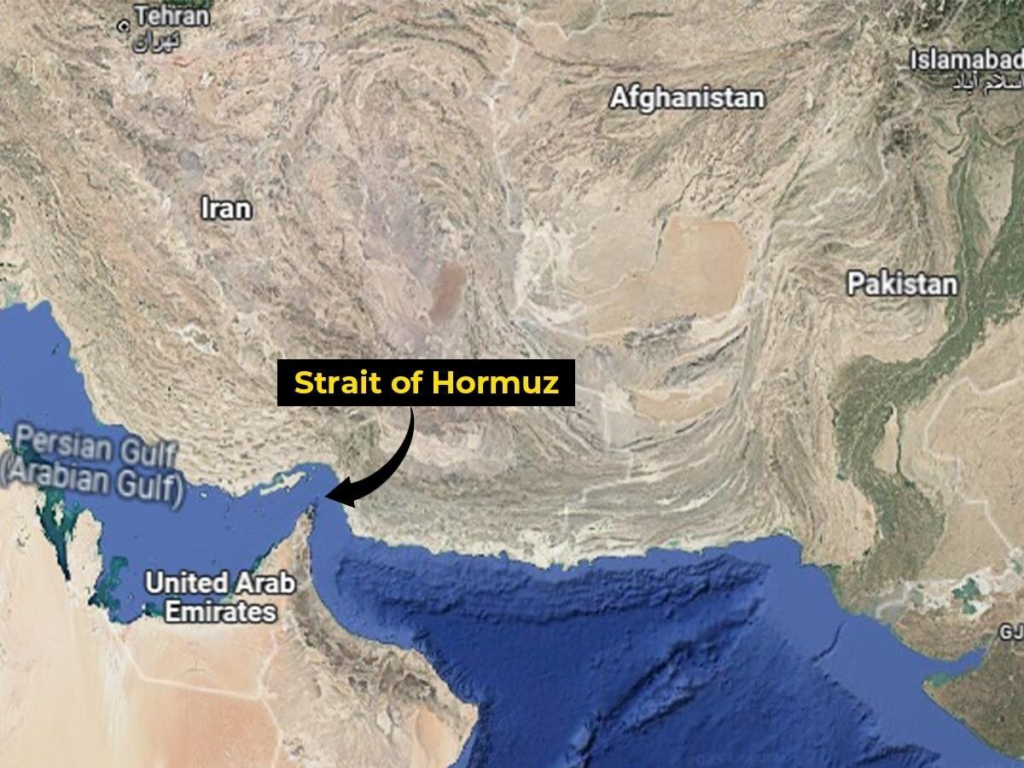
Brent crude is rapidly climbing toward $120 a barrel as traders assess the fallout from the escalating Iran-Israel conflict. At the center of the concern is a narrow waterway that has shaped global energy markets for decades: the Strait of Hormuz.
Roughly 20 million barrels of oil and petroleum liquids pass through this corridor every day, according to the U.S. Energy Information Administration (EIA). That represents about one-fifth of global oil consumption and more than a quarter of the world’s seaborne oil trade.
If tensions around Iran disrupt shipping through the strait, even temporarily, the consequences could echo the oil crises that reshaped the global economy in the 1970s.
What Is the Strait of Hormuz and Why Does It Matter?
The Strait of Hormuz is one of the most critical chokepoints in the global energy system. Located between Oman and Iran, the narrow channel connects the Persian Gulf to the Gulf of Oman and the Arabian Sea.
Nearly every major oil producer in the Gulf relies on this route to ship crude to global markets.
Key facts about the Strait of Hormuz
• Around 20 million barrels of oil per day transit through the strait
• That equals about 20% of global oil consumption
• It accounts for more than 25% of the world’s seaborne oil trade
• Major exporters using the route include Saudi Arabia, Iraq, the UAE, Kuwait, and Iran
Most of the oil shipped through Hormuz flows to Asian economies.
Major importers relying on the Strait
• China
• India
• Japan
• South Korea
Together, these countries receive more than half of the crude traveling through the strait. Any disruption would therefore ripple most strongly across Asia’s largest economies.
Why Brent Crude Is Surging Toward $120
Oil prices react not only to actual supply disruptions but also to the risk of disruption. The Iran-Israel war has injected a geopolitical risk premium into markets.
Traders are now pricing in the possibility that:
• Iran could threaten shipping routes
• Tanker traffic could slow due to security concerns
• Insurance costs for shipping could spike
• Military activity could temporarily halt exports
Even the hint of instability around Hormuz can push prices upward because global spare capacity is limited and supply chains operate with little slack.
Energy analysts note that a complete closure is unlikely, but partial disruptions alone can move prices sharply.
How a Hormuz Blockade Could Trigger the Largest Oil Supply Shock
A widely circulated analysis from market newsletter The Kobeissi Letter warned that a full closure of the Strait of Hormuz could trigger the largest oil supply shock in modern history.
The reason is simple: scale.
If the flow through the strait stopped completely, up to 20 million barrels per day could be affected.
That figure dwarfs most historical supply disruptions.
How This Compares With Past Oil Crises
Global markets have experienced several major oil shocks over the last half-century. None, however, involved supply volumes as large as the potential disruption in Hormuz.
Major historical oil disruptions
1973 Yom Kippur War and Arab oil embargo
• Supply loss: roughly 4–5.5 million barrels per day
• Impact: oil prices quadrupled and triggered global inflation
1978–1979 Iranian Revolution
• Supply loss: about 5–6 million barrels per day
• Impact: another surge in global oil prices
1980s Iran–Iraq War
• Supply loss: about 4 million barrels per day
• Impact: major instability in global oil markets
A full blockade of the Strait of Hormuz could threaten four times as much supply as some of these historical shocks. However, most analysts stress that the worst-case scenario is unlikely. Oil flows might slow rather than stop entirely.
Could Oil Shipments Bypass the Strait?
Some oil exporters have invested in alternative pipelines to reduce dependence on the Strait of Hormuz. These routes allow crude to bypass the chokepoint and reach ports outside the Persian Gulf.
Existing bypass routes
Saudi Arabia’s East-West pipeline
• Moves oil from the Gulf to the Red Sea port of Yanbu
UAE’s Abu Dhabi Crude Oil Pipeline
• Connects Abu Dhabi fields to the Fujairah port on the Gulf of Oman
Together, these routes can redirect several million barrels per day, but not the full 20 million barrels that typically pass through Hormuz.
That means a serious disruption would still create a major supply gap.
Another buffer is the strategic petroleum reserves.
Countries like the United States, China, India, Japan, and members of the International Energy Agency maintain emergency stockpiles designed to stabilize markets during supply shocks.
Why India Could Feel the Impact Quickly
India is particularly exposed to rising oil prices because it imports roughly 85% of its crude oil needs.
A spike in Brent crude typically feeds quickly into the broader economy.
Key economic effects for India
Higher inflation
Oil affects transportation, manufacturing, and electricity costs.
Pressure on government finances
Fuel subsidies and tax policies often shift when prices rise.
Currency pressure
Higher oil imports widen the trade deficit.
The Reserve Bank of India has previously estimated that a 10% rise in crude prices can lift inflation and slow short-term economic growth.
For an economy already balancing growth and inflation pressures, a sustained oil rally could complicate policy decisions.
Why Global Markets Are Watching Hormuz So Closely
The deeper concern is structural: the global energy system relies heavily on a single narrow maritime corridor.
The Strait of Hormuz is only about 21 miles wide at its narrowest point, leaving little room for alternative routes.
That concentration creates vulnerability.
Why the chokepoint matters
• A massive share of global oil flows through one corridor
• Limited pipeline alternatives
• High geopolitical tension in the region
• Shipping lanes that are difficult to secure during conflict
Because of this, the question facing markets is not just whether disruption occurs, but how long uncertainty persists.
Even prolonged tension without an actual blockade could keep oil prices elevated.
Where Oil Prices Could Go Next
Forecasts vary widely, but several scenarios are being discussed in energy markets.
Possible price outcomes
Limited disruption
Oil trades between $100 and $120 per barrel
Partial disruption to shipping
Prices could rise to $130–$150
Severe disruption or blockade
Prices could spike far higher, depending on how long the supply is affected
For now, traders are reacting to geopolitical signals rather than actual supply losses. But as long as tensions remain high in the Gulf, oil markets are likely to stay volatile.
TL;DR
• Brent crude is climbing toward $120 amid the Iran-Israel conflict
• The Strait of Hormuz carries about 20 million barrels of oil per day
• A full closure could trigger the largest oil supply shock in history
• Past crises like the 1973 oil embargo disrupted far less supply
• India and Asian economies would feel the biggest economic impact
• Alternative pipelines and strategic reserves could soften—but not eliminate—the shock