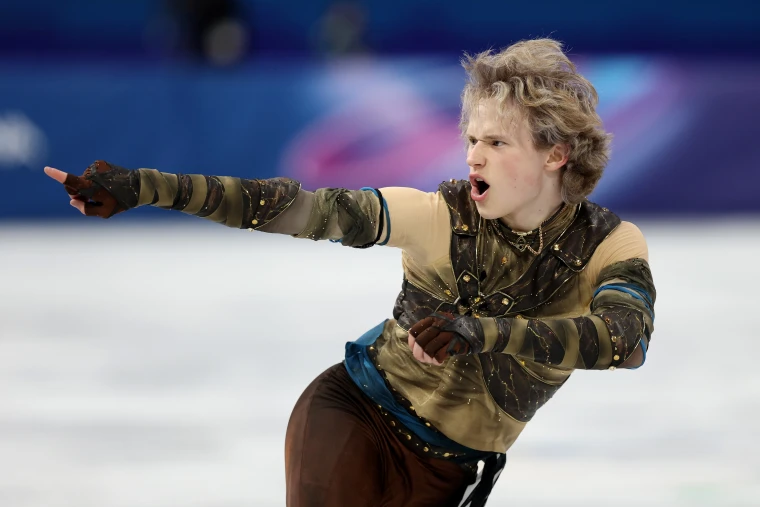
When Ilia Malinin, the “Quad God,” stepped onto Olympic ice in Milan, he wasn’t just another contender. He was the overwhelming favorite. Undefeated for more than two years. The only skater regularly landing a quadruple Axel in competition. The face of American figure skating.
Then, in the men’s free skate final at the 2026 Winter Olympics, it unraveled.
He fell. He doubled jumps that he normally nails. He skipped quads, which he’s built his reputation on. And when it ended, he covered his face in disbelief.
The moment stunned fans. But neuroscience suggests something uncomfortable: what happened may have been predictable.
Why Did Quad God Choke at the Olympics?
The simplest answer is pressure.
The better answer is biology.
Elite athletes don’t suddenly forget how to execute skills they’ve trained for years. But under extreme stakes — Olympic gold, global spotlight, national expectation, the brain changes how it operates.
Malinin himself acknowledged it afterward: “The pressure of the Olympics really gets to you.”
That’s not a cliché. It’s neuroscience.
What Does Brain Science Say About Choking?
Researchers at Carnegie Mellon University and the University of Pittsburgh conducted experiments that help explain high-stakes collapses.
In controlled lab settings, scientists studied rhesus monkeys performing motor tasks for rewards. When rewards were modest, performance was steady. But when researchers dramatically increased the reward, jackpot-level incentives, accuracy dropped.
The monkeys became overly cautious.
Neural activity in motor-planning regions slowed. Instead of fluid movement, the brain hesitated.
Aaron Batista of the University of Pittsburgh described it this way: the animals were “choked by being overcautious.”
Steven Chase of Carnegie Mellon noted the pattern isn’t limited to lab experiments. It shows up “across the board” in sports and beyond.
In other words, when the prize gets bigger, the brain tightens.
What Happens in the Brain During a High-Stakes Moment?
Under intense pressure, three things shift:
1. Overactivation of Self-Monitoring
Movements that are normally automatic become consciously monitored. Instead of trusting muscle memory, the brain interferes.
Figure skating jumps, especially quads, rely on timing measured in fractions of a second. Hesitation disrupts rotation.
2. Increased Caution
The brain prioritizes avoiding error over maximizing performance. That subtle shift can reduce explosiveness and commitment, which is fatal in jumps requiring full rotational confidence.
3. Slower Motor Preparation
Studies show altered firing patterns in motor cortex regions under high reward conditions. Translation: the body doesn’t execute with the same fluid rhythm.
Rob Gray, a sports scientist at the University of Birmingham, has warned that focusing too much on movements you normally perform automatically “makes you mess up.”
For someone like Quad God, whose quads are built on instinctive timing, that split-second hesitation is everything.
Why the Olympics Magnify the Effect
The Olympics are not just another competition.
They are:
- A once-every-four-years stage
- A career-defining spotlight
- A global broadcast moment
- A national expectation amplifier
Quad God entered as the overwhelming favorite. The narrative was already written: generational talent, quad pioneer, gold medal lock.
That expectation can quietly shift an athlete’s internal framing from “attack the program” to “don’t mess this up.”
And that shift is enough.
Is Choking Universal?
Yes, and that’s the uncomfortable part.
It’s not a weakness. It’s wiring.
High-profile examples exist across sports:
- Golf’s Jean van de Velde at the 1999 British Open
- Basketball free throws collapse in playoff moments
- Soccer penalty misses in World Cup finals
The common thread isn’t lack of ability. It’s a heightened consequence.
The brain evolved to treat high-stakes scenarios as potential threats. When a reward feels enormous, it can trigger hyper-control instead of fluid execution.
Malinin’s collapse fits that pattern.
Why Skipping Quads Was Telling
One of the most striking parts of Malinin’s program wasn’t just the falls. It was the absence of jumps that he normally lands routinely.
That suggests internal recalibration mid-program.
Under pressure, athletes sometimes shift to “damage control” mode, reducing risk to avoid further mistakes. Ironically, that often compounds scoring losses in judged sports like figure skating.
In events where base value and execution are tightly linked, hesitation snowballs.
What About His Post-Competition TikToks?
After the performance, Malinin posted troubling TikTok messages expressing frustration and emotional distress.
That reaction reflects something broader than one skate.
When identity is tied to excellence, especially at 21 years old, a public stumble can feel existential.
This is where perspective matters.
Neuroscience does not excuse mistakes. But it reframes them.
His brain didn’t “fail.” It responded to pressure in a deeply human way.
Why This Isn’t the End of the Story
Malinin is 21.
He remains:
- The reigning world champion
- The first to land a quadruple Axel in competition
- Widely regarded as the most technically ambitious skater of his generation
The next Winter Olympics will be in Nice in 2030. He’ll be 25, still in the prime competitive range for men’s figure skating.
History shows that Olympic setbacks often precede redemption arcs.
Athletes who understand pressure and train mental resilience alongside physical execution frequently return stronger.
Sports psychologists increasingly focus on:
- External focus training (attention on outcome, not mechanics)
- Pressure simulation in practice
- Cognitive reframing
- Mindfulness-based performance regulation
The key isn’t eliminating nerves. It’s preventing overcontrol.
What Fans Get Wrong About “Choking”
Calling an athlete a “choker” implies fragility.
But choking is often a byproduct of caring deeply.
Athletes who feel no stakes rarely collapse. Those who understand the magnitude of the moment sometimes overcorrect.
Quad God didn’t lack preparation. He likely had too much awareness of what was at stake.
The Bigger Lesson
The Quad God’s Olympic stumble is memorable not because it was rare — but because it was relatable.
Few of us will attempt a quadruple Axel. But most of us have:
- Frozen during a big presentation
- Missed a crucial interview question
- Overthought a moment we normally handle easily
The mechanism is the same.
The brain tries too hard to protect the outcome.
And protection becomes paralysis.
TL;DR
- Ilia Malinin entered the 2026 Winter Olympics as the favorite and faltered in the free skate.
- Neuroscience suggests high stakes can cause overcautious brain activity.
- Research shows increased reward can slow motor planning and disrupt fluid performance.
- Choking is common across primates — and across elite sports.
- Malinin remains a top contender for future Olympic success.
The Bottom Line
Ilia Malinin’s Olympic collapse wasn’t proof that he isn’t good enough.
It was proof he’s human.
The same brain that lets him rotate four times in midair is wired to tighten under extraordinary pressure.
The real measure of greatness won’t be Milan.
It will be what he does next.