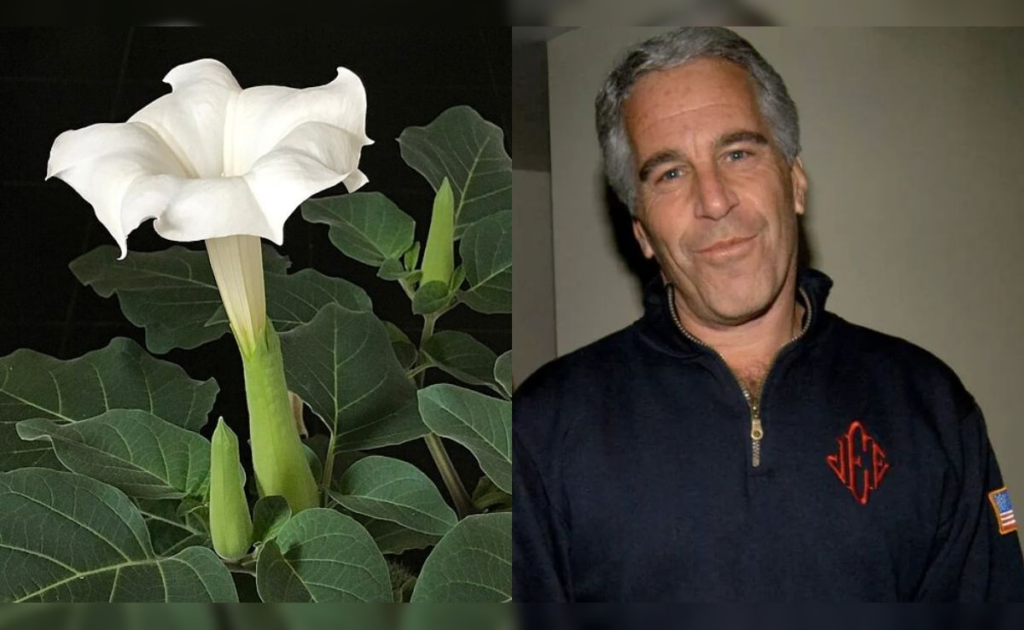
Newly surfaced emails connected to Jeffrey Epstein mention something oddly botanical and deeply unsettling: “trumpet plants,” sometimes nicknamed the zombie flower.
The correspondence refers to plants that contain scopolamine, a powerful psychoactive compound capable of impairing memory, confusing, and affecting decision-making. In some regions the substance is infamous enough to earn the name “devil’s breath” because victims can become unusually compliant and later recall little or nothing.
The discovery has revived public curiosity about the plant itself. What exactly is the zombie flower, and why does it provoke such alarm?
What is the “zombie flower”?
The nickname refers to ornamental trumpet-shaped flowering plants in the genera Brugmansia and Datura.
They are visually striking garden plants with large hanging blooms, often grown for decoration in warm climates across the world, including South Asia and Latin America.
Why do they look harmless but aren’t
These plants contain several tropane alkaloids:
- scopolamine
- atropine
- hyoscyamine
All affect the nervous system.
At small medical doses, they can treat motion sickness and nausea. At uncontrolled doses, they can disrupt the brain’s ability to form memories and process reality.
In Colombia, Brugmansia trees are commonly called “borrachero.” The drug extracted from them is known as burundanga.
What does scopolamine do to the brain?
Scopolamine interferes with acetylcholine signaling, a key neurotransmitter used in memory formation and awareness.
Documented effects
- short-term amnesia
- disorientation
- slowed reaction time
- confusion
- suggestibility
- loss of voluntary decision control at high exposure
In toxic exposure, victims may appear awake and responsive but later retain little memory of their actions.
External sources to cite:
- NIH toxicology database
- World Health Organization poisoning guidelines
- peer-reviewed pharmacology journals
Why the plant appears in the Epstein files
Emails reportedly show Epstein discussing the cultivation of trumpet plants and referencing scopolamine’s behavioral effects.
One message described the compound as eliminating free will and making people highly suggestible. Another referenced the plants growing in his nursery. A later communication included a victim statement mentioning exposure to the drug.
The existence of the emails does not itself prove criminal use of the substance. However, investigators view interest in behavioral-altering compounds as relevant context.
Legitimate medical uses vs criminal misuse
Scopolamine is not inherently illegal. In controlled doses, it is widely prescribed.
Approved medical uses
- motion sickness patches
- post-operative nausea prevention
- gastrointestinal spasm treatment
Criminal misuse
In some regions, powdered scopolamine has been used in robbery or assault cases. The drug’s amnesia effect can make victims unable to recall events.
Important nuance: toxicology experts note that media descriptions sometimes exaggerate “mind control.” The drug impairs judgment rather than granting total obedience.
Why does this plant exist in everyday life
Despite its notoriety, Datura has da eep cultural and historical presence. In parts of India, its flowers are used in religious offerings during festivals dedicated to Shiva. In horticulture, Brugmansia is a prized ornamental.
This dual identity is common in pharmacology. Many medicines originate from toxic plants. The difference lies in dosage, preparation, and supervision.
The takeaway
The “zombie flower” is not a fictional poison but a real group of plants containing potent neurological compounds. Their presence in the Epstein files is notable because scopolamine can impair memory and decision-making, though it does not function as the magical obedience drug often portrayed online.
The story ultimately highlights a broader truth: some of the most dangerous chemicals in the world grow quietly in gardens, looking like decoration.