Most physicists leave one heavy neutrino out of their calculations. A theory paper published in Physical Review Letters on Sept. 8 argues that this particle could have changed how matter won out over antimatter after the Big Bang.
The study does not detect the particle, and its claim is conditional. If the particle exists and lives long enough, it would have reshaped the early universe’s expansion and shifted a key temperature threshold by up to a factor of 10.
The authors are Rishav Roshan of the University of Southampton and Sudipta Show of the Indian Institute of Technology Kanpur. Southampton announced the work on Oct. 20 as a “forgotten particle” that “could answer mystery of why we exist.” Phys.org and BBC Sky at Night Magazine picked it up.
The paper itself makes a narrower, more technical claim. Its sharpest test is a prediction about how light the lightest neutrino must be.
Why physicists expected an empty universe
The Big Bang should have produced matter and antimatter in equal amounts. When a particle meets its antiparticle, the two annihilate into energy. Perfect balance would have left a universe of radiation, with no atoms to build stars, planets or people.
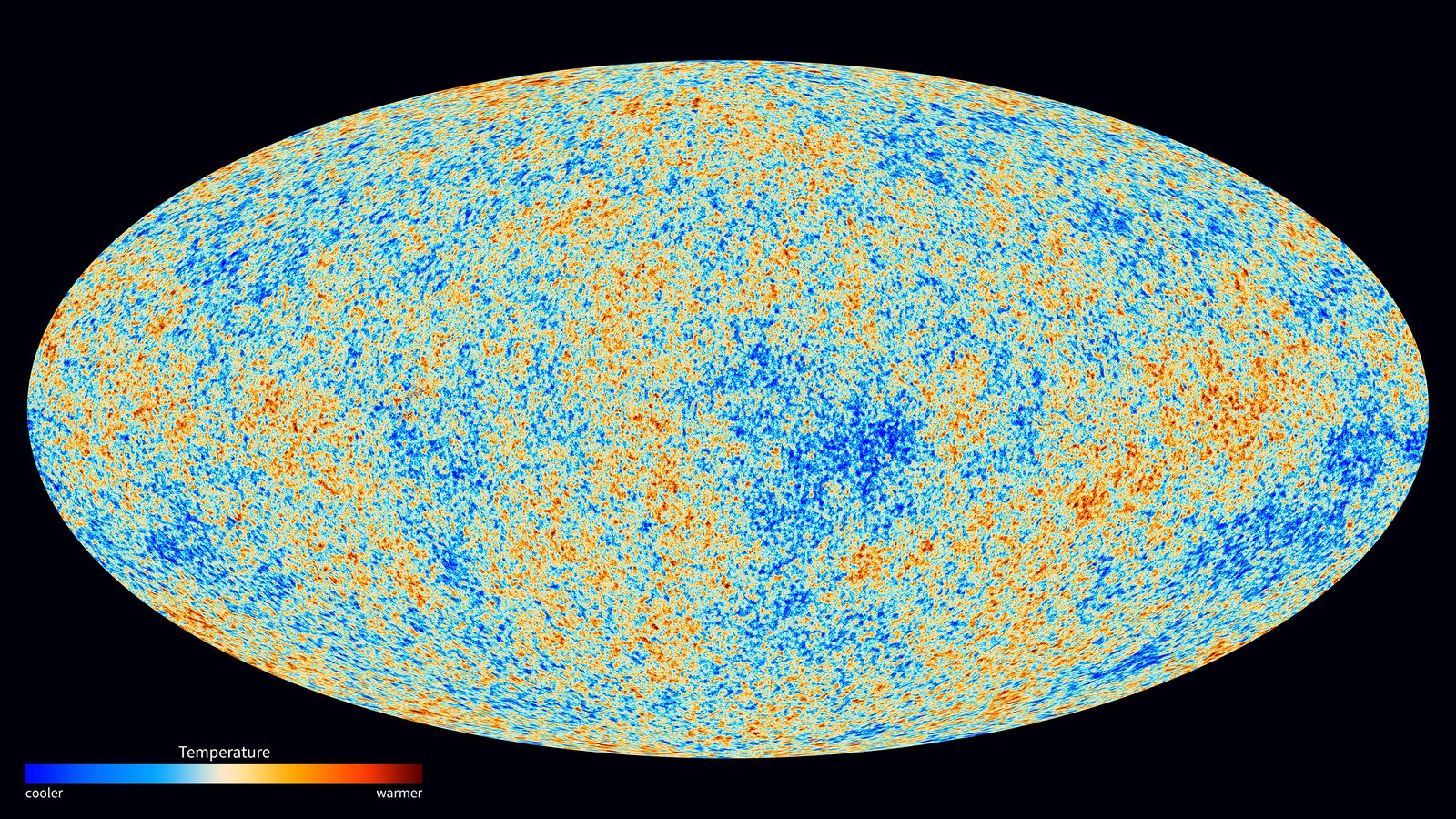
That is not the universe we live in. A small surplus of ordinary matter survived. The Planck satellite measured its size from the oldest light in the cosmos. “The fact that we are here at all proves that an asymmetry between matter and antimatter occurred,” Roshan said in the university’s release.
One leading explanation is leptogenesis. In this picture, very heavy “right-handed” neutrinos decay slightly more often into matter than into antimatter. That leaves a surplus of leptons, the particle family that includes electrons and neutrinos, which later converts into the excess of protons and neutrons around us.
The same heavy neutrinos sit at the center of the type-I seesaw, a popular theory of why ordinary neutrinos are so light. We covered a very different neutrino puzzle earlier this month, the record-energy “ghost particle” spotted under the Mediterranean.
The third heavy neutrino most studies drop
The version of the seesaw in this paper has three heavy right-handed neutrinos. Two do the work: they set the masses of the light neutrinos and generate the matter surplus. The third and heaviest barely couples to anything. Most studies drop it and assume it adds almost nothing to neutrino masses or leptogenesis.
Roshan and Show keep it in the calculation. “This decoupled heavy neutrino has long been dismissed as an irrelevant background detail in particle physics,” Roshan said. “However, it decays incredibly slowly.”
That slow decay is the whole story. In the paper’s scenario, the particle lingers while the universe cools, until its mass makes up most of the universe’s energy. That opens a temporary matter-dominated era inside a period physicists normally model as dominated by radiation. When the particle finally decays, it dumps heat back into the cosmos and dilutes whatever matter surplus already exists.
How a slower-cooling universe moves a key switch
The paper’s core result concerns what that detour does to one particular temperature. Charged leptons, meaning the electron and its heavier cousins the muon and tau, interact with the Higgs field. At some point in the cooling universe those interactions become fast enough to reach equilibrium. Physicists call this charged lepton Yukawa equilibration. The release describes its temperature as “a switch that shapes how the matter-antimatter imbalance was built up.”
The switch matters because leptogenesis calculations depend on whether the three lepton “flavors” behave as distinct particles while the surplus forms. Before the switch flips, a simpler single-flavor calculation works. After it flips, physicists need a more complicated flavored treatment.
In the standard picture, the tau switch flips at about 5×10¹¹ GeV, a measure of temperature as particle energy. With the long-lived heavy neutrino included, the authors calculate it can fall to about 4.2×10¹⁰ GeV. They call that “an order-of-magnitude shift compared to the standard scenario.” The heavy neutrino in that example weighs 10¹⁵ GeV, roughly a million billion times the mass of a proton.
The authors then work through an example. In it, a lighter heavy neutrino at 10¹¹ GeV produces the observed matter surplus with the simpler calculation. Without the delayed switch, that shortcut would not apply at that mass. They describe the example as “illustrative.”
So the paper does not show that this particle created the matter we see. It shows that leaving the particle out can lead physicists to use the wrong equations. That could redraw the map of which leptogenesis models work.
The test: a lightest neutrino that is almost massless
What lifts this above a bookkeeping correction is a prediction. In the model, the couplings that set the heavy particle’s lifetime also set the mass of the lightest ordinary neutrino. The paper predicts that mass at roughly 10⁻¹² to 10⁻¹⁴ electronvolts. It calls the scenario “falsifiable” should experiments such as KATRIN and Project 8 reach that range.
That is a very distant target. In April 2025, Germany’s KATRIN experiment put the best direct limit on neutrino mass below 0.45 electronvolts. The Max Planck Institute for Nuclear Physics, a KATRIN partner, announced the result.
The model’s predicted value sits hundreds of billions of times below that. In practice, the test runs the other way. A firm measurement giving the lightest neutrino a sizable mass would rule the scenario out.
The paper also names gravitational waves as a channel. Primordial gravitational waves are faint spacetime ripples from the first moments after the Big Bang. Show said the altered expansion “leaves distinct but detectable imprints of changes, for example on primordial gravitational waves.” BreezyScroll has covered another theory that uses early-universe gravitational waves to explain dark matter. Here, though, the authors write that they “do not explicitly address experimental signatures in this work.” The paper predicts no specific signal for any observatory.
What the paper assumes, and what comes next
The result rests on stated simplifications. The authors assume the universe heated up instantly after inflation. They also neglect one class of processes that can erase a lepton surplus, and they say a fuller analysis would need more advanced quantum methods.
None of the coverage so far, including the university release, quotes a physicist outside the team. That makes this a peer-reviewed proposal awaiting scrutiny from other theorists, not a settled answer.
The underlying puzzle remains open, and experiments keep testing antimatter directly. In 2023, a CERN experiment showed antimatter falls downward under gravity.
The next number to watch comes from KATRIN. Its 2025 limit drew on about a quarter of the data the collaboration planned to collect, according to the Max Planck Institute, and the team planned to keep measuring until the end of 2025.
A final limit will still sit far above the near-zero mass this model predicts, so it cannot confirm the idea. It will, however, tighten the range of neutrino masses that any seesaw model has to fit.