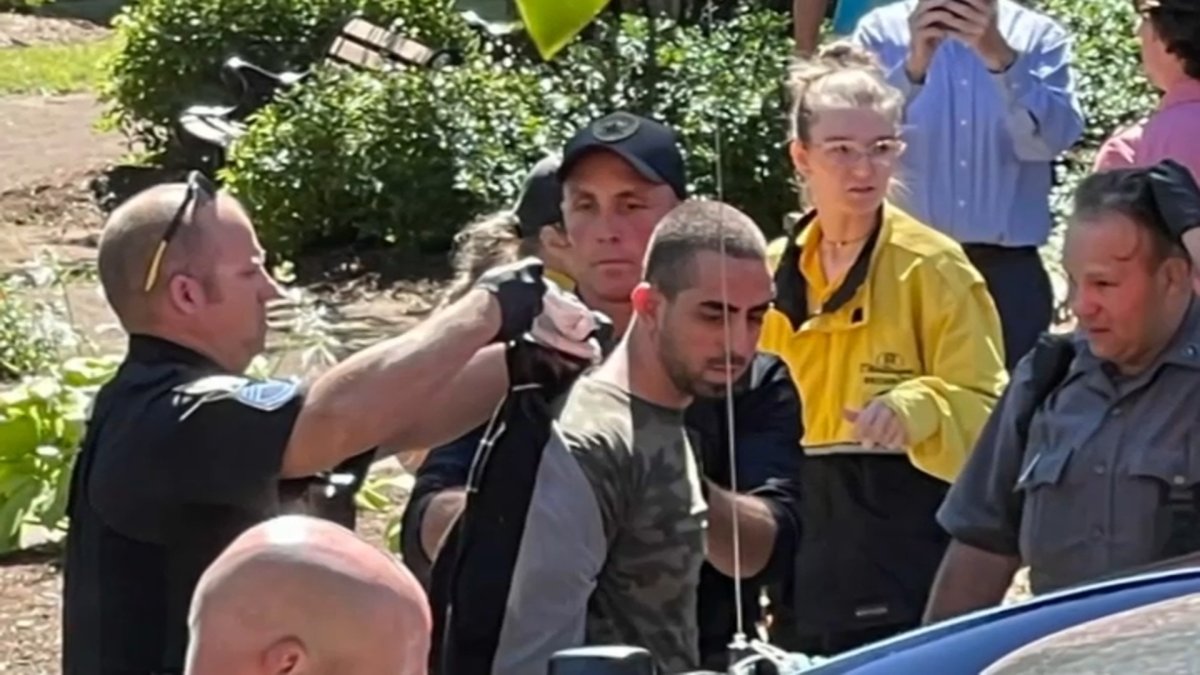
On Friday, Salman Rushdie was attacked at New York’s Chautauqua Institution. Here’s what we know about Hadi Matar, his attacker.
Salman Rushdie attacked in NY
On Friday morning, Salman Rushdie was attacked outside the Chautauqua Institution in New York. The author is currently on a ventilator in a hospital and unable to speak. According to his agents, he may also lose an eye. Rushdie has been living under a fatwa issued by Ayatollah Ruhollah Khomeini, the former Iranian Supreme Leader since 1989. The move was after some sections of his 1988 novel, ‘The Satanic Verses’ were considered blasphemous. A fatwa is a legal ruling on a point of Islamic law, sharia.
In July 1991, Hitoshi Igarashi, the Japanese translator of the novel was stabbed to death in Japan. Soon after Ettore Capriolo, the Italian translator was also injured in Milan. In October 1993, William Nygaard, the Norwegian publisher of the book was shot in Oslo. Later in 1998, Iran’s then-president Mohammad Khatami stated his nation no longer supports Rushdie’s killing. However, the fatwa was not officially withdrawn. Hence, the current supreme leader, Ayatollah Ali Khamenei stated the fatwa was “fired like a bullet that won’t rest until it hits its target”.
Who is Hadi Matar, Rushdie’s attacker?

Hadi Matar is a 24-year-old resident of New Jersey. According to an NBC News report, an analysis of Matar’s social media reveals him as someone sympathetic to Shia extremism and the grounds of the Islamic Revolutionary Guard Corps (IRGC). It is a branch of the Iranian armed forces protecting the nation’s Islamic system from internal conflicts and hostile foreign powers. The Federal Bureau of Investigation (FBI) and other US agencies have not made a formal statement on Matar’s motive.
Currently, it is not clear if he has an Iranian nationality or origins. According to Major Eugene Staniszewski from the New York State Police, the suspect had a pass to the event grounds at Chautauqua Institution. Moreover, Hadi Matar was born about a decade after the fatwa was issued for killing Rushdie. While evidence from his phone links him to the Revolutionary Guard suggesting he was driven by the fatwas. The book in question was banned in Iran in 1988. However many Muslims are still offended by the controversial passages. The author has been facing death threats for decades and several bounties were announced for killing him.