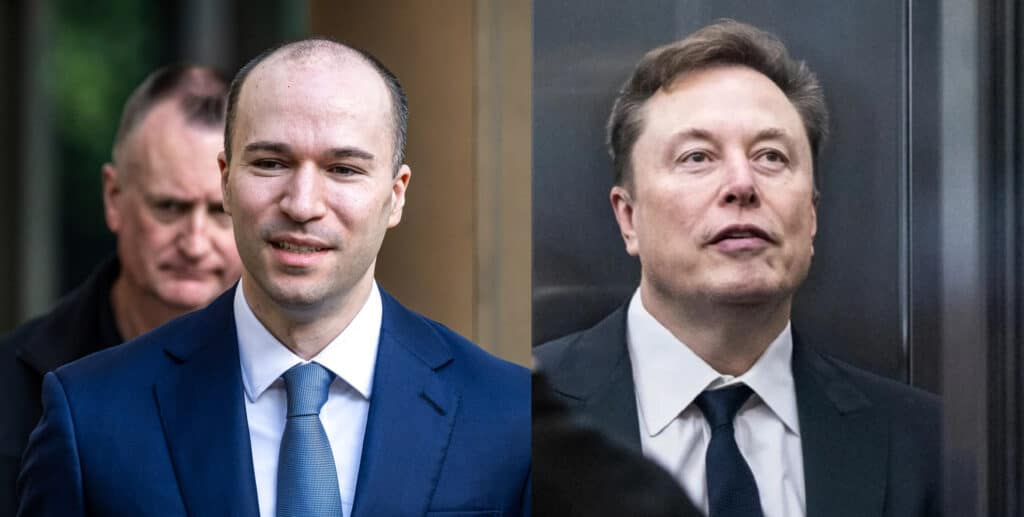
A dramatic courtroom revelation has added a deeply personal dimension to the escalating legal battle between Elon Musk and OpenAI. During testimony in a federal court in Oakland, OpenAI President Greg Brockman claimed he feared Musk could physically lash out during a heated 2017 meeting over control of the company.
“I actually thought he was going to hit me,” Brockman testified, describing a confrontation that allegedly erupted after he rejected a proposal that would have handed Musk greater authority over OpenAI.
The testimony offers a rare inside look at the breakdown of one of Silicon Valley’s most important relationships, one that helped shape the modern artificial intelligence race now transforming the global tech industry.
Why the 2017 OpenAI meeting matters now
The courtroom account is significant because it sits at the center of Musk’s broader legal campaign against OpenAI and its CEO, Sam Altman.
Musk has accused OpenAI of betraying its founding mission as a nonprofit research lab dedicated to developing AI safely for humanity.
According to Musk, the organization abandoned those principles by transitioning into a for-profit structure closely tied to commercial products and massive investment deals.
OpenAI disputes that characterization.
The company argues Musk voluntarily left after failing to secure majority control over the organization and later became a direct competitor through his AI startup, xAI.
Brockman’s testimony now provides a more emotionally charged version of those early power struggles.
What Greg Brockman said happened
According to Brockman, tensions escalated after he rejected Musk’s proposal to gain more control over OpenAI.
He testified that Musk’s demeanor shifted sharply during the exchange, creating what Brockman described as an intimidating atmosphere.
The meeting reportedly ended with Musk threatening to withdraw funding from OpenAI, which he had financially supported since the company’s founding in 2015.
At the time, OpenAI was still a relatively small research-focused organization operating far from the scale it occupies today.
The dispute highlights how foundational disagreements about governance and safety were already emerging years before the modern AI boom exploded into public view.
The deeper conflict: who should control powerful AI?
Beneath the personal tension lies a much larger philosophical battle over artificial intelligence.
The central question is deceptively simple:
Who should control AI powerful enough to reshape economies, politics, warfare, and human labor?
That issue has haunted OpenAI since its creation.
The organization originally launched as a nonprofit research initiative backed by several major tech figures, including Musk, with the stated goal of ensuring advanced AI would benefit humanity broadly rather than enriching a small group of corporations.
But building frontier AI systems became vastly more expensive than many early founders anticipated.
Why OpenAI changed its structure
Brockman testified that OpenAI now spends around $50 billion annually on computing infrastructure, compared to just $30 million in 2017.
That staggering increase helps explain why OpenAI moved toward a hybrid for-profit structure capable of attracting massive outside investment.
Training advanced AI models now requires:
- Huge data centers
- Specialized AI chips
- Massive electricity consumption
- Large engineering teams
- Global cloud infrastructure
In effect, modern AI development increasingly resembles a geopolitical arms race wrapped inside a technology business.
That shift fundamentally altered OpenAI’s trajectory.
Critics, including Musk, argue the organization drifted away from its original nonprofit ideals.
Supporters counter that remaining purely nonprofit may have made it impossible to compete against rivals backed by trillion-dollar tech companies.
Brockman’s testimony revives long-running concerns about Musk’s leadership style
The testimony also feeds into broader public debate surrounding Musk’s management style and personality.
Over the years, Musk has cultivated an image built around:
- Aggressive ambition
- High-pressure leadership
- Confrontational communication
- Extreme risk-taking
- Unpredictable public behavior
Former employees across several companies have described environments marked by intense expectations and abrupt decision-making.
At the same time, supporters argue that Musk’s relentless style helped drive breakthroughs in industries many considered stagnant, including electric vehicles, commercial spaceflight, and satellite internet systems.
Brockman’s account adds another layer to that complicated public image.
The “wolves and sheep” quote raises fresh AI safety questions
One of the most striking parts of Brockman’s testimony involved comments he claimed Musk made while leaving OpenAI in 2018.
According to Brockman, Musk told employees he intended to pursue AI development at Tesla without prioritizing safety constraints.
Brockman testified Musk allegedly said:
“If the sheep are dictating safety and the wolves are not, then there’s no purpose.”
The alleged comment has attracted attention because it touches directly on one of the biggest debates in AI today: whether safety concerns slow innovation in a strategically dangerous way.
Some technology leaders believe excessive caution could allow geopolitical rivals or competitors to dominate AI first.
Others argue insufficient safeguards could create catastrophic consequences ranging from disinformation and cyberattacks to autonomous weapon risks or loss of human oversight.
That tension increasingly defines the global AI race.
Why this legal battle matters beyond Silicon Valley
The lawsuit is not just about personal grievances or corporate governance.
It may shape how future AI companies are structured and regulated.
The case raises major questions:
- Can nonprofit AI labs remain independent once development costs explode?
- Should advanced AI research prioritize public benefit over shareholder value?
- How much power should founders retain?
- What role should governments play in regulating frontier AI systems?
These issues now affect not only technology companies but also national security, global economics, labor markets, and geopolitics.
The OpenAI-Musk conflict has effectively become a proxy battle over the future direction of the AI industry itself.
From allies to rivals
The irony is hard to miss.
Musk helped launch OpenAI partly out of concern that artificial intelligence could become too concentrated inside large corporations.
Years later, he is now suing the organization he once helped build while simultaneously competing against it through xAI.
Meanwhile, OpenAI has evolved from a niche research nonprofit into one of the most powerful companies in the AI sector.
The split reflects how quickly artificial intelligence transformed from a theoretical concern into one of the world’s most valuable and strategically important technologies.
What happens next?
The legal battle between Musk and OpenAI is expected to continue drawing intense scrutiny because it combines several explosive elements:
- Billionaire rivalries
- AI governance
- Corporate power struggles
- Questions about ethics and safety
- The future of advanced technology
Brockman’s testimony adds emotional drama to a case already packed with industry-defining implications.
But beyond the courtroom spectacle lies something much larger.
The dispute is ultimately about who gets to shape the next era of artificial intelligence, and under what rules.
That fight is only beginning.
TL;DR
OpenAI President Greg Brockman testified in federal court that he feared Elon Musk might hit him during a tense 2017 meeting over control of OpenAI. The testimony emerged during Musk’s lawsuit against OpenAI and Sam Altman over the company’s shift from nonprofit to for-profit operations. The case highlights growing tensions around AI governance, safety, funding, and corporate control in the rapidly expanding artificial intelligence industry.