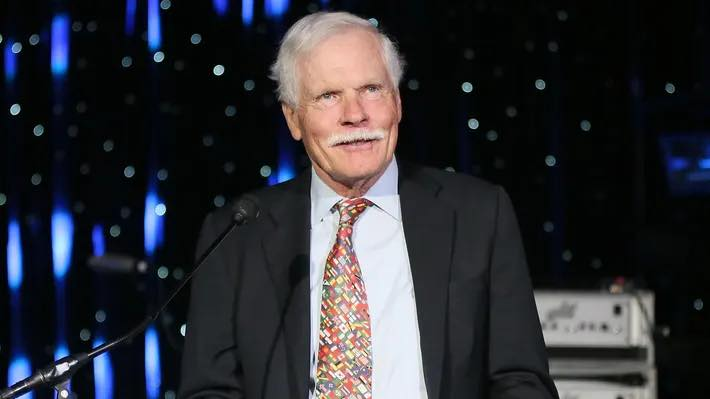
Ted Turner, the outspoken media mogul who founded CNN and transformed the global news industry with the world’s first 24-hour television news channel, has died at the age of 87.
According to a statement from Turner Enterprises, Ted Turner died peacefully, surrounded by family, on May 6.
Few figures reshaped modern media as dramatically as Turner. At a time when television news was confined largely to scheduled evening broadcasts, he gambled on an idea many considered absurd: a channel delivering live news around the clock.
That gamble permanently changed journalism, politics, war coverage, entertainment, and how billions of people consume information.
Long before smartphones and social media turned the world into a nonstop information stream, Turner imagined television that never slept.
Who was Ted Turner?
Born Robert Edward Turner III in 1938 in Cincinnati, Turner grew up in a turbulent household shaped by ambition, pressure, and tragedy.
His life changed dramatically in 1963 after the suicide of his father, who ran a billboard advertising business. At just 24 years old, Turner inherited the company and aggressively expanded it, displaying the relentless risk-taking style that would later define his media empire.
What began as a regional billboard business eventually evolved into one of the most influential media operations in modern history.
Ted Turner moved from outdoor advertising into radio, then television, acquiring a struggling Atlanta station that became the foundation for his future empire.
That station evolved into WTBS, one of the first “superstations” distributed nationally through cable television.
It was a preview of Turner’s greatest skill: seeing the future of media before everyone else did.
The bold gamble that created CNN
Turner’s defining moment arrived in 1980 with the launch of CNN.
At the time, the concept of a 24-hour news network sounded financially reckless to many industry insiders. Traditional television networks relied on fixed news schedules, usually morning broadcasts and evening bulletins.
Ted Turner believed audiences wanted something radically different.
He famously argued that millions of people missed the evening news entirely because they were still at work when broadcasts aired.
That insight became the foundation for CNN.
When the network launched, critics mocked the idea, with some dismissing it as “Chicken Noodle News.” But Turner’s instinct proved remarkably accurate.
CNN fundamentally changed journalism by introducing:
- Continuous live coverage
- Real-time breaking news
- Global satellite reporting
- Rolling crisis coverage
- Instant international broadcasting
The network’s influence exploded during major world events, especially the Gulf War, when CNN’s live reporting from Baghdad demonstrated the power of real-time global television news.
The so-called “CNN effect” soon became a recognized force in politics and international relations, influencing how governments responded to crises viewed live by audiences worldwide.
How Ted Turner built a cable television empire
CNN was only one part of Turner’s broader media vision.
Over the years, he launched or expanded several influential cable networks, including:
- TNT
- Cartoon Network
- Turner Classic Movies
These networks helped define cable television during the 1980s and 1990s.
Ted Turner understood something many executives missed early on: cable television allowed channels to target highly specific audiences rather than trying to appeal to everyone simultaneously.
That strategy became central to the modern television business model.
His empire eventually merged into larger media conglomerates, helping shape the corporate landscape that later evolved into today’s streaming and global media giants.
Why Ted Turner changed journalism permanently
Before CNN, breaking news often waited for scheduled broadcasts.
After CNN, audiences expected immediacy.
Turner helped create the modern live-news environment where events unfold continuously on screen rather than being summarized hours later.
That transformation affected nearly every aspect of journalism:
Speed became essential
News organizations faced pressure to report developments instantly.
Global coverage expanded
International reporting became more immediate and visually driven.
Television became crisis-centered
Wars, elections, disasters, and political scandals increasingly unfolded live before viewers.
The 24-hour news cycle was born
CNN’s success inspired competitors worldwide and permanently accelerated the pace of modern media.
Many of today’s strengths and weaknesses in news culture, including constant live analysis and nonstop political coverage, trace back to Turner’s original idea.
Ted Turner’s personality became part of his legend
Ted Turner was not a conventional corporate executive.
Nicknamed “The Mouth of the South,” he cultivated a loud, unpredictable, and often controversial public image.
He was known for:
- Public feuds
- Bold predictions
- Risk-heavy business decisions
- Blunt interviews
- Competitive instincts
That larger-than-life persona made him one of the most recognizable business figures in America during the peak cable television era.
Unlike many modern media executives who operate behind the scenes, Turner became a celebrity in his own right.
His sports empire and cultural influence
Turner’s ambitions extended beyond news and entertainment.
He owned major professional sports teams, including:
- Atlanta Braves
- Atlanta Hawks
He used broadcasting creatively to expand their national visibility, especially through WTBS.
Ted Turner essentially helped pioneer nationally televised regional sports branding before streaming and digital sports platforms existed.
His influence stretched across American popular culture during the cable television boom years.
Ted Turner’s philanthropy and environmental work
In later life, Turner increasingly focused on philanthropy, conservation, and global advocacy.
One of his most significant moves came in 1997, when he pledged $1 billion to support the United Nations, one of the largest charitable commitments ever made by an individual at the time.
He also became deeply involved in:
- Environmental conservation
- Nuclear disarmament advocacy
- Wildlife preservation
- Public health initiatives
Ted Turner emerged as one of North America’s largest private landowners and played a notable role in restoring bison populations in the American West.
He also supported initiatives including:
- Captain Planet Foundation
- Nuclear Threat Initiative
His health struggles in later years
In 2018, Turner publicly revealed he had been diagnosed with Lewy body dementia, a progressive neurological condition.
Despite declining health in later years, his influence on global media remained immense.
Earlier in 2025, Turner was hospitalized with pneumonia before recovering.
His death now marks the end of one of the most consequential careers in modern broadcasting history.
The legacy Ted Turner leaves behind
It is difficult to overstate Turner’s impact on modern media.
The idea that news should be available instantly, globally, and continuously is now so normalized that it feels inevitable.
It was not inevitable.
It was Ted Turner’s gamble.
CNN became the blueprint for countless news channels around the world, while Turner’s broader cable empire helped shape modern television culture itself.
His career blended entrepreneurial brilliance, relentless ambition, controversy, and genuine media innovation in ways few modern executives can match.
Even in an age dominated by streaming platforms and social media feeds, the architecture of today’s global information system still carries Turner’s fingerprints.
The screen never turns off anymore.
That world is, in many ways, the one Ted Turner built.
TL;DR
CNN founder Ted Turner has died at 87, leaving behind one of the most influential legacies in media history. Turner revolutionized journalism by launching the world’s first 24-hour news network and later built a cable empire that included TNT, Cartoon Network, and TCM. Beyond media, he became known for philanthropy, environmental conservation, and global advocacy efforts.