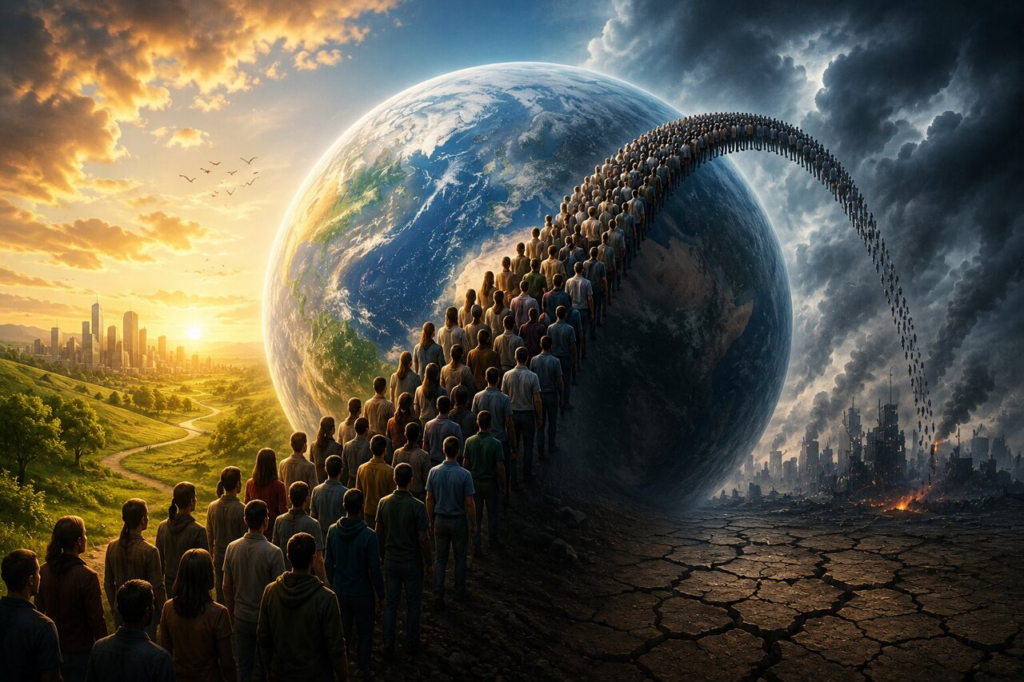
The idea of a “population crash” sounds like the opening scene of a dystopian streaming series: empty cities, abandoned suburbs, grocery shelves echoing like caves. But a new study from researchers at the University of Milan is not predicting humanity’s doom. Instead, it explores a mathematical worst-case scenario showing how the global population could rapidly shrink if Earth suddenly became unable to support current human numbers.
The study, published in the journal Chaos, Solitons & Fractals, suggests that under extreme conditions, the human population could fall to half its current size by 2064. That would mean billions fewer people on Earth within less than four decades.
The key detail often lost in headlines: the researchers are not forecasting this outcome. They are testing what could happen if multiple global crises hit at once and dramatically reduce Earth’s carrying capacity.
What does the mathematical equation predict?
The researchers analyzed roughly 12,000 years of human population growth, stretching from the Neolithic era to modern industrial society. Their goal was to create a mathematical model that could accurately reflect how human populations expanded through different historical periods.
The equation accounted for:
- Slow population growth during ancient eras
- Rapid acceleration after industrialization
- Declining fertility trends in modern economies
- Environmental and resource constraints
According to the authors, the current global trajectory appears relatively stable under normal conditions. But the study also tested extreme stress scenarios.
One of those scenarios assumed Earth’s sustainable carrying capacity suddenly dropped to around two billion people. In that hypothetical case, the model showed a sharp population decline beginning within decades.
What is “carrying capacity,” and why does it matter?
Carrying capacity refers to the number of people Earth can sustainably support using available resources, such as:
- Food
- Fresh water
- Energy
- Livable land
- Stable climate systems
The concept is commonly used in ecology, where scientists study how animal populations rise or collapse when resources become scarce.
In human terms, carrying capacity is influenced not just by nature, but also by technology, politics, trade, and public health. A wealthy, technologically advanced society can often support larger populations than poorer regions with fewer resources.
The study’s alarming scenario assumes that several major systems fail at once, dramatically reducing humanity’s ability to sustain current population levels.
What could trigger a global population collapse?
The paper points to four major risk factors that could sharply reduce Earth’s carrying capacity.
Climate collapse
Extreme climate disruption remains one of the largest long-term risks to global stability.
Rising temperatures can affect:
- Crop yields
- Water supplies
- Coastal cities
- Disease patterns
- Mass migration
Scientists have repeatedly warned that food systems become increasingly fragile as temperatures rise. Multi-year droughts, failed harvests, and severe weather events could place enormous strain on governments and economies.
A future pandemic
The COVID-19 pandemic exposed how vulnerable global systems can become when healthcare infrastructure is overwhelmed.
While COVID itself did not significantly reduce the world population, researchers note that a more lethal or persistent pandemic could have very different consequences.
Potential risks include:
- Higher fatality rates
- Healthcare collapse
- Supply chain disruptions
- Economic instability
- Declining birth rates
Global conflict
Large-scale wars have historically reshaped population trends through death, displacement, famine, and economic collapse.
Modern warfare introduces additional risks, including:
- Nuclear escalation
- Cyberattacks on infrastructure
- Food and energy disruption
- Long-term environmental damage
The researchers do not predict imminent conflict, but they note that systemic instability can accelerate demographic decline.
Resource shortages
Modern civilization runs on tightly connected supply networks. Disruptions in energy, food, fertilizer, or water availability can ripple rapidly across continents.
Resource shortages could worsen because of:
- Population pressures
- Environmental degradation
- Political instability
- Overconsumption
- Declining agricultural productivity
Why the study is not actually predicting doomsday
This is the most important part of the discussion.
The authors explicitly state that the model is “illustrative,” not predictive. In other words, they are exploring mathematical possibilities, not forecasting the future.
That distinction matters because dramatic headlines can easily blur the line between:
- “This could happen under extreme conditions”
and - “Scientists say this will happen”
The researchers emphasize that current population trends do not point toward an imminent collapse.
In fact, global fertility rates have already slowed in many countries. Nations including Japan, South Korea, Italy, and even parts of China are facing declining birth rates and aging populations instead of runaway population growth.
That shift is one reason earlier “population explosion” fears from the 20th century have not materialized.
The forgotten 1960 “doomsday” prediction
The study also revisits a famous theory from 1960 known as the “Doomsday Argument,” which suggested humanity could face extinction because of unchecked population growth.
One dramatic interpretation of that theory pointed to November 13, 2026 as a potential collapse date.
Clearly, humanity has not spiraled toward extinction on schedule. Researchers say falling fertility rates and slower growth prevented the runaway population explosion feared decades ago.
Still, the study warns that systems can become unstable under extreme stress conditions, particularly if multiple crises overlap.
It is less “the end is near” and more “civilization runs on thinner ice than people assume.”
Why population decline is already a major global issue
Ironically, many economists are more concerned about shrinking populations than exploding ones.
Countries with falling birth rates face growing challenges:
- Aging workforces
- Pension strain
- Labor shortages
- Slower economic growth
- Rising healthcare costs
In places like South Korea, fertility rates have fallen so low that policymakers are offering cash incentives to encourage people to have children.
That creates a strange demographic paradox: some regions fear overpopulation, while others fear demographic collapse.
What the study really tells us
The biggest takeaway is not that humanity will disappear by 2064. It is that global systems are deeply interconnected.
Climate stability, healthcare resilience, food production, energy access, and geopolitical peace all influence whether societies remain sustainable.
The study functions more like a stress test than a prophecy. It asks a difficult question: what happens if multiple safeguards fail at once?
For now, researchers say humanity remains on a stable trajectory. But the paper serves as a reminder that population trends are not guaranteed to move in only one direction.
Civilizations can expand for centuries, then suddenly hit turbulence. History has done that dance before. The modern world just performs it with 8.3 billion people packed onto the stage.
TL;DR
- A new mathematical study explored how the global population could decline under extreme conditions
- Researchers modeled a scenario where Earth’s carrying capacity drops to two billion people
- In that case, the population could halve by around 2064
- The study is hypothetical and not a real-world prediction
- Scientists identified climate collapse, pandemics, global conflict, and resource shortages as key risk factors
- Current population trends remain relatively stable, according to the researchers