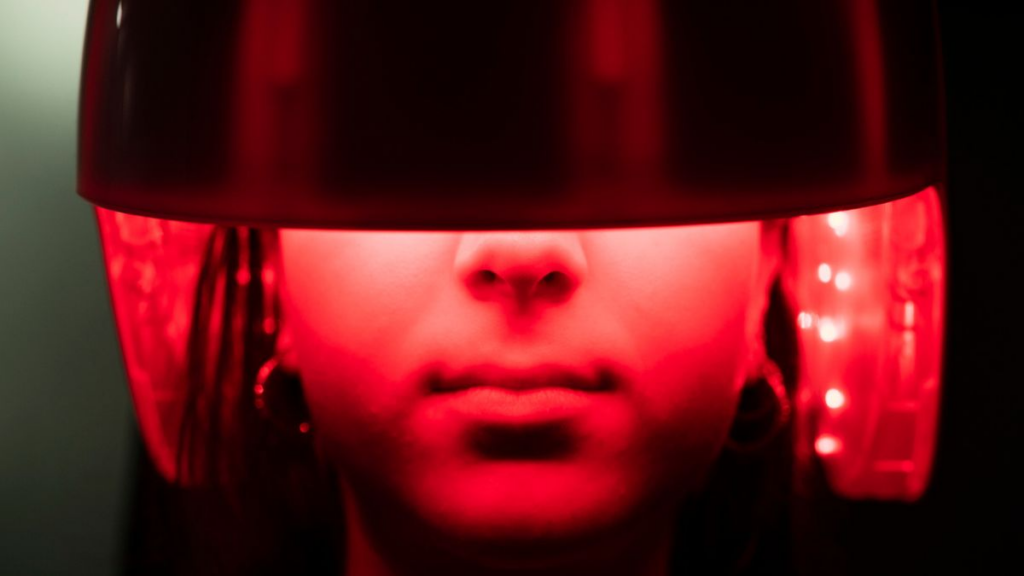
Millions of Americans struggle with hereditary hair loss, often turning to messy topical creams or prescription pills with frustrating side effects. Now, researchers from the Korea Advanced Institute of Science & Technology have developed a wearable solution that sounds like something out of a science fiction novel. They designed a flexible near-infrared light therapy hat that dramatically reduces cellular aging markers in the scalp. Published recently in the journal Nature Communications, the findings offer a promising new frontier for hair regeneration and a potential shift away from chemical treatments.
What is the new near-infrared light therapy for hair loss?
The core of this scientific breakthrough lies in targeting human dermal papilla cells. These critical cells reside at the very base of your hair follicles and act as the control center for the hair growth cycle. As we age, these follicles accumulate high levels of an enzyme called beta-galactosidase. This specific enzyme is a well-documented biomarker directly linked to cellular aging, follicle dormancy, and subsequent hair thinning. By addressing this enzyme, the researchers aimed to stop the aging process at the cellular root rather than just treating the surface symptoms.
In rigorous laboratory tests, the scientists exposed these aging human hair cells to a highly customized near-infrared light. The results were staggering for the medical community. Cells treated with this specific light wavelength showed a 92 percent reduction in the beta-galactosidase aging marker compared to untreated cells. Essentially, the light therapy managed to rewind the biological clock on the hair follicles, reverting them to a much younger, more active state.
How does OLED technology improve hair growth treatments?
Light therapy for hair loss is not entirely new to the dermatology world, but the delivery method created by the Korean team is a major functional upgrade. Traditional laser caps or LED helmets currently on the market are often rigid, heavy, and notoriously uncomfortable. Furthermore, they struggle to deliver a uniform spread of light across the uniquely curved surface of a human head. The research team solved this physical limitation by utilizing organic light-emitting diode technology.
Why flexibility matters for scalp health
- Thin and adaptable design: OLEDs can be manufactured on ultra-thin, flexible materials, allowing the device to fit snugly inside a standard soft fabric cap.
- Even light distribution: A closer, custom fit means the therapeutic light hits the scalp uniformly, eliminating the dead zones frequently missed by rigid plastic helmets.
- Optimal wavelength tuning: The system is finely tuned to emit light precisely between 730 and 740 nanometers, which researchers identified as the exact sweet spot for waking up dormant hair-regenerating cells.
- Superior heat management: Because OLEDs produce significantly less heat than traditional LEDs, the cap can be worn comfortably for extended periods without the risk of burning or irritating the scalp tissue.
The science of photobiomodulation
Near-infrared light therapy works through a biological process known as photobiomodulation. When specific wavelengths of light penetrate the dermal layers of the skin, they stimulate the mitochondria—the powerhouses—inside the cells. This stimulation boosts overall cellular energy production and promotes rapid healing and regeneration. By dialing in the precise wavelength, the Korean scientists maximized this biological reaction specifically for the dermal papilla cells, prompting them to shed their aging markers and resume normal hair production cycles.
Why this matters for the future of hair loss solutions
Up to 40 percent of people in the United States experience some form of patterned hair loss, making it a massive public health focus. For decades, the standard medical interventions have been limited mostly to minoxidil and finasteride. While effective for a portion of the population, these options require a strict, lifelong commitment and carry documented risks of severe skin irritation or systemic hormonal side effects. A non-invasive, wearable device offers a highly attractive, drug-free alternative for consumers desperate for a simpler routine.
The hair loss industry is massive, with consumers spending billions annually on serums, vitamin supplements, and painful clinical procedures like hair transplants. An effective, at-home OLED therapy could disrupt this market significantly. The user-friendly approach of simply wearing a comfortable hat is critical for ensuring patients actually stick to their treatment regimen, which is often the biggest hurdle in treating chronic hair loss.
It is important to note that this specific technology is still firmly in the laboratory phase. The device has successfully rejuvenated human cells in a controlled environment, but it has not yet been tested on actual human subjects. The research team is currently planning comprehensive preclinical studies to verify both the safety and long-term effectiveness of the hat in real-world scenarios. If those upcoming clinical trials succeed, this flexible OLED cap could eventually replace the daily pill or topical foam routine in medicine cabinets worldwide.
TL;DR: The Korean OLED Light Therapy Breakthrough
- Researchers in South Korea developed a flexible near-infrared OLED hat designed to treat hair loss without drugs.
- Laboratory tests demonstrated a 92 percent reduction in the beta-galactosidase aging marker within human hair cells.
- The device specifically targets dermal papilla cells using an optimized 730 to 740-nanometer light wavelength.
- Flexible OLED technology allows for a much more comfortable fit and even light distribution compared to traditional, rigid laser helmets.
- Further preclinical and clinical studies are the required next steps before this wearable tech becomes available to the general public.