TL;DR
British artist David Shrigley has built a one-ton mound of discarded ropes collected from all over the UK and placed it as the sole exhibit in a London gallery. Inspired by the phrase “money for old rope,” the installation questions how we assign value to art. It’s on sale for £1 million, and Shrigley insists that’s a fair price.
What Is the “Exhibition of Old Rope”?
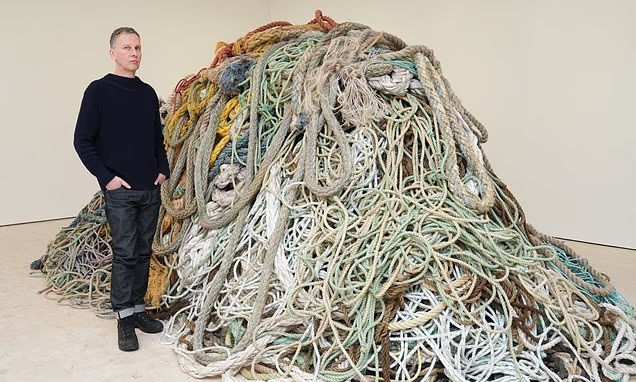
British artist David Shrigley has assembled a massive installation made entirely of used ropes gathered from across the UK. The work, weighing more than an African bush elephant calf, is the only piece on display at the Stephen Friedman Gallery in London between November 13 and December 20.
The title says it all: “Exhibition of Old Rope.”
The piece includes:
- Short beach ropes Shrigley collected himself.
- Cords from crab and lobster pots.
- Cruise liner mooring lines.
- Ropes from climbing schools and tree surgeons.
- Heavy lines from offshore wind farms and scaffolders.
- Everyday cords are used by window cleaning firms.
If you stretched every rope end to end, the artwork would run more than 32 kilometers, roughly the distance of a marathon.
Shrigley spent months collecting, hauling, and cleaning the ropes before piling them in his studio. The result is a sprawling mound that looks part industrial relic, part nautical archive, part organized chaos.
Why Did Shrigley Build a Mountain of Rope?
Shrigley says the inspiration came from the old idiom “money for old rope,” which refers to earning cash for something worthless.
That sparked a question: What if someone literally gathered old rope and declared it art? How would the public assign value to something considered useless?
In his words:
“The work exists because I’m interested in the value people place on art, and the idiom gave me an excuse to explore that.”
This isn’t new territory for Shrigley. He’s built a career around playful, often satirical works that test how people interact with objects in a gallery. His “Mayfair Tennis Ball Exchange” invited visitors to swap pristine tennis balls with the old ones they brought from home. Over time, the display morphed into a pile of dented, faded balls — a commentary on trade, participation, and the absurdity of everyday objects entering a gallery space.
The rope exhibition takes that same instinct and pushes it further. It isn’t a symbolic rope or a sculpted version of rope. It is rope, a mountain of it.
Is It Really Worth £1 Million?
Shrigley thinks so.
He’s asking £1 million (about $1.3 million) for the installation and maintains that it’s a “fair price.” The figure isn’t tied to the material value, recycled marine rope is practically worthless, but to the idea behind the piece and to Shrigley’s standing as a contemporary artist.
Here’s the bigger context:
Why do artists assign high prices to conceptual art
- Labor and time: Months of collecting and cleaning discarded rope.
- Scale: The work is massive and logistically complex.
- Intention: Conceptual art often focuses on the idea rather than the object.
- Market dynamics: Shrigley is an established artist with a track record of collectible, high-value work.
Why the price is part of the joke and the point
The absurdity of paying a million pounds for a pile of rope mirrors the absurdity of the idiom itself. Shrigley is poking at the gulf between perceived worth and actual value. It’s both a critique of art markets and a reflection of them.
How Shrigley Collected the Rope
Shrigley didn’t simply buy rope in bulk. He sourced it piece by piece from places across Britain:
Coastlines and harbors
Shorter lengths washed ashore on beaches. Shrigley personally walked shorelines to gather them, treating the process like a form of environmental cleanup.
Fishing and maritime industries
He tapped into:
- Crab and lobster potting communities.
- Cruise liner operations.
- Harbors are disposing of old mooring lines.
Industrial and commercial sectors
He contacted:
- Climbing schools and outdoor centers.
- Tree surgeons.
- Offshore wind farm operators.
- Scaffolders and building maintenance firms.
- Window cleaning companies.
Collecting rope from so many sectors transforms the piece into a sort of quiet documentation of British labor. Each rope once served a functional, often physical job, hauling, lifting, anchoring, before being discarded. Now they share a second life in a gallery.
What Makes This Exhibit Stand Out?
1. It’s a single-artwork exhibition.
Many galleries present dozens of pieces. Here, the entire show centers around one object. Visitors enter the room and encounter nothing but a giant mound of rope.
2. It questions what counts as art.
Shrigley isn’t the first to challenge this, Marcel Duchamp’s Fountain and Tracey Emin’s My Bed did so decades ago. But Shrigley’s work plays on a culturally familiar idiom to make the conversation more accessible.
3. It spotlights waste and reuse.
Even though the exhibition isn’t branded as environmental art, it raises questions about reuse, recycling, and how everyday materials are discarded.
4. It taps into humor without losing seriousness.
Shrigley’s tone is intentionally deadpan. He’s joking, but he’s also not. The tension between those two things is what gives the exhibit its edge.
Why This Exhibition Matters
Shrigley’s “Exhibition of Old Rope” isn’t just about rope. It’s about:
- How we assign meaning to objects.
- How language shapes our understanding of value.
- How the art world determines price and authenticity.
- How discarded materials can gain new relevance.
- How humor can coexist with serious critique.
Whether viewers see it as satire, sculpture, commentary, or a clever stunt, the work succeeds in sparking conversation — which is exactly what conceptual art aims to do.
Where to See It
Stephen Friedman Gallery, London
Dates: November 13 – December 20
Admission: Public exhibition
Before publishing, consider adding:
- A link to the gallery’s official exhibition page.
- A note comparing this exhibit to other notable conceptual installations.
- A sidebar interview with a curator or critic.