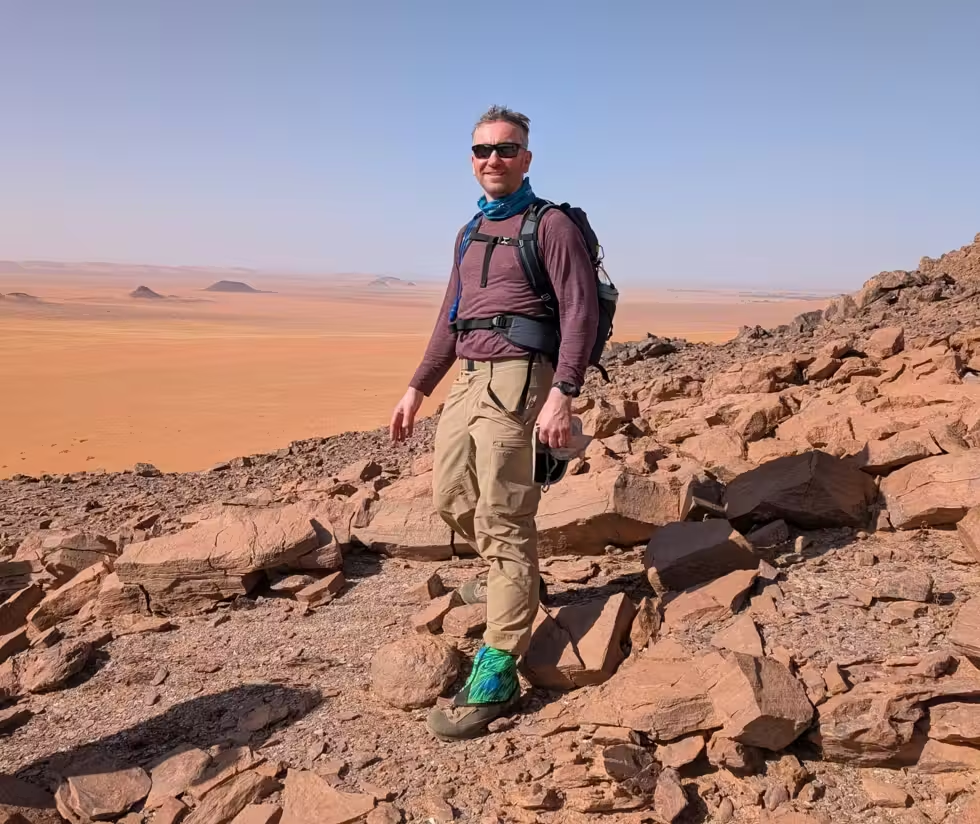
Two years after receiving a life-saving heart transplant, Fraser Wilson, a bank worker from Glasgow, walked more than 110 kilometers across the Sahara Desert—an achievement he once believed would be impossible.
Diagnosed with genetic cardiomyopathy, a condition that had already claimed the lives of four close family members, including his mother, Wilson underwent a heart transplant in March 2023 when his health rapidly deteriorated. Today, at 48, he is not only alive—but thriving, energized, and redefining what recovery can look like after organ transplantation.
His Sahara trek, completed in Morocco in November last year, was both a personal milestone and a fundraising mission, raising nearly £11,500 for homelessness charity Crisis.
Who is Fraser Wilson?
Fraser Wilson is a Glasgow-based bank worker who has lived most of his life under the shadow of inherited heart disease.
A family history marked by loss
Genetic cardiomyopathy runs deep in Wilson’s family. Before his own diagnosis escalated, the condition had already taken the lives of:
- His mother
- Three other close family members
As his health worsened, a heart transplant became his only option. That operation, carried out in 2023, ultimately saved his life.
“I definitely wouldn’t have been able to do this pre-transplant,” Wilson said, reflecting on the physical challenge of the Sahara trek.
What was the Sahara trek challenge?
More than two years after his transplant, Wilson decided to push his limits—physically and mentally.
The scale of the challenge
- Distance: Over 110km
- Duration: Four full days and two half-days
- Location: Sahara Desert, Morocco
- Participants: Around 90 colleagues from Lloyds Banking Group
Trekking through the Sahara is no small feat even for seasoned athletes. For a heart transplant recipient, it raised understandable concerns.
Wilson admitted he initially worried about whether the extreme conditions would affect his health. In the end, those fears proved unfounded.
“This trek has energised me,” he said. “I feel like I can do anything now.”
Why did he take on the trek?
Wilson’s motivation was deeply personal—but also outward-looking.
Raising money and awareness
The trek was undertaken to raise funds for Crisis, a UK charity supporting people experiencing homelessness. But the journey became something more.
Along the way, Wilson openly shared his transplant story with fellow trekkers, many of whom told him it reshaped how they viewed organ donation.
“There was an overwhelming feeling of support,” he said. “People told me it had changed their minds and educated them about organ donation.”
That ripple effect—changing perceptions, not just raising money—became one of the most meaningful outcomes of the journey.
How did he cope with the physical and mental strain?
While the Sahara is known for its heat and harsh terrain, Wilson said the mental challenge was often harder than the physical one.
“Walking in the middle of nowhere”
“The hardest part mentally was walking in the middle of nowhere with no landmarks to aim for,” he explained.
What kept him going was the camaraderie within his trekking group:
- Singing
- Talking
- Laughing
- Supporting one another mile after mile
That shared experience turned isolation into solidarity.
The final night of the trek proved especially emotional, with tears, hugs, and a collective sense of relief and accomplishment as the group reached camp.
“The feeling of elation was palpable,” Wilson said.
Where was his transplant carried out?
Wilson’s heart transplant was performed by the Scottish National Advanced Heart Failure Service (SNAHFS) at the Golden Jubilee University National Hospital in Clydebank.
Scotland’s sole heart transplant center
Since 2008, NHS Golden Jubilee has been the only provider of adult heart transplants in Scotland, carrying out:
- 271 heart transplants to date
Wilson’s journey is part of a much broader story of long-term care and survival made possible by specialist teams and donor generosity.
A family connection to transplantation
Remarkably, Wilson is not the only transplant recipient in his family.
Cousins with the same condition
His cousin, Louise Campbell from Wishaw, also has genetic cardiomyopathy. Like Wilson, she required a heart transplant—receiving hers in 2020 at the same hospital.
Both were 45 years old at the time of their respective surgeries, underscoring the hereditary nature of the disease and the life-saving role of modern transplant medicine.
What do healthcare professionals say?
For transplant staff, Wilson’s achievement represents more than a personal victory—it’s proof of what organ donation makes possible.
“Lives are not just saved—they are improved”
Julie Smith, a transplant nurse at NHS Golden Jubilee, described the broader significance:
“Behind every transplant is a story of hope. Fraser’s brave and inspirational exploits show that lives are not just saved, but they are also improved.”
She emphasized that transplant care is lifelong and deeply collaborative—but always rooted in the generosity of donors and their families.
Why this story resonates beyond one man
Wilson’s Sahara trek lands at the intersection of several powerful themes:
- The long-term impact of organ donation
- Life after serious illness
- The physical and psychological potential of transplant recipients
- Using survival as a platform to help others
In an era when recovery stories are often framed cautiously, Wilson’s experience challenges assumptions about what “post-transplant life” can look like.
TL;DR
- Fraser Wilson received a heart transplant in March 2023 due to genetic cardiomyopathy.
- Two years later, he trekked 110km across the Sahara Desert.
- The challenge raised nearly £11,500 for Crisis, a homelessness charity.
- Wilson says the experience left him feeling energized and capable of anything.
- His journey highlights the life-changing power of organ donation.