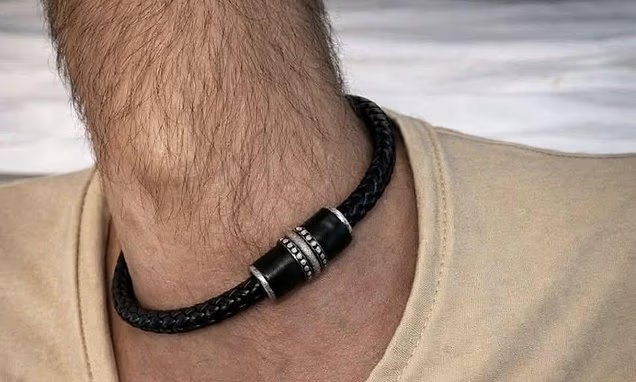
An optical illusion of a male body part is circulating online, and it’s turning timelines into staring contests. At first glance, the image appears to show a thin, hairy neck with a black leather necklace resting against beige fabric. Look longer, and your certainty starts to wobble. Look even longer, and your brain begins to negotiate with itself.
The image, first shared on X by users including @doxie_gay and later amplified by @ilyasroza, has sparked a flood of confused reactions. Many viewers insist they see a neck, complete with what looks like a sharp Adam’s apple. Others admit they cannot decode it at all.
Then comes the reveal. It is not a neck. It is a hand tucked into a trouser pocket. The “necklace” is a bracelet. The “Adam’s apple” is a wrist bone. And once you know that, your brain still resists the correction.
Welcome to the strange mechanics of visual perception.
What is this optical illusion actually showing?
Let’s break down what most people see first.
At initial glance, the image appears to depict:
• A narrow, hairy neck
• A black leather necklace or choker
• A beige V-neck shirt
• A prominent Adam’s apple
That interpretation feels coherent. The shadows line up. The textures make sense. The proportions appear plausible.
But the full, zoomed-out image, later shared by another X user, reveals the truth. The beige “shirt” is actually the pocket lining of trousers. The black “necklace” is a bracelet. The pointed “Adam’s apple” is the wrist bone. The hair is simply arm hair.
It is a hand in a pocket, captured from a tight, misleading angle.
A good visual addition here would be a side-by-side comparison:
• Left: Cropped illusion image
• Right: Full image revealing the hand in the pocket
With arrows pointing to the wrist bone and pocket crease to show how the illusion forms.
Why does the brain see a neck first?
This image falls into the category of what psychologists call an ambiguous or bistable image. These are pictures that can be interpreted in two different ways, and the brain tends to lock onto the most familiar pattern first.
A classic example is the Duck–Rabbit illusion, where the same drawing can look like a duck or a rabbit depending on how you frame it. Once you see one version, it can be hard to “unsee” it.
In the case of this viral optical illusion, several visual cues push the brain toward “neck”:
1. Familiar anatomy patterns
Humans are wired to recognize faces and body parts quickly. A vertical shape with a central protrusion strongly resembles a throat with an Adam’s apple.
2. Context clues from color
Beige fabric near skin tone resembles clothing near a neckline. The brain fills in missing context based on color relationships.
3. Cropping removes reality checks
The tight crop eliminates obvious signals like fingers or trouser seams. Without context, the brain defaults to the most likely explanation.
This process is called top-down processing. Your brain uses prior knowledge to interpret incomplete information. It is efficient most of the time. In illusions like this, it backfires spectacularly.
Why is it still confusing after you know the answer?
Here is where things get interesting.
Even after learning that the image shows a hand in a pocket, many viewers report that they still see a neck. That mental tug-of-war happens because perception is not purely logical.
Your visual system operates faster than your reasoning system. The “neck” interpretation is processed almost instantly. The “hand in pocket” explanation requires conscious correction.
So your brain runs two competing scripts:
• The automatic pattern match
• The corrected interpretation
They take turns winning.
This is similar to how other ambiguous illusions work. The image does not change. Only your interpretation flips back and forth.
Why do these illusions go viral?
Optical illusions thrive online for a simple reason: they invite participation.
This particular optical illusion of a male body part works especially well because:
• It creates instant confusion
• It feels slightly shocking at first glance
• It rewards viewers who solve it
• It encourages people to challenge friends
There is also a social element. When users comment, “It took me hours,” others feel compelled to test themselves. The comment section becomes part puzzle, part support group.
What type of illusion is this?
This image qualifies as a bistable or ambiguous illusion. It shares traits with:
• Figure-ground illusions
• Cropped perspective illusions
• Context-dependent illusions
In figure-ground illusions, the brain must decide which part of the image is the subject and which is the background. In this case, the pocket crease becomes a neckline, and the wrist bone becomes a throat protrusion.
The bigger takeaway
This viral moment is not just internet trivia. It is a small reminder of how perception works.
Your brain does not passively record reality. It predicts it. It guesses. It fills gaps. Most of the time, that system keeps you efficient and alert. Occasionally, it convinces you that a wrist bone is an Adam’s apple.
And once that first impression lands, it can be stubborn.
So if you are still seeing a skinny, hairy neck, do not worry. Your brain is simply doing what it was designed to do. It just got tricked by a clever crop.
TL;DR
• A viral image that looks like a thin, hairy neck is actually a hand in a trouser pocket.
• The “necklace” is a bracelet, and the “Adam’s apple” is a wrist bone.
• The illusion works because the brain uses familiar patterns to interpret incomplete visuals.
• Even after learning the answer, your perception may flip back and forth.