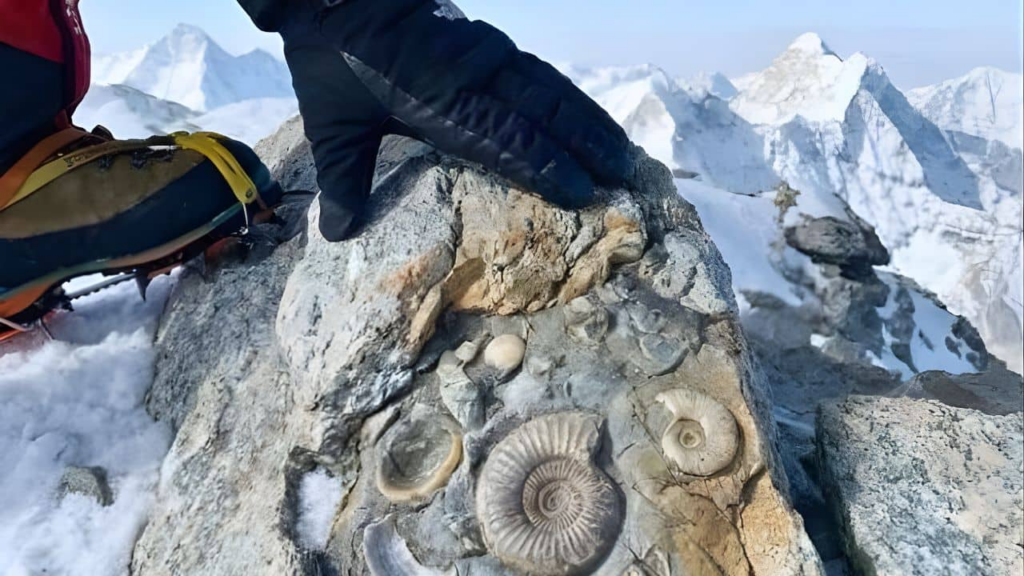
A viral post claiming that marine fossils on Mount Everest prove the Biblical Great Flood has reignited an old debate about Noah’s Ark, but the geology tells a very different story.
The fossils are real. Rocks near Everest’s summit contain remains of ancient marine organisms, including fragments of trilobites, ostracods and crinoids. The evidence shows that the rock now sitting more than 8,000 metres above sea level was once deposited in a shallow marine environment.
What it does not show is that a flood covered Mount Everest thousands of years ago.
The distinction matters because the marine limestone at Everest’s summit is hundreds of millions of years older than the biblical flood chronology cited in viral posts. Scientists explain the presence of these fossils through sedimentation, plate tectonics and the collision of India with Asia.
Why are there marine fossils on Mount Everest?
The simplest answer is that Everest was not always a mountain.
The limestone forming the mountain’s summit was deposited in a warm, shallow sea during the Ordovician Period, roughly 450 million years ago. The International Union of Geological Sciences describes the summit rocks as tropical Middle Ordovician limestone containing abundant marine fossils.
A 2005 study published in the journal Island Arc examined limestone from the summit of Mount Qomolangma, the Tibetan name for Everest. Researchers identified skeletal fragments of trilobites, ostracods and crinoids embedded in the rock.
In other words, the fossils did not somehow travel upward from the ocean after Everest became a mountain. The rocks containing those fossils were already part of an ancient seafloor.
A useful visual here would be a simple four-step graphic:
- Ancient shallow sea
- Marine organisms die and become buried in sediment
- Sediment hardens into fossil-bearing limestone
- Tectonic forces lift the rock thousands of meters
How did an ancient seabed become Mount Everest?
The answer lies in plate tectonics.
The Indian tectonic plate gradually moved northward toward the Eurasian plate. Around 50-55 million years ago, the two landmasses began colliding, initiating the enormous geological process that eventually produced the Himalayas.
The collision compressed and uplifted existing rocks, including sedimentary layers that had formed on the floor of the ancient ocean.
Over geological time, those layers were pushed upward, folded, faulted and exposed by erosion. Material that once sat near sea level eventually became part of one of Earth’s highest mountain ranges.
The U.S. Geological Survey notes that tectonic plates are massive slabs of Earth’s lithosphere that move over geological time, with collisions capable of producing major changes to Earth’s surface.
That process is the key to understanding the fossils on Everest.
The mountain did not have to be covered by water after it reached its present height. The rocks were formed in a marine setting long before the modern Himalayan landscape existed.
Does this prove the biblical Great Flood?
No. The fossils demonstrate that the rocks at Everest’s summit originated in an ancient marine environment. They do not provide evidence that a global flood described in Genesis covered Everest.
The timing is one of the clearest problems with making that connection.
The summit limestone is approximately 450 million years old. The Biblical flood is presented in religious chronology as a much more recent event. Those time scales are separated by hundreds of millions of years.
That does not settle questions of faith or religious interpretation. It does mean that the geological evidence itself has a well-established explanation that does not require a recent worldwide flood.
Scientists use multiple lines of evidence to reconstruct Earth’s geological history, including rock layers, fossil types and the environments in which those organisms lived. The USGS explains that marine fossils can reveal where ancient seas once existed and help scientists reconstruct past environments.
What did scientists actually find on Everest?
The discovery is more interesting than the viral claim suggests.
The 2005 study examined limestone from the summit region and found skeletal debris from several groups of marine organisms. The researchers identified:
- Trilobites, an extinct group of marine arthropods
- Ostracods, tiny crustacean-like organisms
- Crinoids, marine animals related to modern starfish and sea urchins
The fossils occur within limestone of the Qomolangma Formation. Researchers interpreted the fossil material as having originated around a marine bank and subsequently been deposited in nearby environments.
The International Union of Geological Sciences likewise identifies the summit rocks as Ordovician limestone formed in a warm, shallow-water sea and notes the presence of marine fossils including brachiopods, conodonts and crinoids.
This is not a newly discovered phenomenon. Scientists have known for decades that Everest contains marine rocks and fossils.
What is new is the renewed social-media attention surrounding an old geological fact.
What does the fossil evidence tell us about Earth?
The fossils provide a remarkable record of how dramatically Earth’s surface can change.
An animal living in a shallow sea hundreds of millions of years ago could leave behind a shell or skeletal fragment. That material could become part of sedimentary rock. Geological forces could then move that rock thousands of meters upward over immense periods of time.
Eventually, a climber could stand on that same rock near the top of Everest.
The fossil is therefore not evidence that an ocean recently rose to the summit. It is evidence that the Earth’s surface has been transformed over geological time.
The USGS describes fossils as important clues to the ancient distribution of land and sea. Fossil organisms preserved in sedimentary rocks can reveal whether an area was once covered by shallow water, deeper ocean or another environment.
Was the entire Himalayas once underwater?
The answer needs some precision.
It is accurate to say that parts of the region that now form the Himalayas were once covered by ancient seas. It would be misleading to picture the modern Himalayan range sitting underwater in its current form.
The Himalayas did not exist when the marine limestone at Everest’s summit was deposited.
The ancient landscape was dramatically different. Sediments accumulated in marine environments, were buried and eventually became rock. Much later, the collision between India and Eurasia transformed the region into a massive mountain system.
This is why saying “Mount Everest was once under the sea” is useful as shorthand but can create the wrong mental picture. A more scientifically accurate description is that the rocks now forming Everest’s summit were deposited on an ancient seafloor.
Why did the viral Noah’s Ark claim spread?
The connection is visually irresistible.
A modern photograph of Everest represents the highest terrain on Earth. The discovery of marine fossils at that altitude seems, at first glance, to create a dramatic contradiction: how could sea creatures have ended up there?
That apparent contradiction makes the story ideal for social media.
A viral post by Newsmax host David J. Harris Jr. revived the claim by arguing that marine rocks on Everest prove the mountain was once at the bottom of the ocean and asking whether the Bible had described the same event.
The first part of that statement has a scientific basis, with an important qualification: the rocks were deposited in an ancient marine environment and were later uplifted.
The leap from that fact to proof of Noah’s flood is an interpretation, not a scientific conclusion.
What does the Bible say about Noah’s flood?
The story of Noah appears in the Book of Genesis.
In the Biblical account, God warns Noah of a catastrophic flood and instructs him to build an ark. Noah, his family and representatives of the animals survive while the flood destroys the rest of humanity.
The Genesis account describes the waters rising over the mountains.
That religious narrative has been interpreted in different ways by Jewish, Christian and other traditions. Some readers understand the account literally, while others interpret it as a theological or symbolic story.
Scientific geology approaches the question differently. It looks for physical evidence, including the age and origin of rocks, fossil sequences and geological structures.
Those are different frameworks for answering different questions.
What is the scientific explanation for the marine fossils on Everest?
The evidence fits a sequence that geologists have studied for decades:
- Marine sediments accumulated in an ancient sea roughly 450 million years ago.
- Marine organisms became preserved in those sediments.
- The sediments hardened into limestone.
- The Indian plate moved north toward Eurasia.
- The collision between India and Eurasia drove enormous geological uplift.
- The former marine rocks were incorporated into the growing Himalayas.
- Erosion exposed portions of those rocks at very high elevations.
The result is one of geology’s most striking demonstrations of plate tectonics: marine rocks that began their history near sea level now occur at the summit of the world’s highest mountain.
So, do Mount Everest fossils prove Noah’s Ark?
The evidence does not establish that conclusion.
What the fossils show is something independently remarkable: the rocks at Everest’s summit formed in an ancient marine environment hundreds of millions of years ago and were later lifted to their present elevation through tectonic processes.
They do not establish that a global flood occurred during the period traditionally associated with Noah, nor do they provide evidence that Noah’s Ark existed.
The viral claim takes a genuine scientific discovery and attaches it to a much later religious narrative. The underlying geological fact is real. The geological evidence does not support the claimed connection between that fact and Noah’s flood.
The bigger story is even more extraordinary
The real story does not need a Biblical flood to be astonishing.
The limestone beneath Everest’s summit preserves evidence of an ancient sea that existed hundreds of millions of years before the modern Himalayas. Continental movement then transformed that old seafloor into part of a mountain range that now rises nearly nine kilometres above sea level.
That is the lesson the fossils actually offer: Earth’s surface is not fixed.
Oceans can disappear, continents can collide, seabeds can become mountains, and organisms that lived in ancient seas can eventually be found thousands of meters above today’s oceans.
The fossils on Everest are therefore not evidence that a recent flood lifted the mountain. They are evidence of something much slower and more powerful: the extraordinary geological machinery that has been reshaping Earth for hundreds of millions of years.