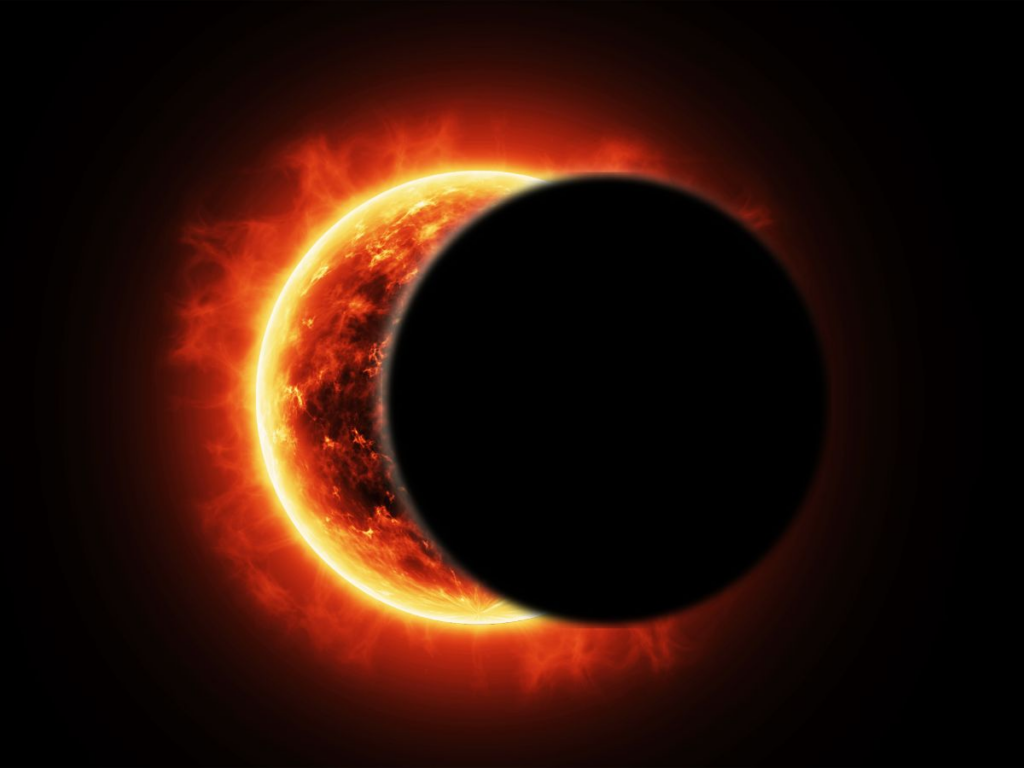
On February 17, 2026, the first major sky event of the year will unfold over one of the most isolated places on Earth. An annular solar eclipse 2026—often called a “ring of fire” eclipse, will briefly darken parts of Antarctica. And yet, almost no humans will see it.
Unlike past high-profile eclipses that drew millions of spectators across North America and Asia, this one is headed for a frozen continent with no permanent residents, brutal winter temperatures, and just a handful of research stations. The result: a spectacular cosmic alignment that will largely play out for penguins, satellites, and a few bundled-up scientists.
What Is an Annular Solar Eclipse?
An annular solar eclipse happens when the Moon passes directly between Earth and the Sun, but doesn’t completely block it.
How It Works
Because the Moon’s orbit is elliptical, its distance from Earth changes. When the Moon is farther away (near apogee), it appears slightly smaller in the sky. If it aligns with the Sun at that distance, it cannot cover the Sun entirely. Instead, a bright outer rim of sunlight remains visible, forming a glowing ring. That’s the “ring of fire.”
Unlike a total solar eclipse, the sky does not plunge into deep twilight. The light dims significantly, but the Sun’s outer edge continues to shine.
Where Will the Annular Solar Eclipse 2026 Be Visible?
The February 17 event will trace a narrow path across Antarctica. A partial eclipse will be visible from the southern tip of South America, parts of southern Africa, and surrounding Southern Ocean regions. But the full annular “ring of fire” effect is almost entirely confined to Antarctica.
The Path of Annularity
The path of annularity stretches approximately 4,282 kilometers long and 616 kilometers wide. The eclipse will last up to 2 minutes and 20 seconds, and the Moon’s antumbral shadow will cross Earth in about 59 minutes. The sun will rise over mainland Antarctica while the shadow sweeps across the icy plateau and exits near the Davis Sea coast.
Why Almost No Humans Will See It
Antarctica has no cities, no towns, and no permanent population. Only rotating teams of scientists and support staff occupy research stations year-round.
According to eclipse meteorologist Jay Anderson (as reported by Space.com), only two inhabited locations fall within the annular shadow: Concordia Station and Mirny Station. Neither is designed for tourism. There are no viewing festivals or public gatherings—just research facilities operating in extreme cold.
In practical terms, that means perhaps a few dozen people at most have a chance to witness the full ring.
Concordia Station: The Best Seat on Earth?
The strongest viewing odds belong to Concordia Station, a joint French-Italian research facility operating since 2005.
Located deep in Antarctica’s interior, Concordia houses around 16 scientists during winter. Cloud cover averages roughly 35 percent in February, and the station sits directly within the path of annularity.
Concordia is one of only three permanent inland stations on the continent. Temperatures can plunge to –80°C (–112°F). The base includes an atmospheric monitoring tower, satellite calibration systems, underground storage vaults, telescopes, observation platforms, and a small airstrip.
Ironically, the scientists best positioned to witness the eclipse may also be the least inclined to step outside for it.
Mirny Station: A Historic Outpost With Tough Odds
The second potential viewing site is Mirny Station, established in 1956 and located in Queen Mary Land along the Davis Sea coast. Scientists there conduct research in climate science, sea ice monitoring, cosmic ray detection, meteorology, glaciology, and biodiversity studies.
However, Mirny faces a major obstacle: cloud cover. The station averages around 65 percent cloud cover in mid-February, compared with roughly 35 percent over the Antarctic interior. That difference significantly lowers Mirny’s odds of a clear view.
How Rare Is This Type of Eclipse Location?
Annular eclipses occur every one to two years somewhere on Earth. What’s unusual here is the path landing almost entirely on an uninhabited continent.
Compare that with recent high-profile eclipses across North America that drew millions of viewers. The annular solar eclipse of 2026, by contrast, will likely be one of the least-observed major eclipses in decades.
Why It Still Matters
Even if few humans see it in person, the eclipse holds scientific value. Researchers can measure atmospheric changes during rapid solar dimming, observe ionospheric effects, and calibrate satellite instruments. Remote sensing equipment and orbiting satellites will capture detailed data, even if clouds block ground observers.
This event also highlights a broader truth: astronomical events are global, but human access is not. Nature doesn’t schedule around population centers.
Will Anyone Be Able to Watch It?
Possibly—but likely through recorded footage rather than in person. If the skies cooperate, researchers may capture imagery and release it afterward. Live public broadcasts from Antarctica are rare due to infrastructure limits.
Readers eager to see a ring-of-fire eclipse firsthand will have better opportunities later in the decade. NASA’s eclipse calendar provides verified future dates and viewing paths.
TL;DR
The annular solar eclipse 2026 occurs on February 17 and will create a “ring of fire” almost exclusively over Antarctica. Only two research stations—Concordia and Mirny—sit within the annular path. Cloud cover gives Concordia a better chance of clear skies. Very few humans, if any, may witness it live.
Final Thoughts
The February 17 annular solar eclipse is a reminder that spectacular events don’t always align with population centers. Sometimes the cosmos performs over ice sheets instead of cities. For most of us, it will pass quietly overhead, unseen. But for a small team of Antarctic researchers—if the skies clear—it could be a once-in-a-career moment in one of the harshest environments on Earth.
Before publication, fact-check eclipse duration and path measurements using NASA’s eclipse database, verify cloud cover statistics through meteorological records, and confirm station population numbers. Accuracy remains essential in science reporting.