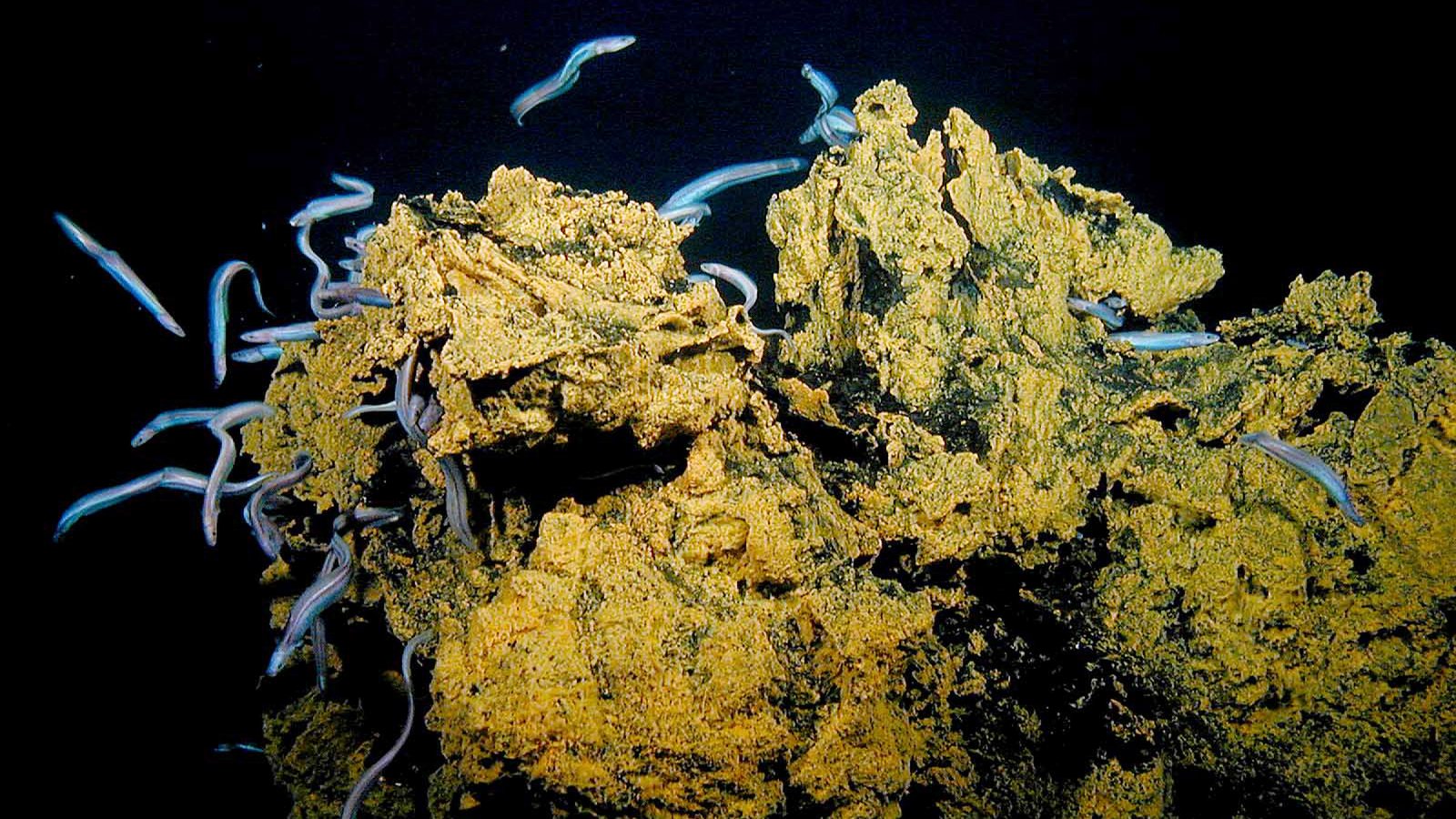
Up to 2.8 million basketwork eels gather each year on one underwater mountain south of Tasmania. At their peak they weigh about 3,550 metric tons, according to a new study in Royal Society Open Science. The authors work at CSIRO, Australia’s national science agency.
The count is new, but the puzzle is old. Patience Seamount is one of about 120 seamounts in the marine parks south of Tasmania, and it’s the only one where the gathering has been recorded.
The study, led by CSIRO marine scientist Ben Scoulding, sizes one of the deep sea’s strangest spawning events. It still can’t say why the eels pick this mountain.
A small extinct volcano a kilometer down
Patience Seamount sits inside Australia’s Huon Marine Park. It is a small extinct volcano with a base of about 3 square kilometers. Its peak lies about 857 meters below the surface and its base at 1,250 meters, according to Phys.org’s summary of the paper.
Basketwork eels (Diastobranchus capensis) belong to the cutthroat eel family. They live off southern Australia, South Africa and New Zealand, and grow to about 1.8 meters. Their name comes from a crosshatch pattern on the skin, which Scoulding told ABC News Australia looks like “old woven baskets.”
Fishers knew the spot long before scientists counted anything. Since the 1980s, trawlers chasing orange roughy kept hauling up the eels as bycatch. They nicknamed the seamount “Eel Hill,” ABC reported.
CSIRO first filmed the eels with a towed camera in 2007, ScienceAlert reported. A 2021 paper put the April 2015 gathering in the tens of thousands.
How you count eels you can’t see
The new figure comes from nine sonar surveys run from the research ship RV Investigator between 2023 and 2025. Scoulding described the method to ABC as a “really expensive scientific fish finder.” Sound pulses go down, bounce off fish and come back.
Basketwork eels return a strong echo because of their large swim bladders. “Air is a really good reflector of sound,” Scoulding said.
The catch is that orange roughy crowd the same mountain, and sonar alone can’t tell the two species apart. So the team used deep-towed camera footage to map where each species sits, then split the echoes to match. The paper’s abstract says the eels favor “deeper, flatter terrain.” Orange roughy stay on the steep slopes near the summit.
The researchers also capped the orange roughy share at 200 to 850 metric tons, based on past stock assessments. Without that cap, the authors write, the roughy numbers became “implausible.” That’s why 2.8 million is best read as a careful estimate, not a headcount.
A swarm 2 miles long
At its largest, the swarm stretched about 3 kilometers long and 2 kilometers wide, ScienceAlert reported. It rose about 150 meters off the seafloor. In US terms, that’s roughly 1.9 miles by 1.2 miles.
The densest part sits along a ridge northwest of the peak. There, Scoulding told ABC, the eels are “almost touching each other.” Farther out, the density drops to roughly one eel per 20 cubic meters of water.
The swarm swells with the seasons. Eel biomass was about 750 metric tons in March and more than 3,500 metric tons by May, the study found. ABC reported that the eels start arriving in December, peak around May to August and are gone by October. “One of the interesting things is the persistence of the aggregation,” Scoulding told ABC.
The case that it’s about spawning
Everything the team found points to breeding, not feeding. The researchers caught only seven eels, ScienceAlert reported, and every stomach was empty. One female had already spawned and the others were close, according to ABC.
Fish that stop eating before spawning rarely take baited gear, which may explain the small sample. It also means the spawning case rests on a handful of animals. Nobody has yet seen where or when the eels release their eggs. Where the young go afterward is also unknown.
ABC described Patience as the only known spawning site for purely oceanic eels anywhere. That makes the location question pressing.
Researchers are now testing whether the eels of Australia and New Zealand form one population that travels here. “It’s quite unique that all the eels chose Patience to aggregate at,” Scoulding told ABC. Why they do is still unknown.
A smaller ‘Eel City’ in US waters
The closest American comparison is far smaller. In 2005, scientists explored Vailulu’u, an underwater volcano now inside the National Marine Sanctuary of American Samoa. They found swarms of small cutthroat eels in crevices on a new volcanic cone and named the site “Eel City,” according to NOAA Ocean Exploration.
A University of Oregon biologist on that trip estimated “hundreds and perhaps thousands” of eels, NBC News reported in 2005. Patience holds up to 2.8 million. And its eels come to breed, not to live around a warm vent.
Fossils can tell scientists what lived in a sea millions of years ago, as with the shark teeth found in Egypt’s Sahara this month. Patience is rarer: a living gathering that can be counted again next year.
Why a baseline matters for a vulnerable species
Basketwork eels are listed as vulnerable on the IUCN Red List, partly because of bycatch, ABC reported. A population off New Zealand fell 85% over 40 years. Nobody knows whether the Patience eels went through a similar decline before anyone counted them.
The seamount itself was once bottom-trawled. A management plan adopted last year now protects it from bottom trawling, ABC reported. ScienceAlert reported that living corals have returned to previously trawled areas.
Shaun Barclay, head of Parks Australia’s island and marine parks branch, told ABC the study gives managers a baseline. The authors agree. They write that the seamount’s “protection and recovery from historical fishing” offer a rare chance for long-term study.
Not every Australian natural oddity is hidden a kilometer down. On land, a NASA satellite recently picked out a spider-shaped crater in the outback.
The next surveys will test whether the 2.8 million figure holds from year to year. After that comes the harder question of where the eels travel from. ABC reported that researchers are now studying how the Australian and New Zealand populations connect.