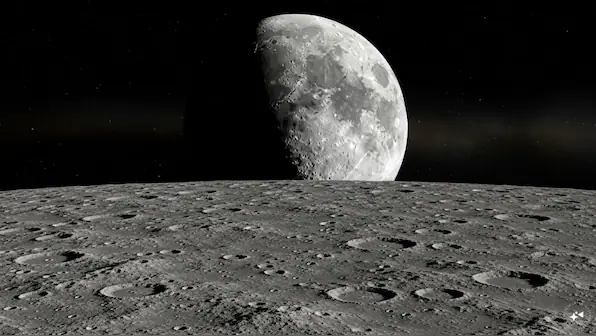
China has unveiled what researchers describe as the world’s first practical timekeeping software designed specifically for the moon, a development that could quietly reshape how future lunar missions are planned, coordinated, and executed.
The new system addresses a fundamental problem in space exploration: time itself behaves differently on the moon. Because of weaker gravity, clocks on the lunar surface tick slightly faster than those on Earth. The difference is tiny, about 56 millionths of a second per day—but over time it adds up, making Earth-based time increasingly unreliable for precise lunar operations.
As more spacecraft and, eventually, humans prepare to work on and around the moon, that gap is no longer a theoretical curiosity. It is becoming an engineering challenge that demands a permanent solution.
Why do clocks tick faster on the moon?
The answer lies in Einstein’s theory of general relativity, which predicts that time runs faster in weaker gravitational fields.
How gravity affects timekeeping
Earth’s stronger gravity slows clocks down slightly compared with those in weaker gravitational environments. On the moon, gravity is about one-sixth as strong as Earth’s, so lunar clocks run faster.
While the daily difference is measured in millionths of a second, navigation systems depend on extreme precision. Over weeks, months, or years, these discrepancies can lead to meaningful errors.
- A few microseconds can affect position calculations.
- Over longer missions, errors compound and become harder to correct.
For early lunar missions, engineers simply applied manual corrections using Earth time. That approach is now reaching its limits.
What is China’s new lunar timekeeping software?
Chinese scientists have developed a software model that allows lunar time to be accurately synchronized with Earth-based clocks, eliminating the need for complex, mission-specific corrections.
Who developed it?
The work was led by researchers at the Purple Mountain Observatory in Nanjing, one of China’s leading astronomical research centers. Their findings were published in the December issue of the journal Astronomy and Astrophysics, a key point where an external link to the journal would be appropriate.
How the system works
The model accounts for two major factors:
- The moon’s weaker gravitational field
- The moon’s motion through space relative to Earth
By combining these elements, the software can precisely track how the time difference between Earth and the moon evolves over long periods.
According to the researchers, the system remains accurate to within a few tens of nanoseconds even over 1,000 years, a level of precision well beyond current mission needs.
Why does lunar timekeeping matter now?
For decades, the difference between Earth time and lunar time was largely academic. Lunar missions were rare, short, and isolated.
That is no longer the case.
A crowded future around the moon
The moon is becoming a shared workspace. Multiple countries and private companies are planning:
- Robotic landers
- Lunar orbiters
- Surface infrastructure
- Human missions later this decade
As activity increases, so does the need for a common time reference.
Jonathan McDowell, a Harvard astronomer and space historian, has described lunar timekeeping as a growing engineering necessity rather than a theoretical issue. Even a microsecond error, he notes, can quickly affect navigation systems that rely on constant, precise calculations.
This is particularly important for technologies similar to GPS, which future lunar missions are expected to rely on for precision landings and surface operations.
How is this different from previous approaches?
Until now, most lunar missions operated entirely on Earth time, applying corrections only when needed.
Why ad hoc fixes no longer work
That method breaks down as complexity increases:
- Multiple spacecraft operating simultaneously
- Long-duration surface missions
- Shared infrastructure, such as navigation satellites
Relying on manual or mission-specific corrections becomes cumbersome and risky when coordination is required across agencies and systems.
China’s software packages lunar timekeeping into a single, automated tool, allowing engineers to compare Earth and lunar time directly without performing complex calculations themselves.
What is LTE440, and what can it do?
The research team named the software LTE440, short for Lunar Time Ephemeris.
Key features of LTE440
- Ready-to-use comparison between lunar and Earth time
- High long-term accuracy
- Designed for engineering and mission-planning use
The researchers emphasize that LTE440 is an early step. It is not yet a full real-time navigation system, but it lays the groundwork for future lunar clock networks and positioning systems.
How does this fit into the global moon race?
China’s lunar timekeeping software arrives as competition around the moon intensifies.
International context
In 2024, the International Astronomical Union adopted a broad framework calling for the moon to have its own time reference. That move signaled recognition that lunar operations were becoming too complex to rely on Earth time alone.
The Chinese team’s work builds directly on that framework, turning an abstract concept into a usable engineering tool.
McDowell notes that while similar research has been underway in the United States, he is not aware of another openly available, ready-to-use system. That openness, he argues, underscores how seriously China is taking long-term lunar planning.
What comes next for lunar timekeeping?
The researchers acknowledge that LTE440 is only a starting point.
Future challenges
To fully support sustained lunar activity, future systems will need:
- Real-time synchronization
- Networks of lunar clocks
- Integration with navigation satellites
As permanent lunar infrastructure becomes a reality, timekeeping will shift from a background calculation to a foundational system, much like GPS time is on Earth today.
TL;DR
Clocks run faster on the moon due to weaker gravity, and the difference adds up over time. Chinese scientists have now released the world’s first practical lunar timekeeping software, allowing precise synchronization between Earth and lunar time. As missions to the moon multiply, this tool could become essential for navigation, coordination, and future human activity on the lunar surface.