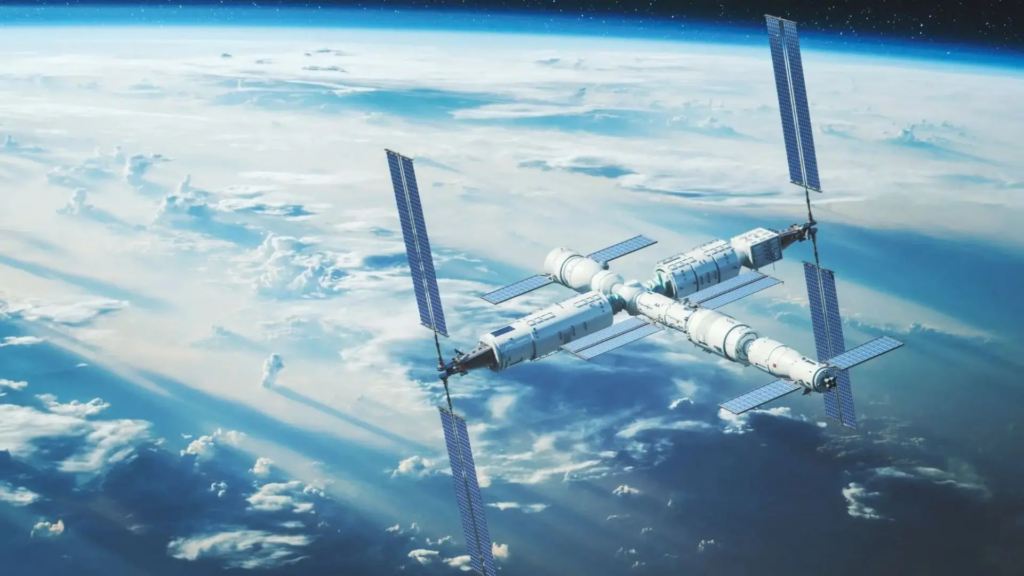
Why China is studying batteries in space
China has begun a new round of experiments aboard its Tiangong space station aimed at improving lithium-ion batteries—a technology that underpins everything from smartphones to deep-space missions.
The work is being led by Zhang Hongzhang, a 39-year-old battery scientist and only the second civilian astronaut China has ever sent into orbit, according to state media reports on Wednesday. The experiments focus on how batteries behave in microgravity, a condition impossible to replicate fully on Earth.
Understanding these effects could help engineers design safer, longer-lasting, and more efficient batteries for spacecraft, satellites, and potentially even future lunar or Mars missions.
Who is Zhang Hongzhang?
Zhang is a professor at the Dalian Institute of Chemical Physics, one of China’s top research centers for energy science. He is currently part of the Shenzhou-21 mission, which sent three astronauts to Tiangong.
Unlike China’s early space crews, drawn almost exclusively from military pilots, Zhang represents a newer approach. In 2018, China opened astronaut recruitment to scientists and flight engineers, signalling a shift toward research-driven missions.
China’s first civilian astronaut under that program, Gui Haichao, a Beihang University professor, flew to the space station in 2023.
Why lithium-ion batteries matter in space
Lithium-ion batteries are a cornerstone of modern spaceflight because they offer:
- High energy density, delivering more power with less weight
- Reliability in harsh environments
- Rechargeability, critical for long missions
They power satellites, spacecraft systems, and space station equipment. But space also introduces unique risks.
Battery failures in orbit can be catastrophic, leading to fires, loss of power, or mission failure. Improving battery safety and durability is therefore not just a scientific challenge—it’s a mission-critical one.
What makes microgravity so important
On Earth, gravity constantly interacts with electric and chemical forces inside a battery. That makes it difficult to isolate gravity’s role in how batteries charge, discharge, and degrade over time.
“In normal conditions, gravitational fields are always intertwined with electric fields,” Chinese researchers have explained. “This makes it hard to clearly identify gravity’s influence.”
The microgravity environment aboard Tiangong removes that variable, allowing scientists to observe battery behavior with far greater precision.
What the experiments are actually testing
Zhang’s in-orbit work focuses on internal battery processes, particularly what happens during charging.
Key areas of study include:
Ion movement between electrodes
When a lithium-ion battery charges, lithium ions move from one electrode to another through an electrolyte. Microgravity allows scientists to observe this movement without gravitational interference, potentially revealing inefficiencies or instabilities that aren’t visible on Earth.
Electrolyte distribution
According to China’s state news agency Xinhua, the distribution of chemical substances within the electrolyte is a major factor in battery performance and lifespan.
In space, liquids behave very differently. Surface tension, rather than gravity, dominates—changing how chemicals spread and interact inside the battery.
Uneven distribution can:
- Reduce power output
- Shorten battery life
- Increase safety risks
Lithium dendrite growth
One of the most dangerous phenomena in lithium-based batteries is the formation of lithium dendrites—tiny, needle-like structures that grow on electrodes over time.
Dendrites can:
- Pierce battery separators
- Cause short circuits
- Trigger overheating or fires
Zhang will attempt to capture images of dendrite growth in microgravity, offering rare insight into how and why they form—and how to prevent them.
Why space batteries behave differently than Earth batteries
In space, the absence of gravity alters how liquids, gases, and solids interact.
Inside a battery, that can mean:
- Different flow patterns in the electrolyte
- Slower or uneven chemical reactions
- Increased risk of structural instability
These differences may reduce performance or increase safety hazards if not properly understood.
By studying these effects directly, scientists hope to design batteries specifically optimized for space—not just adapted from Earth-based designs.
From space stations to future missions
While the immediate applications are for spacecraft and satellites, the implications go further.
Better battery technology could support:
- Longer space station missions
- Deep-space exploration, including lunar bases and Mars missions
- More resilient satellite networks
Some findings may even translate back to Earth, improving battery safety in electric vehicles, grid storage, or consumer electronics.
A scientist’s role in orbit
Zhang has emphasized that his job is not just to run experiments, but to act as a bridge between space and Earth.
In an interview with China Youth Daily before launch, he said he applied immediately after seeing the 2018 recruitment notice.
“Every experiment conducted on the space station embodies the hard work of the ground researchers,” Zhang said. “Being able to carry out their experiments in space is not only a privilege but also a responsibility.”
Throughout the mission, he is expected to maintain constant communication with ground teams to adjust experiments and maximize results.
Why this mission reflects a broader shift
China’s decision to send specialist scientists like Zhang into orbit reflects a strategic shift in its space program—from symbolic milestones to precision science.
Rather than focusing solely on crewed presence, Tiangong is increasingly being positioned as a laboratory in orbit, competing with and complementing research once carried out on the International Space Station.
That shift mirrors trends in other spacefaring nations, where space is becoming less about flags and more about data.
What comes next
Results from the battery experiments will be analyzed after Zhang’s return, with findings expected to guide future spacecraft design.
For now, the work highlights a simple reality: as space missions grow longer and more ambitious, power systems may matter just as much as rockets.
And understanding how a battery behaves when gravity disappears could be one of the keys to getting humans farther than ever before.
TL;DR
- China has launched new battery experiments aboard the Tiangong space station
- The work is led by Zhang Hongzhang, China’s second civilian astronaut
- Scientists are studying lithium-ion batteries in microgravity to improve safety and efficiency
- Key focuses include ion movement, electrolyte distribution, and lithium dendrite growth
- Findings could shape future space missions—and possibly improve batteries on Earth