
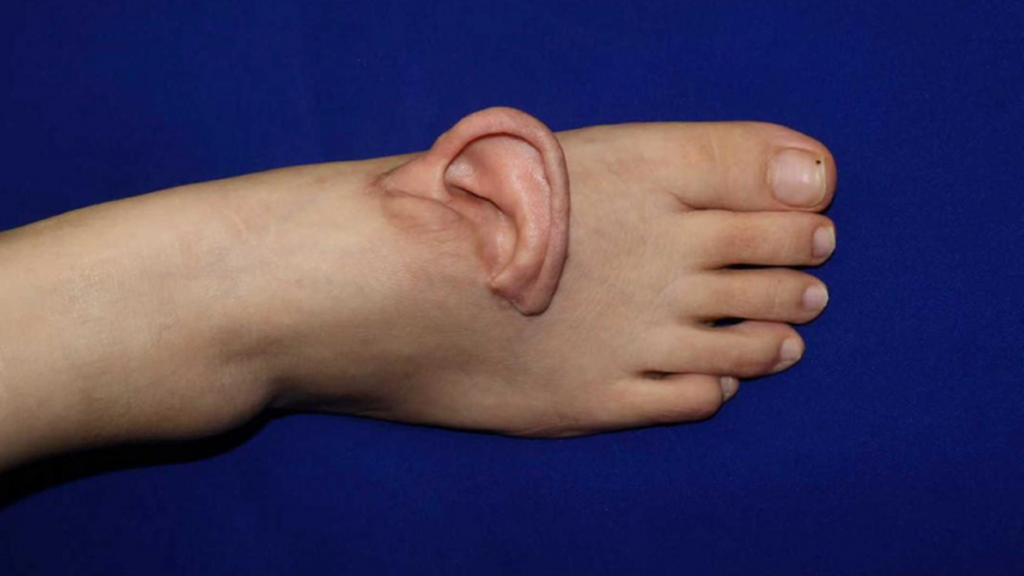
In a groundbreaking medical achievement, Chinese surgeons have successfully reattached a woman’s severed ear after temporarily grafting it onto her foot — a procedure believed to be the first of its kind in the world.
The extraordinary case, reported by Chinese medical outlet Yixue Jie and later cited by the South China Morning Post, highlights both the limits of modern microsurgery and the creativity doctors can employ when conventional treatment fails.
A Devastating Workplace Accident
The patient, identified only by the surname Sun, suffered catastrophic injuries in a workplace accident in April when heavy machinery tore away her ear along with a large section of her scalp.
According to Qiu Shenqiang, deputy director of the microsurgery unit at Shandong Provincial Hospital in Jinan, the injuries were severe and life-threatening.
The scalp, neck, and facial skin were “split into multiple fragments,” and the ear was “completely severed along with the scalp,” Qiu said.
Doctors immediately attempted emergency reconstruction, but the damage was far more extensive than initially expected.
Why Conventional Treatment Failed
Severe Tissue and Blood Vessel Damage
When the patient arrived at the hospital, surgeons from the hand, foot, and reconstructive microsurgery team attempted standard repair techniques. However, the injury had destroyed much of the scalp’s blood supply.
Without a stable vascular network, reattaching the ear directly was impossible.
The problem was not just reattachment; it was keeping the ear alive long enough for the rest of the head to heal.
That’s when the surgical team made an unprecedented decision.
The Radical Solution: Grafting the Ear to the Foot
With no established medical precedent to follow, the team decided to temporarily graft the severed ear onto the top of the patient’s foot.
Why the Foot?
According to Dr. Qiu, the foot offered several advantages:
- Blood vessels similar in size to those of the ear
- Thin skin comparable to scalp tissue
- Reliable blood circulation
- A location that allows close surgical monitoring
The goal wasn’t cosmetic, it was survival.
The ear needed a blood supply to stay viable until the patient’s scalp could heal enough for reattachment.
A 10-Hour Surgery and Microscopic Precision
The initial operation lasted 10 hours.
Surgeons worked under a microscope to connect blood vessels measuring just 0.2 to 0.3 millimeters in diameter, a task requiring extraordinary precision.
At this stage, even a minor clot or misalignment could have destroyed the tissue.
And then came another crisis.
A Life-Threatening Complication
Five days after the graft, doctors noticed the ear turning dark purple, a sign of dangerous venous congestion.
Blood was flowing into the tissue but not draining properly, a condition that could quickly lead to tissue death.
To save it, the team performed manual bloodletting nearly 500 times over five days, carefully relieving pressure and restoring circulation.
At the same time, surgeons reconstructed the patient’s scalp using skin grafts taken from her abdomen.
Final Surgery: Reattaching the Ear
After more than five months of recovery, swelling subsided, and blood flow stabilized. In October, doctors performed the final operation — reattaching the ear to the patient’s head.
The procedure lasted six hours.
This time, it worked.
The ear survived, blood circulation remained stable, and the tissue began functioning normally.
Patient Recovery and Current Condition
The patient has since been discharged from the hospital.
According to doctors:
- Facial appearance has largely recovered
- Ear tissue remains healthy
- Hearing and blood flow are stable
- Minor follow-up procedures are planned to:
- Restore eyebrow appearance
- Reduce scarring on the foot
Doctors described the outcome as a major success, both medically and surgically.
Why This Case Matters
This operation marks a major milestone in reconstructive microsurgery.
Why it’s significant:
- No documented precedent for ear-to-foot temporary grafting
- Demonstrates new possibilities for tissue preservation
- Could reshape treatment for severe trauma cases
- Offers hope for patients with otherwise irreversible injuries
Experts say this technique could be adapted in future cases involving:
- Facial trauma
- Industrial accidents
- Battlefield injuries
- Severe burns
A Remarkable Blend of Innovation and Precision
While modern medicine often relies on advanced technology, this case stands out for something else: human ingenuity under pressure.
With no textbook solution available, the surgeons made a bold decision, one that ultimately saved a part of the patient’s identity.
As reconstructive surgery continues to evolve, this case may be remembered as a turning point in what doctors believe is possible.
TL;DR
- Chinese surgeons temporarily grafted a severed ear onto a woman’s foot
- The patient suffered severe injuries in a workplace accident
- Traditional reconstruction failed due to blood vessel damage
- The ear was kept alive on the foot for over five months
- Surgeons later successfully reattached it to her head
- The case is believed to be a world first in medical history