

A physicist in Japan has built a digital black hole out of logic gates on a programmable chip. It simulates water swirling into a drain, with a horizon that traps ripples the way a real black hole traps light. When he flipped a single bit just inside that horizon, most of the disturbance stayed trapped. A small part escaped.
Nothing here was a real black hole, and nothing about real black holes changed. The result concerns a narrower question that physicists care about a great deal. Does a horizon behave the same whatever it is made of? On this chip, it doesn’t.
The work is a single-author preprint by Antonino Flachi of Keio University’s physics department in Yokohama. “Engineering a digital acoustic black hole” went up on arXiv on Nov. 7 and has not been peer reviewed.
ScienceAlert’s Michelle Starr brought it to wider attention on Nov. 22.
A black hole made of moving water, then made of bits
The idea goes back to 1981. That year physicist William Unruh showed that sound in a flowing fluid obeys the same equation as light near a black hole.
Picture water speeding up as it swirls into a drain. At some radius the inflow outruns a ripple, so nothing from inside that circle can travel back out. That circle is an acoustic event horizon.
Labs have since built these analog black holes in water tanks, ultracold atomic gases, optical fibers and superfluid helium. They let physicists measure horizon effects that can’t be tested on the real thing, which is light-years away even at its nearest.
Flachi replaced the water with arithmetic. His grid has 768 by 768 cells, and each cell stores 32 numbers of 32 bits. That comes to about 604 million bits.
At every clock tick, one rule wired as logic gates updates each cell from its neighbors. On large scales the rule acts like a thin layer of water flowing into a central drain, with a swirl that makes it rotate.
No wire marks the horizon, and the logic is identical on both sides of it. “Its horizon is a property not of the wiring but of the state,” Flachi writes. The boundary exists only because of how fast the simulated water moves there.
“On a chip,” with a caveat about the memory
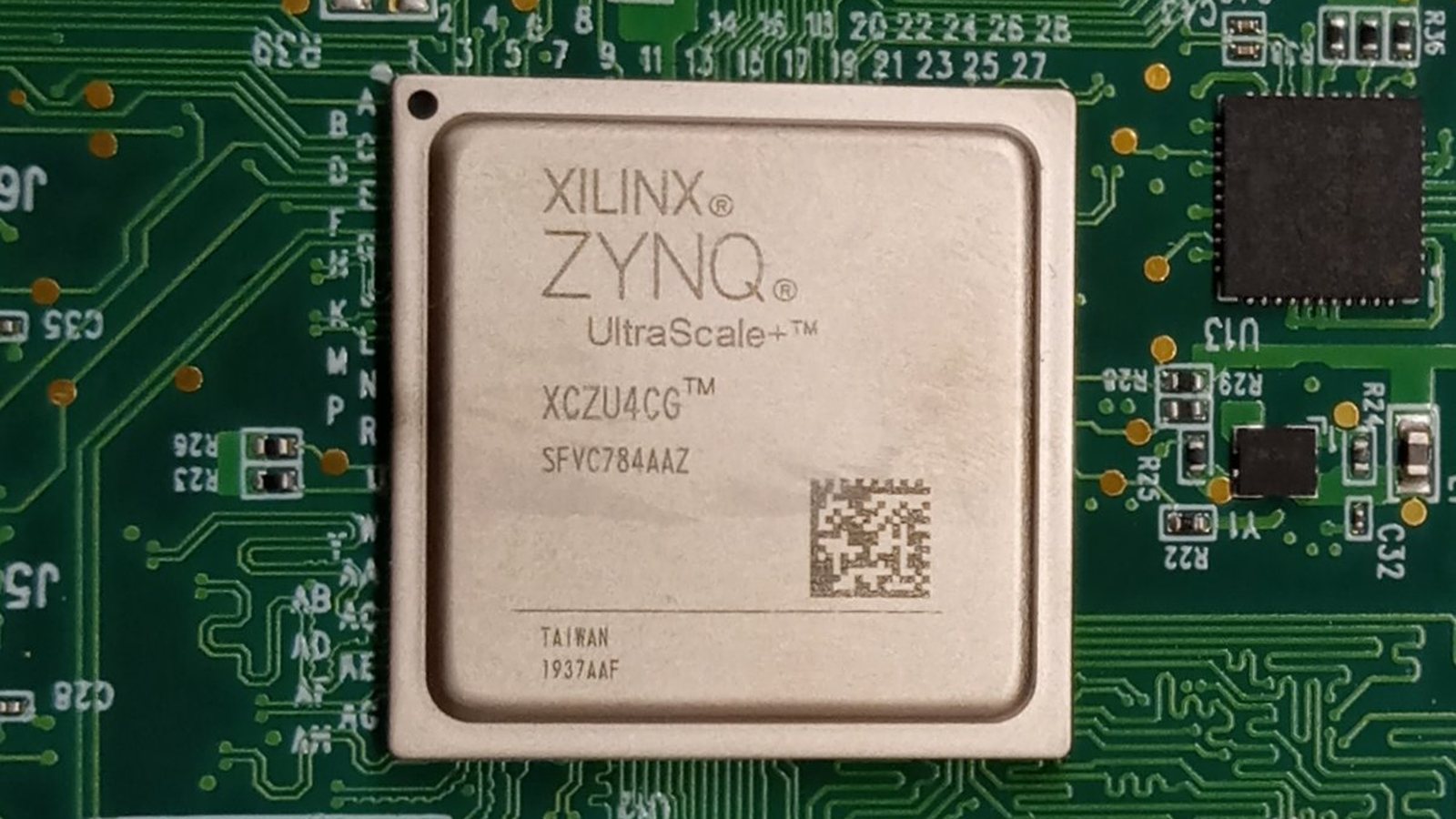
The hardware is an AMD Kria KV260 board. Its Zynq UltraScale+ chip pairs programmable logic with a small processor. The paper is candid that the grid doesn’t fit on the chip itself.
It sits in the board’s memory, about 75 MB of it, and streams through one copy of the rule cell by cell. Each tick takes about a tenth of a second.
“The device is thus the chip together with the memory and converters of its board,” Flachi writes. That matters less than it sounds, because the physics still runs in logic gates rather than software. He probed it the way an engineer tests any circuit: a signal generator fed voltages in, and an oscilloscope read them out.
He measured five things. The horizon settled at a radius of 114.29 cells. It then held to one part in 10,000 for about 110,000 ticks, roughly three hours on the oscilloscope.
Struck with a pulse, the hole rang down in decaying tones. Gravitational-wave detectors hear the same kind of ringing after real black holes merge. The chip’s tones matched a 64-bit computer model of the system to within 1%.
The rotating hole also showed superradiance. A wave turning with the swirl came back carrying extra energy taken from the flow. The hole absorbed waves turning the other way, and so did a non-rotating copy. The measured gain was 0.31 on the oscilloscope, the board’s own record and the computer model alike.
Why one flipped bit got out
The circuit is perfectly deterministic, which allows something no water tank can do. Flachi ran it twice from the same state, flipping one bit between the runs. Subtracting one run from the other left only the disturbance that bit caused, tracked exactly.
When the bit sat outside the horizon, its ripple spread both ways. When it sat inside, the flow swept the bulk of the ripple inward and it never reached the outside. A sliver did, though, and it came out as short waves.
The reason is that the grid is not a smooth fluid. On scales of a few cells, short ripples in this rule travel faster than long ones. The fastest can outrun the inflow near the horizon.
Of what first arrived well outside the horizon, 83% of the power sat at short wavelengths. Inside the horizon, 90% of it was at long ones.
The leak also faded fast with depth. On the chip, the escaping share fell by a factor of about 2.7 for every 3.1 cells deeper along the grid’s axes. Along the diagonals it fell that much every 1.9 cells.
So the horizon is sharp for long waves and leaky for short ones, by an amount that depends on direction. Flachi says both effects follow from the rule’s math “with nothing fitted.”
What this says about real black holes, and what it doesn’t
It says nothing about matter, light or information escaping a black hole in space. The leak comes from the grain of the grid. A real event horizon in Einstein’s general relativity has no such grain, at least none anyone has measured.
The link is subtler. Since the mid-1990s, physicists have asked whether a horizon’s behavior depends on physics at tiny distances.
Flachi cites a 1996 paper by Steven Corley and Ted Jacobson on horizons in a medium where short waves outrun long ones. The question matters for Hawking radiation, the faint glow Stephen Hawking predicted in 1974. Its derivation leans on waves squeezed to ever-shorter wavelengths near the horizon.
Flachi’s chip did not look for Hawking radiation. What it offers is a horizon whose smallest scale is known exactly, because the rule defines it. He calls the leak a known theoretical signature “here measured directly.”
As with false vacuum decay, the headline version and the paper’s version are different claims. The paper’s is smaller and better supported.
A rewritable lab, and what to check next
The practical pitch is flexibility. Rewriting stored bits changes the hole’s shape, rotation and friction. Changing the physics rule itself takes “a few hundred lines of logic,” Flachi writes, with no new tank to build.
FPGAs are a different kind of chip from the AI accelerators in our explainer on laptop NPUs, but both are hardware built to run one job fast. AMD sells the KV260 as a starter kit for developers.
There are limits worth stating. The paper has one author and no outside review yet. The grid is too small to show the hole ringing on its own. Its tones belong to the hole and its surrounding box together.
The paper also discloses that AI tools helped with simulation code, data analysis, plotting and language editing. Flachi has posted all the underlying data publicly on Zenodo, and the figures are plotted from it.
A companion paper with the theory behind the rule, “Shallow-water black holes and lattice superradiance”, went up the same day. Next, Flachi sketches a three-dimensional hole, which he says “costs only memory and logic.” He also proposes a simpler rule that could run in every cell at once.