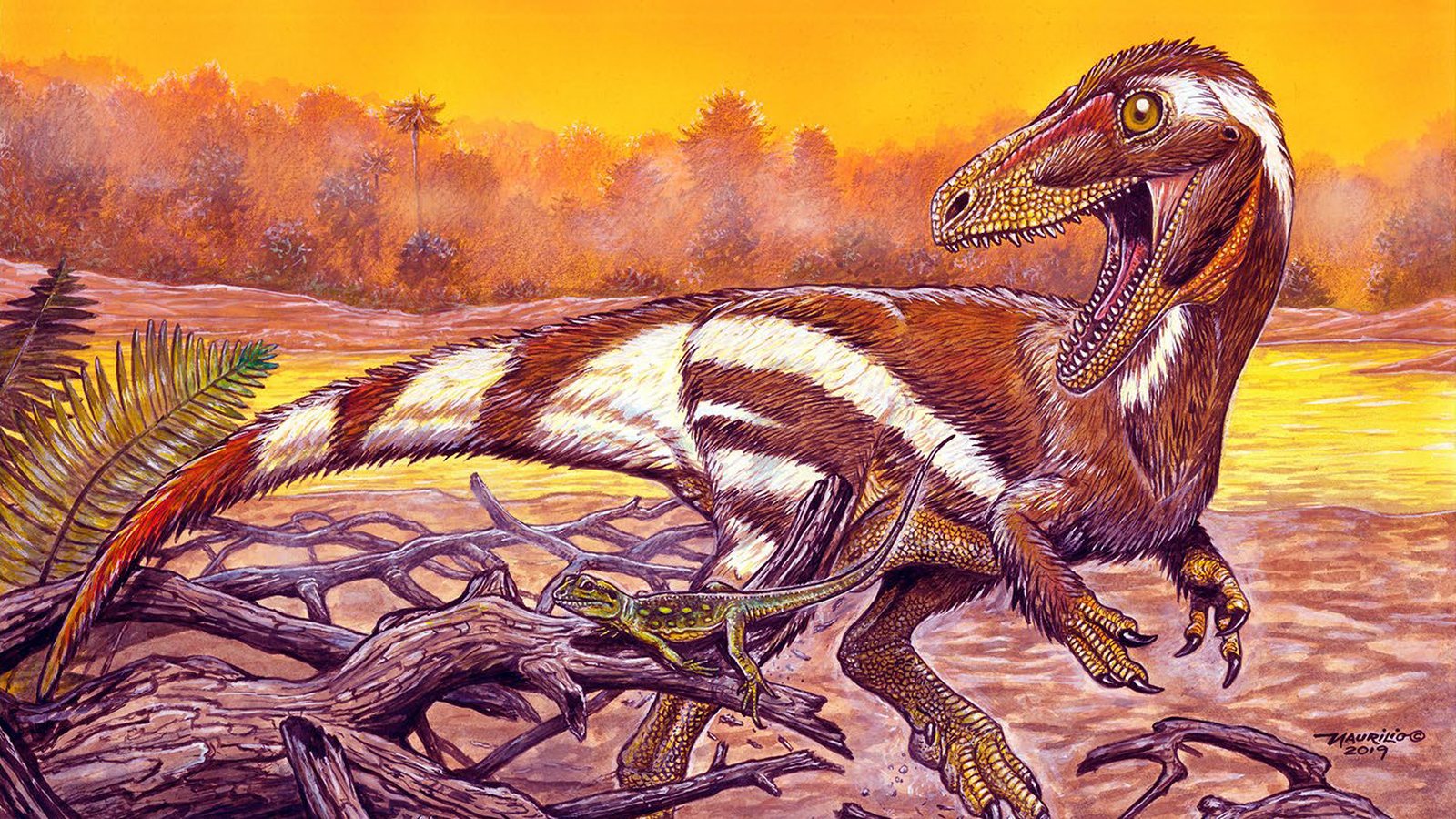
Scientists say they have found dinosaur red blood cells in the leg bones of a 115-million-year-old meat-eater from north-eastern Brazil. The cells are mineralised, but they still carry chemical traces of heme, the team led by Curtin University geochemist Kliti Grice reports in the Proceedings of the National Academy of Sciences on November 2.
Reuters called it the strongest evidence yet of blood cells in a dinosaur fossil. Mary Schweitzer, whose 2005 T. rex soft-tissue find started two decades of debate, doesn’t think the structures are red blood cells at all.
The stakes go beyond one fossil. Heme tied to specific structures would give researchers a chemical route into questions bones can’t answer, such as how dinosaur blood worked. Grice herself keeps the claim narrow. “We have not found a vial of dinosaur blood,” she told Reuters.
What the team found inside Aratasaurus’s leg
Aratasaurus museunacionali is a small theropod first described in 2020 in Scientific Reports. Researchers know it from one partial right hind limb. It came from Mina Pedra Branca, a gypsum quarry near Santana do Cariri in Ceará state, in the lower Romualdo Formation.
The 2020 paper put the animal at about 3.1 metres long and 34 kilograms. It was at least four years old and still growing when it died. The Guardian’s Ian Sample reports that the fossil turned up in a mine in 2008.
The new paper describes ellipsoid structures inside the bone’s vascular canals, the channels where blood vessels once ran. They average about 23 by 20 micrometres, Sci.News reported.
The case rests on chemistry in three layers. First, mass spectrometry found that heme B and altered forms of it were the main pigment molecules in the bone. Heme is the iron-holding core of haemoglobin, the protein that carries oxygen and makes blood red.
The rock around the bone held different pigments: chlorophyll and bacterial chlorophyll, from plants and microbes. The authors read that contrast as a sign the heme came from the animal itself.
Second, Raman spectroscopy placed heme signals inside the ellipsoids. Third, electron microscopy found iron, nitrogen and carbon, heme’s key elements, in the same structures. A manganese oxide mineral called hausmannite sat alongside them.
“To the best of our knowledge, that combination has not previously been demonstrated in a dinosaur fossil,” Grice told Reuters.
Why cells shouldn’t survive 115 million years
When an animal dies, its cells burst. Its own enzymes and bacteria then digest the proteins, while water and oxygen attack the rest. The PNAS paper opens on the problem: fragile compounds “degrade quickly and are highly susceptible to contamination.”
DNA shows how fast that clock runs. A 2012 study of 158 dated moa bones estimated a half-life of 521 years for a short stretch of DNA. By our arithmetic, 115 million years equals more than 220,000 of those half-lives, which leaves nothing.
Sure enough, the team’s ancient DNA tests came back negative, the ABC reported. Large molecules like DNA “have very different preservation characteristics,” Grice told Reuters.
The authors credit speed and chemistry for what did survive. They point to rapid burial in a low-oxygen, microbe-rich setting. A microbial mat “probably helped enormously with this preservation,” Grice told the ABC. In a piece she wrote for The Conversation, she adds that hausmannite “can act a bit like antioxidants.”
That idea has a precedent. In 2014, Schweitzer’s group found iron particles bound up with soft tissue from two dinosaurs. In their lab tests, haemoglobin kept ostrich blood vessels intact for more than two years, against about three days without it.
Twenty years of dinosaur blood claims, and what each one had
We read the earlier papers side by side to see what is new this time. In 2005, Schweitzer’s team reported in Science on a Tyrannosaurus rex leg bone. Once they dissolved the mineral, flexible blood vessels remained, holding “small round microstructures.”
In 2008, Thomas Kaye and colleagues pushed back in PLoS ONE. They argued that such tissues were bacterial biofilms, and that the cell-sized spheres were oxidised pyrite, a mineral. Carbon dating pointed to a modern origin for the film.
In 2015, a team at Imperial College London reported “putative erythrocyte remains” in eight ordinary dinosaur bones in Nature Communications. Their chemical spectra resembled emu blood. “We still need to do more research,” co-author Sergio Bertazzo said in Imperial’s release.
Then a 2021 PeerJ study re-examined Beipiaosaurus, another dinosaur said to hold fossil blood cells. It found clay minerals filling the canals and no heme anywhere. Its verdict: the red spheres most likely formed from minerals during fossilisation.
The pattern is clear. Earlier claims leaned mostly on shape, and their chemistry came from bulk samples or wasn’t found at all. The Aratasaurus paper argues from location: heme inside the structures, and different from the rock around them.
That is exactly the evidence the Beipiaosaurus team looked for and failed to find. New tools reading old material have changed other fields too, from fingerprints on the Terracotta Army to a 4.1-billion-year-old Martian meteorite.
Shape is still the sticking point
The chemistry has mostly won over the critics. The cells have not. “I have no problem with the presence of heme and collagen in the bone matrix,” Schweitzer, an emeritus professor at North Carolina State University, told the ABC.
Her objection is shape. A dinosaur’s red blood cells should have a “nuclear bulge” on both sides, The Guardian reports, but the Aratasaurus structures are concave. In one image, a “cell” appeared to be about 15 micrometres across, she told the ABC. “This is smaller than almost all non-mammalian red blood cells, which are larger because of the retained nucleus,” she said.
That is below the 23-micrometre average Sci.News reported, and we could not read the full paper to reconcile the two.
Mauricio Barbi, an outside researcher at the University of Regina, told the ABC the structures look consistent with red blood cells. But “their identification still involves some interpretation,” he said. “We are not talking about intact blood cells or preserved haemoglobin.”
In The Conversation, Grice concedes that the structures look “a bit larger and more rounded” than bird red blood cells. Fossilisation may have distorted them, or dinosaur cells differed. “We’ll need further research to resolve this question,” she writes.
Schweitzer still sees the trend favouring finds like this: the old view that organic molecules vanish within a million years “is being routinely challenged,” she told The Guardian. Grice sets the same bar we applied to a startup’s claim to have turned mercury into gold. “Any extraordinary claim needs extraordinary analytical evidence,” she said.
Her next step is museum drawers. Modern tools “can revisit specimens collected decades ago,” she writes. The result to watch is an independent lab finding heme inside cell-shaped structures in another dinosaur, in a shape that fits a red blood cell with a nucleus.