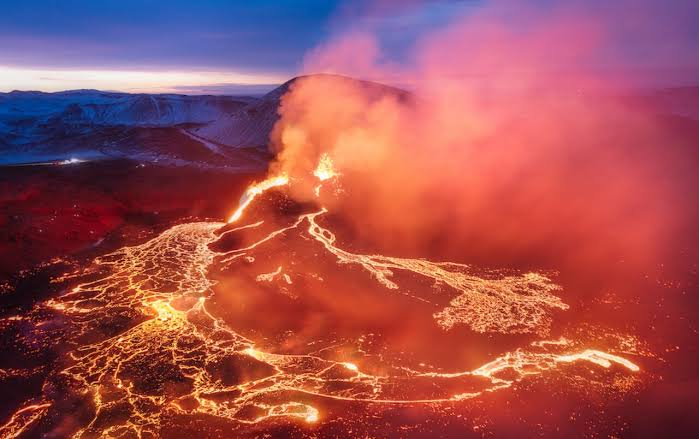
A new study has reignited debate over one of geology’s most controversial ideas: that Earth’s biggest catastrophes—including mass extinctions, asteroid impacts, and massive volcanic eruptions—may occur on a surprisingly regular schedule.
Published in the journal Evolving Earth, the research argues that many of the planet’s most significant geological and biological upheavals follow a recurring 27-million-year cycle. The study’s author, geologist Michael Rampino of New York University, suggests the pattern could be linked to processes inside Earth, the solar system’s movement through the Milky Way, or a combination of both.
While the findings are intriguing, many scientists remain sceptical, noting that the proposed mechanisms—particularly those involving dark matter—remain speculative and lack strong observational evidence.
TL;DR
- A new study suggests Earth’s largest geological disasters may recur roughly every 27 million years.
- The research analysed 89 major geological events over the past 260 million years.
- Events examined include mass extinctions, asteroid impacts, volcanic eruptions, earthquakes, and oceanic changes.
- The author proposes links between Earth’s interior, the solar system’s orbit through the Milky Way, and even dark matter.
- Many experts consider the hypothesis controversial because it has not been conclusively demonstrated.
What is the 27-million-year disaster cycle?
The study argues that Earth’s history exhibits a recurring pattern in which some of its most dramatic geological and biological events cluster at approximately 27-million-year intervals.
According to Rampino, the timing of numerous major events appears too regular to be entirely random.
The research analyzed 89 geological and environmental events spanning roughly 260 million years, including:
- Mass extinction events
- Major asteroid impacts
- Large volcanic eruptions
- Earthquake episodes
- Sea-level fluctuations
- Ocean oxygen depletion
- Changes in seafloor spreading
The study concludes that many of these events align with recurring geological cycles, although the underlying cause remains uncertain.
What evidence does the study present?
Rather than focusing on a single type of catastrophe, the study compares the ages of multiple geological events to identify recurring patterns.
Researchers found possible timing similarities in:
- Large igneous provinces formed by massive volcanic eruptions
- Periods of widespread biological extinction
- Significant asteroid impacts
- Global environmental changes
Rampino also proposes that Earth may experience additional periodic cycles, including:
- A shorter cycle of approximately 8.9 million years
- A much longer cycle approaching 270 million years
These overlapping cycles, he argues, may influence Earth’s geological history in different ways.
What could cause these recurring disasters?
The study explores several possible explanations, ranging from Earth’s internal geology to astronomical influences.
Importantly, these are hypotheses, not established scientific conclusions.
1. Activity inside Earth’s mantle
One possibility involves slow-moving convection within Earth’s semi-molten mantle.
Changes in mantle circulation could trigger:
- Massive volcanic eruptions
- Continental movement
- Earthquakes
- Changes in ocean basins
Because mantle processes unfold over millions of years, some researchers have long explored whether they exhibit recurring cycles.
2. The Solar System’s journey through the Milky Way
Rampino also examines whether Earth’s geological history is influenced by the Solar System’s movement through our galaxy.
As the Solar System orbits the Milky Way, it periodically passes through the galaxy’s central plane.
According to the study, these crossings could gravitationally disturb distant icy bodies in the Oort Cloud, increasing the likelihood of comets entering the inner Solar System and potentially striking Earth.
Previous researchers have proposed similar ideas, although the evidence remains debated.
3. A controversial dark matter hypothesis
Perhaps the study’s most speculative proposal involves dark matter, the invisible substance believed to make up much of the universe’s mass.
Rampino suggests that during certain parts of the Solar System’s galactic orbit, Earth could encounter regions with higher concentrations of dark matter.
In theory, dark matter particles could accumulate inside Earth’s core and release energy through interactions, increasing internal heat and triggering geological activity.
However, there is currently no direct evidence that such a process occurs.
Most physicists view this idea as highly speculative because the nature of dark matter remains one of modern science’s greatest unsolved mysteries.
Has this theory been proposed before?
Yes.
The concept of periodic mass extinctions gained attention during the 1980s, when researchers suggested Earth’s extinction events might occur at regular intervals.
Those early studies sparked considerable interest but also significant criticism.
Subsequent analyses have produced mixed results, with some identifying apparent periodicities while others concluded the observed patterns could arise from statistical coincidence or uncertainties in dating ancient geological events.
The new study revisits the hypothesis using updated geological datasets.
Why do many scientists remain sceptical?
Although recurring patterns can be intriguing, identifying a statistical pattern does not necessarily establish a physical cause.
Several questions remain unresolved.
Key concerns include the following:
- Geological dating contains uncertainties spanning millions of years.
- Not all extinction events fit the proposed cycle.
- Different statistical methods can produce different conclusions.
- Proposed mechanisms involving galactic motion and dark matter remain unproven.
Even Rampino acknowledges that the hypothesis is controversial and that additional evidence will be required to test it.
Independent studies using improved dating techniques and larger geological datasets will be necessary to determine whether the proposed cycle reflects a genuine natural phenomenon.
Does this mean Earth faces an imminent catastrophe?
No.
The study does not predict that a global disaster is about to occur.
Instead, it argues that Earth may be approaching another phase within a long-term geological cycle.
According to Rampino, the Solar System last crossed the Milky Way’s central plane approximately 3 to 4 million years ago, with the next crossing expected in roughly 2 million years.
These timescales are vastly longer than human civilisation has existed and should not be interpreted as forecasts of imminent global catastrophe.
Why the research matters
Whether or not the 27-million-year cycle ultimately withstands scientific scrutiny, the study highlights an important area of research: understanding how Earth’s geological evolution may interact with processes occurring elsewhere in the Solar System and the galaxy.
It also underscores the value of combining geology, astronomy, and palaeontology to investigate Earth’s deep history.
Future observations, improved geological dating methods, and advances in astrophysics may help determine whether these apparent cycles reflect genuine natural processes or statistical coincidences.
For now, the proposed 27-million-year cycle remains an intriguing, but unconfirmed, hypothesis rather than an accepted scientific consensus.