TL;DR
Hubble has captured a striking new photo of 3I/ATLAS—the third confirmed interstellar object to visit our solar system—revealing a massive teardrop-shaped halo and an unusual “anti-tail” stretching sunward. Harvard astrophysicist Avi Loeb says this feature may be caused by a swarm of macroscopic objects accelerated away from the Sun. The comet is fast, ancient, and heading for its closest approach to Earth in December 2025.
What Makes 3I/ATLAS Different From Any Other Comet?
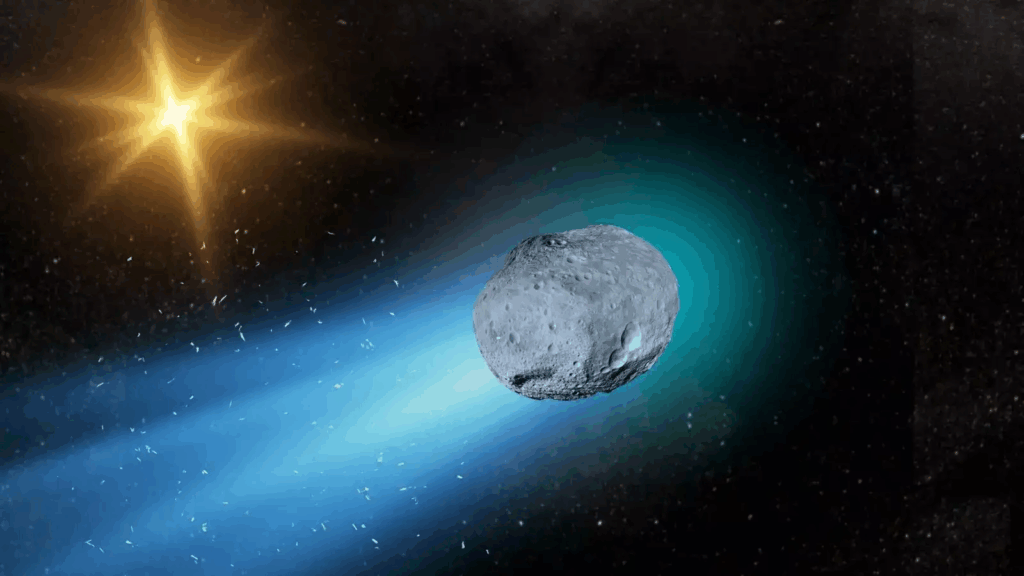
Hubble’s newest image of 3I/ATLAS shows something that immediately sets it apart from typical comets: a glowing teardrop-shaped halo pointing toward the Sun, not away from it. That’s unusual because comet tails normally extend away from the Sun due to solar radiation and the solar wind.
This “anti-tail” extends roughly 60,000 kilometers, with a coma radius of about 40,000 kilometers, according to Harvard astronomer Avi Loeb, who has been following the object since its discovery. The timing is notable; Hubble captured the photo on November 30 from 286 million kilometers away, about a month after the comet’s closest pass by the Sun.
Why Is 3I/ATLAS Showing a Sunward Glow?
Loeb’s explanation is not your typical comet science. He argues the feature is caused by non-volatile, macroscopic objects—think a swarm of pebble-sized or larger pieces—not the gas and dust normally blown off a comet’s nucleus.
Loeb’s Theory in Brief
- These objects may have been pushed away from the Sun by non-gravitational forces.
- This creates a concentrated stream of material stretching toward the Sun, the opposite of a standard dust tail.
- Loeb says he predicted this very structure earlier in the year, noting that the 60,000-kilometer extension matches his July estimate almost exactly.
If true, this would suggest that 3I/ATLAS is shedding material in a fundamentally different way than comets born inside the solar system.
Did 3I/ATLAS Drop “Mini-Probes” Near Jupiter?
Another eyebrow-raising detail: Loeb has also suggested the object might release small bodies near Jupiter.
3I/ATLAS is expected to pass close to the giant planet’s Hill sphere, its zone of gravitational influence. Loeb argues this creates the ideal conditions for fragments—if they exist—to get trapped by Jupiter’s gravity.
Why This Matters
- It’s extremely rare for an interstellar object to interact with a planet this way.
- Captured fragments could linger in the Jupiter system for years or centuries.
- These mini objects, if found, would give scientists a unique opportunity to study material from outside the solar system without mounting a deep-space mission.
Wait—Why Was It Once Called a Potential “Mothership”?
Loeb has never been shy about exploring unconventional hypotheses. Early in 3I/ATLAS’ discovery, he floated the idea that it could be an artificial craft—a “mothership” releasing probes to explore the solar system.
To be clear:
- There is no evidence supporting an alien origin.
- Most scientists consider 3I/ATLAS a natural comet.
- Loeb’s speculation stems from him exploring the widest possible range of explanations, a pattern familiar to anyone who followed the debate around the earlier interstellar object ʻOumuamua.
What Did the European Space Agency Capture?
Before the Hubble release, the European Space Agency shared an early image from its Juice spacecraft as it traveled toward Jupiter.
Even from afar and with partial data, Juice showed that:
- 3I/ATLAS was highly active after its close pass by the Sun.
- The halo of material was thicker and brighter than expected.
Because Juice is headed to study Jupiter’s icy moons, its incidental capture of an interstellar comet was an unexpected bonus for researchers.
How Old, How Fast, and How Close Will 3I/ATLAS Get?
Interstellar objects don’t come with a passport, but scientists estimate 3I/ATLAS is between 7 and 14 billion years old—older than our solar system and possibly older than the Milky Way’s current structure.
The Speed Factor
When detected, it was moving at about 60 km/second, fast enough to cross the continental United States in under a minute. Its trajectory is hyperbolic, meaning it’s not bound to the Sun and will never return after passing through.
As it swung past Mars and reached its perihelion (its closest point to the Sun), its speed and direction shifted slightly due to gravitational interactions.
When to See It
The comet reaches its closest approach to Earth on December 19, 2025.
While it won’t be a naked-eye spectacle for most people, skywatchers can track it using:
- Binoculars
- A backyard telescope
- Online tracking tools (link out here to a NASA tracker or a reputable astronomy site)
Why 3I/ATLAS Matters—Even If It’s Just a Comet
Interstellar objects are rare—only two confirmed visitors before this one:
- ʻOumuamua in 2017
- Comet 2I/Borisov in 2019
Studying them helps astronomers:
- Understand how other star systems form and evolve.
- Compare foreign comet chemistry with our own.
- Test theories about non-gravitational dynamics and radiation pressure.
- Explore whether fragments from other planetary systems routinely pass through ours unnoticed.
Whether or not Loeb’s more speculative ideas hold up, 3I/ATLAS gives scientists a once-in-a-generation chance to study a traveler from beyond our solar neighborhood.