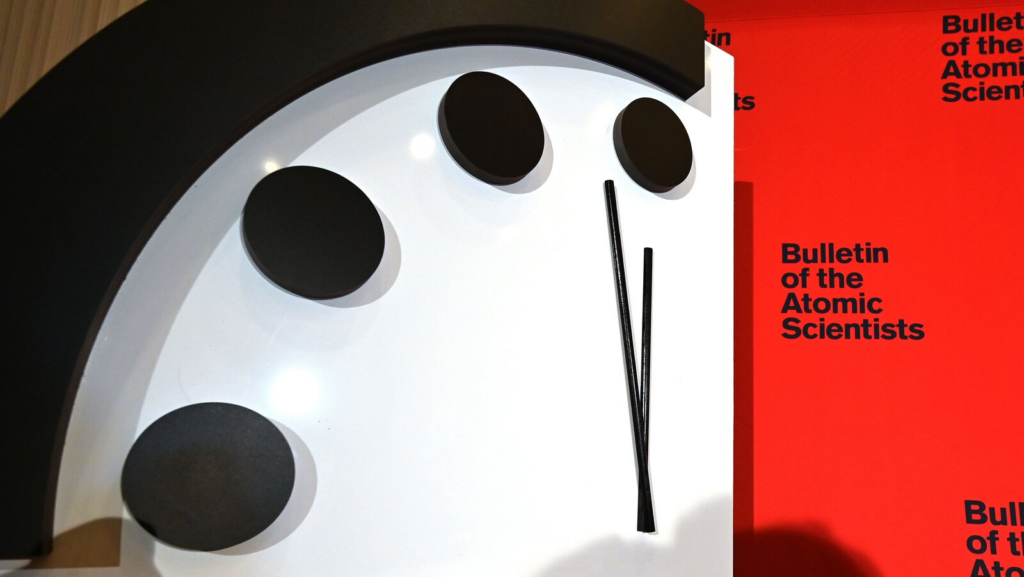
Is the world edging closer to self-destruction, or is the Doomsday Clock meant to shock us into paying attention rather than predicting the end? On January 27, the Bulletin of the Atomic Scientists will update its iconic clock, a symbolic measure of how close humanity is to a human-made catastrophe. The announcement, to be livestreamed at 3 pm GMT, comes at a moment when nuclear tensions, rapid advances in artificial intelligence, and unresolved global conflicts are converging in unsettling ways.
The clock currently stands at 89 seconds to midnight, the closest it has ever been. Whether it moves forward, stays put, or retreats slightly, the update is less about counting seconds and more about forcing a difficult conversation: how much risk is the world willing to tolerate?
What is the Doomsday Clock, and why does it matter?
The Doomsday Clock is not a scientific instrument. It does not forecast disasters or calculate probabilities. Instead, it is a metaphor created to communicate risk in a way that cuts through technical language and reaches the public.
The clock was introduced in 1947 by the Bulletin of the Atomic Scientists, a group founded by researchers involved in the Manhattan Project. Their concern was simple but profound: the same scientific breakthroughs that ended World War II could also end civilization if misused.
Key points about the clock’s purpose include:
- It measures threats created by human activity, not natural disasters
- Midnight represents a global catastrophe, originally nuclear war
- Time is adjusted by the Bulletin’s Science and Security Board, with input from Nobel laureates and policy experts
Over the decades, the clock has evolved. While nuclear weapons remain central, other risks such as climate change, emerging technologies, and biological threats now factor into the decision.
Why is the January 27 update drawing global attention?
This year’s update carries unusual weight because the clock is already closer to midnight than at any point during the Cold War. In past decades, even moments of extreme tension, such as the Cuban Missile Crisis, did not push it this far.
Several developments have sharpened attention ahead of the announcement:
- Persistent nuclear rhetoric linked to ongoing wars
- The lack of progress on arms control agreements
- The rapid integration of artificial intelligence into military and strategic systems
According to reporting by outlets such as the Daily Mail, some experts expect the clock to move forward, possibly by one second or more. Even a small shift would be symbolically significant, reinforcing the idea that risks are compounding rather than easing.
How nuclear weapons continue to shape the clock’s warning
Nuclear risk remains the single largest factor influencing the Doomsday Clock. Despite decades of non-proliferation efforts, the world still possesses more than 12,000 nuclear warheads, many of them on high alert.
In the past year, nuclear concerns have intensified due to:
- Escalating rhetoric among nuclear-armed states
- Increased investment in modernizing nuclear arsenals
- The erosion of arms control frameworks
Alicia Sanders-Zakre, head of policy at the International Campaign to Abolish Nuclear Weapons, has argued that the situation has deteriorated due to what she describes as skyrocketing investments in nuclear arms. Her view reflects a broader concern that modernization efforts may lower the threshold for use rather than enhance deterrence.
Dr. SJ Beard, a researcher at the University of Cambridge’s Centre for the Study of Existential Risk, has gone further, suggesting the clock could move forward by several seconds because of the growing risk of conflict between major powers.
What role do current wars and geopolitical tensions play?
The Doomsday Clock does not react to a single conflict in isolation. Instead, it reflects the overall stability of the international system.
Right now, that system appears fragile. The Russia-Ukraine war shows no clear path to resolution. Tensions between Iran and Israel remain high, with periodic escalations raising fears of a wider regional conflict. At the same time, disputes involving major powers risk drawing in allies and amplifying consequences.
Even seemingly unrelated issues can contribute to risk. Discussions around strategic territories and military posturing, including renewed debates over regions such as Greenland, feed into a broader climate of distrust and brinkmanship.
The concern is not that one event will trigger catastrophe on its own, but that overlapping crises reduce the margin for error. In such an environment, miscalculation becomes more likely.
How artificial intelligence is changing existential risk calculations
Artificial intelligence is a newer addition to the Doomsday Clock’s considerations, but it is rapidly becoming central to the discussion.
Experts worry about AI for several reasons:
- AI-driven decision systems can accelerate military responses beyond human control
- Automated systems may misinterpret data, leading to unintended escalation
- AI tools could lower barriers to developing biological or cyber weapons
Unlike nuclear weapons, AI development is largely decentralized. Governments, private companies, and individuals all contribute, often without clear oversight. This makes regulation difficult and coordination uneven.
The Bulletin of the Atomic Scientists has repeatedly warned that AI does not just add another risk. It amplifies existing ones by increasing speed, complexity, and opacity in decision-making.
Is the clock predicting the end of humanity?
Despite dramatic headlines, the Doomsday Clock is not a countdown to extinction. Its creators have always stressed that it is a call to action, not a prophecy.
When the clock moves closer to midnight, it signals that experts believe:
- Global cooperation is weakening
- Risk-reduction measures are insufficient
- The balance between technological power and ethical restraint is tipping
Importantly, the clock has moved backward before. Periods of arms reduction, diplomatic breakthroughs, and international cooperation have all resulted in more optimistic settings.
This underscores a crucial point: the clock reflects choices, not fate.
Why the Doomsday Clock still resonates in 2026
Some critics argue that the clock oversimplifies complex issues. Others say it relies too heavily on subjective judgment. Yet its staying power suggests it fulfills a role few other tools can.
The clock works because it:
- Translates abstract risk into an easily understood image
- Forces public discussion beyond expert circles
- Creates accountability by revisiting the same question each year
In an age of information overload, the simplicity of the clock is its strength. It cuts through noise and asks a stark question: are we making the world safer, or more dangerous?
What happens after the update?
Once the time is announced, the real work begins. The Bulletin typically releases a detailed statement explaining the reasoning behind the decision, outlining specific risks and policy failures.
These statements often emphasize:
- The need for renewed arms control talks
- Stronger international cooperation on climate and technology
- Public engagement to pressure leaders toward risk reduction
Whether the clock moves forward or not, experts stress that complacency is the real danger. Stability is not achieved by accident. It requires deliberate choices and sustained effort.
TL;DR
- The Doomsday Clock will be updated on January 27 and livestreamed globally
- It currently stands at 89 seconds to midnight, the closest ever
- Nuclear weapons, ongoing wars, and artificial intelligence are key factors
- Experts warn risks are growing due to arms buildup and rapid tech adoption
- The clock is a warning, not a prediction, and can move back with action