
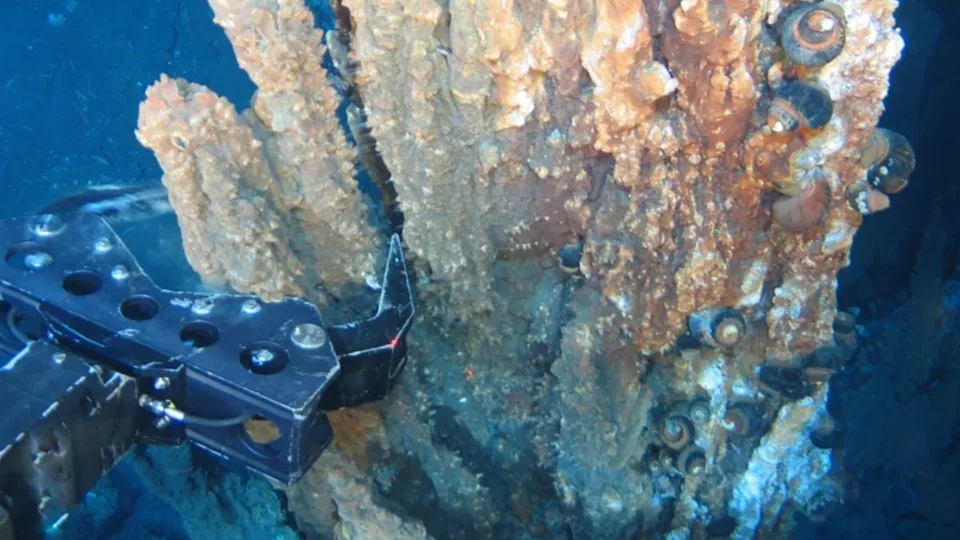
Japanese researchers have uncovered what may be one of the richest hidden gold deposits ever identified beneath the ocean floor. The discovery was made at hydrothermal vents inside the Higashi-Aogashima caldera, about 350 kilometers (217 miles) south of Tokyo, where scientists found exceptionally high concentrations of “invisible gold” locked inside the mineral pyrite.
Unlike traditional gold deposits, this gold cannot be seen with the naked eye or even under a standard microscope. Instead, it exists as microscopic nanoparticles and individual atoms embedded within mineral crystals. The finding has renewed interest in deep-sea mineral resources while also raising questions about balancing future mining opportunities with the protection of fragile marine ecosystems.
What is the ‘invisible gold’ discovered beneath the seafloor?
The newly identified gold is not present as visible nuggets or veins.
Instead, researchers found gold trapped inside pyrite—a sulfide mineral commonly known as “fool’s gold” because of its metallic appearance.
The gold exists in two forms:
- Tiny gold nanoparticles dispersed within the pyrite.
- Individual gold atoms embedded directly into the mineral’s crystal structure.
Because these particles are so small, they are effectively invisible without highly specialized scientific instruments.
Where was the discovery made?
The discovery comes from the Higashi-Aogashima hydrothermal vent field, located within Japan’s Exclusive Economic Zone in the Philippine Sea.
The underwater volcanic system was first identified in 2015.
Researchers from:
- Shizuoka University
- Waseda University
- The University of Tokyo
analyzed rock samples collected from active hydrothermal vents and black smoker chimneys within the caldera.
The area remains relatively unexplored, and scientists are still studying the unique ecosystems that inhabit the vent field.
What are hydrothermal vents?
Hydrothermal vents are underwater openings where seawater seeps into Earth’s crust, becomes heated by magma, dissolves minerals from surrounding rocks, and then rises back to the seafloor.
As the superheated, mineral-rich fluids cool upon contact with seawater, they deposit metals that gradually build structures known as:
- Black smoker chimneys
- Hydrothermal mounds
- Massive sulfide deposits
These environments are rich in metals such as:
- Gold
- Silver
- Copper
- Zinc
- Iron
Hydrothermal vents also support unique ecosystems that survive without sunlight by relying on chemical energy.
How did scientists detect the Invisible Gold
The research team used a technique called Secondary Ion Mass Spectrometry (SIMS).
SIMS is capable of detecting extremely small amounts of elements within minerals at microscopic scales.
Using this technology, researchers discovered gold concentrations inside pyrite that they describe as the highest yet recorded in hydrothermal vent deposits worldwide.
Without advanced analytical equipment, the deposits would appear to contain little or no gold.
Why is pyrite called ‘fool’s gold’?
Pyrite has long been nicknamed “fool’s gold” because its shiny metallic appearance resembles genuine gold.
However, the two minerals differ significantly.
| Pyrite | Gold |
|---|---|
| Iron sulfide mineral | Pure metallic element |
| Brittle | Highly malleable |
| Less dense | Very dense |
| Often worthless as jewelry | Highly valuable |
Ironically, researchers found that this pyrite actually contains genuine gold hidden within its crystal structure.
Could this discovery lead to underwater gold mining?
Potentially—but not anytime soon.
Researchers note that the Higashi-Aogashima vent field is relatively shallow compared with several other deep-sea mineral deposits being studied in Japan.
That could make future extraction more technically feasible.
However, several major obstacles remain:
- No commercially viable method currently exists to efficiently extract invisible gold from pyrite at large scale.
- Deep-sea mining remains technologically challenging and expensive.
- Environmental concerns surrounding hydrothermal vent ecosystems remain unresolved.
Scientists emphasize that further research is needed before any commercial development could occur.
Why are scientists urging caution?
The discovery comes as international debate continues over deep-sea mining.
Hydrothermal vents support some of Earth’s most unusual biological communities, including organisms that rely on chemical energy instead of sunlight.
Many researchers argue these ecosystems should be carefully studied before industrial mining begins.
Concerns include:
- Habitat destruction.
- Loss of undiscovered marine species.
- Disruption of unique ecosystems.
- Long-term environmental impacts that remain poorly understood.
The researchers involved in the study have highlighted the need to balance resource exploration with environmental protection.
Why this discovery matters
Beyond its economic potential, the finding improves scientists’ understanding of how valuable metals accumulate beneath the seafloor.
The study also demonstrates that important mineral deposits may exist in forms invisible to conventional exploration methods.
As analytical technologies continue improving, researchers may discover similar hidden metal deposits elsewhere in Earth’s oceans.
For now, the Higashi-Aogashima vent field represents both a scientific breakthrough and a reminder of how much remains unknown about the deep ocean.
TL;DR
- Japanese researchers discovered record concentrations of “invisible gold” inside pyrite at hydrothermal vents south of Tokyo.
- The gold exists as microscopic nanoparticles and individual atoms rather than visible nuggets.
- Scientists detected the deposits using Secondary Ion Mass Spectrometry (SIMS).
- The Higashi-Aogashima hydrothermal vent field could become a future mining candidate, although no economical extraction method currently exists.
- Researchers also emphasize the importance of protecting fragile deep-sea ecosystems before commercial mining is considered.