Thirteen thousand years ago, North America was home to giant Ice Age mammals, sprawling grasslands, and a thriving hunter-gatherer society known as the Clovis people. Within a shockingly short geological window, both the megafauna and this early human culture disappeared from the continent. For decades, scientists believed shifting climate patterns at the end of the last Ice Age were largely responsible.
But emerging research suggests the story is far more dramatic and far more violent. According to new evidence, a cosmic explosion triggered a sudden global cooling event, setting off a chain reaction that reshaped Earth’s climate, wiped out iconic species like the woolly mammoth, and caused the mysterious vanishing of the Clovis culture.
This research centres on a catastrophic event at the onset of the Younger Dryas, a millennium-long return to near-glacial conditions after the planet had just begun to warm. The idea: a fragmented comet exploded in Earth’s atmosphere, generating intense heat, shockwaves, fires, and a climate-altering dust cloud. Below, we break down the science, the archaeological evidence, and the ongoing debate about whether a cosmic disaster truly “reset” life in ancient North America.
What happened 13,000 years ago, and why did Earth suddenly plunge back into cold?
At the end of the Last Glacial Period, the planet was slowly warming. Ice sheets were retreating, plant life was expanding, and megafaunal species roamed vast territories. Then, almost instantly in geological terms, global temperatures reversed course.
Earth entered the Younger Dryas—a thousand-year cold snap marked by severe environmental disruption. The abrupt freeze has long puzzled scientists: it was too sudden to be explained solely by natural climate cycles.
Researchers behind a recent study published in PLOS One argue that a cosmic event provides the missing piece.
A comet that shattered before impact
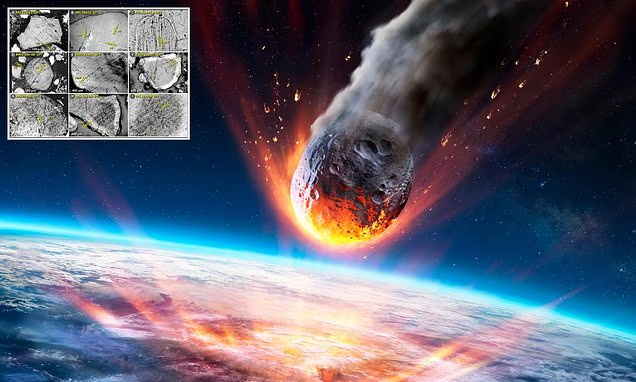
The theory proposes that a large comet broke apart as it entered Earth’s atmosphere. Instead of a single crater-forming strike, the fragments detonated above the surface, unleashing:
- intense heat
- shockwaves
- continent-wide wildfires
- massive dust and soot clouds
These effects would have drastically cooled the atmosphere, blocking sunlight and altering wind and precipitation patterns. The result: an “impact winter” that plunged ecosystems into turmoil.
This dramatic scenario aligns with archaeological records showing an abrupt end to both megafaunal populations and the Clovis people.
How the study links a comet explosion to extinct mammoths and a vanished people
Shocked quartz: microscopic evidence of a cosmic blast
The evidence highlighted in the study comes from shocked quartz—sand grains transformed by immense heat and pressure. These grains form during high-energy events such as meteor impacts, nuclear blasts, or massive atmospheric explosions.
Researchers found shocked quartz at three key Clovis archaeological sites:
- Murray Springs, Arizona
- Blackwater Draw, New Mexico
- Arlington Canyon, California’s Channel Islands
These locations hold some of the most well-documented evidence of both megafaunal extinction and the decline of the Clovis culture. The presence of shocked quartz suggests an extraordinary event occurred around the same time.
UC Santa Barbara Earth scientist James Kennett, who led the study, noted that these sites played a central role in identifying the collapse of both the Clovis culture and North America’s Ice Age giants. Finding physical markers of a cosmic explosion at those very locations strengthens the hypothesis.
A continent already on the edge
While mammoths and mastodons were resilient species, they lived at a moment of ecological stress. The warming climate was reshaping habitats, shrinking grasslands, and altering migratory patterns.
A cosmic event would not have acted alone, researchers caution, but it may have been the tipping point—an environmental shock layered on top of already fragile ecosystems.
What happened to the mammoths, mastodons, and other megafauna?
The fossil record shows a sharp decline in large mammals around 12,900 years ago—the same time shock signatures and soot layers appear in sediment samples across North America.
A cosmic explosion could have triggered a cascade of effects:
Intense wildfires
The heat from atmospheric detonations would have ignited widespread fires. Evidence of ancient burning, soot, and charcoal layers is found at dozens of sites associated with the Younger Dryas onset.
These fires likely destroyed huge swaths of vegetation—removing food sources for large herbivores.
Sudden climate reversal
Dust, smoke, and aerosols could have blocked sunlight, leading to rapid cooling. This dramatic shift would have made survival even more challenging for megafauna already stressed by habitat changes.
Disrupted ecosystems
With plant life decimated and temperatures falling, predators and scavengers would have followed the herbivores into decline.
In this scenario, extinction was not a gradual fade but a system-wide collapse.
Why did the Clovis culture disappear so abruptly
The Clovis culture is famous for its distinctive stone tools and is widely viewed as one of the earliest widespread human societies in North America. Yet their presence in the archaeological record ends sharply around the same time the megafauna disappear.
A people shaped by their environment
Clovis hunting practices and movement patterns depended heavily on large mammals. As these animals vanished, the food systems and cultural traditions of the Clovis would have been severely disrupted.
Smoke, dust, and climate stress
The environmental fallout from a cosmic explosion—fires, reduced sunlight, colder temperatures—would have directly affected human populations.
Food became scarce. Migration routes shifted. Habitable regions shrank.
In such conditions, the Clovis culture may not have died out entirely but instead fragmented and blended into emerging post-Clovis societies.
What is the Younger Dryas, and why is it central to this debate?
The Younger Dryas is one of the most abrupt climate shifts in geological history. Its onset marks a sudden cooling event after thousands of years of gradual warming.
Researchers have long debated its cause. Proposed explanations include:
- meltwater floods disrupting ocean circulation
- shifts in polar jet streams
- volcanic eruptions
- extraterrestrial impacts
The comet explosion hypothesis remains controversial but intriguing because it unifies multiple observations:
- soot layers
- shocked quartz
- sudden species extinctions
- simultaneous cultural disappearance
- rapid global cooling
Kennett describes the scenario succinctly: when the comet fragments exploded, “all hell broke loose.”
The scientific debate: Is the comet hypothesis proven?
The short answer: not yet.
Many researchers argue that more evidence is needed, especially direct signs of comet material. Others suggest alternative explanations—like massive meltwater releases—can produce similar effects.
But the discoveries strengthen the possibility that a cosmic event contributed significantly to the Younger Dryas.
For readers, it’s important to note:
- shock quartz is a strong but not definitive indicator
- the timing aligns closely with ecological and cultural collapses
- competing theories still exist
The story is ongoing, and future discoveries may shift the debate yet again.
Why this research matters today
Understanding climate shocks
The Younger Dryas teaches us that Earth’s climate can shift rapidly—and catastrophically. Studying such events helps scientists assess modern climate risks.
Preparing for future cosmic encounters
Cometary explosions do not require direct impacts to be dangerous. Understanding atmospheric detonations (similar to the 1908 Tunguska event) informs modern planetary defence strategies.
Rethinking extinction narratives
This research challenges long-held assumptions about the past, showing how multiple forces—climate change, human activity, and cosmic events—can amplify one another.
TL;DR summary
- Around 13,000 years ago, mammoths and the Clovis culture abruptly disappeared.
- A study suggests a fragmented comet exploded in the atmosphere, triggering fires, shockwaves, and global cooling.
- Shocked quartz found at multiple archaeological sites supports the idea of a high-energy cosmic event.
- The resulting “impact winter” may have driven both megafaunal extinctions and human cultural shifts.
- The debate continues, but the evidence adds a dramatic new dimension to the story of the Younger Dryas.