

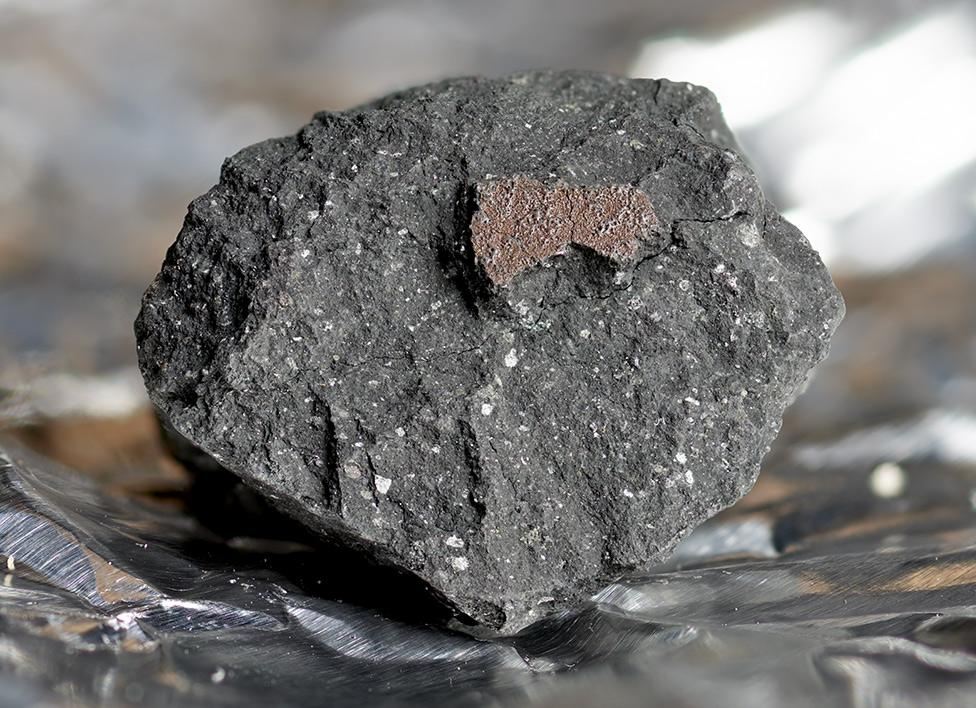
A chance walk along a Welsh beach has turned into a moment of scientific significance. In the United Kingdom, a nine-year-old girl has discovered a meteorite that predates Earth itself, offering researchers a rare glimpse into the earliest chapter of our solar system’s history.
The find is remarkable not just because of the rock’s age, but because it underscores how scientific breakthroughs can emerge far from laboratories, and sometimes from the sharp eyes of a child.
What exactly was found on a Welsh beach?
The discovery was made by Ariana Church, a nine-year-old fossil and sea-glass enthusiast, while she was exploring Penarth beach in South Wales with her family. Amid the usual limestone rocks common to the Welsh coastline, Ariana noticed something unusual.
The object was dark, heavier than expected, and had a metallic feel. Roughly the size of a tennis ball, it stood out immediately. “It looked different from all the others,” Ariana later recalled.
Her parents were initially unconvinced. But a quick scan using Google Lens suggested the rock could be a meteorite. They contacted an expert for confirmation and were stunned to learn that Ariana had indeed picked up a genuine space rock.
Is the meteorite really older than Earth?
According to experts who examined the specimen, the meteorite is about 4.5 billion years old. For comparison, Earth itself is estimated to be roughly 4.54 billion years old.
That narrow margin matters. It places the meteorite’s origins in the chaotic infancy of the solar system, before planets had fully formed.
A relic from the protoplanetary disk
Scientists believe the rock likely formed within the protoplanetary disk, a vast, rotating cloud of gas and dust that surrounded the young Sun. Over time, this disk gave rise to planets, moons, asteroids, and comets.
Meteorites like this one are fragments left over from that era. Unlike Earth, which has been reshaped by tectonics, volcanism, and erosion, these space rocks have remained largely unchanged for billions of years.
How do scientists know it came from space?
Geologists identified several telltale signs that distinguish meteorites from ordinary terrestrial rocks.
Key features found on the rock
- Regmaglypts: shallow, thumbprint-like depressions formed as the rock heated and melted while tearing through Earth’s atmosphere
- Fusion crust: a thin, glassy outer layer created by intense friction during atmospheric entry
- High density: significantly heavier than common Earth rocks
- Iron content: elevated levels of metallic iron, typical of many meteorites
These characteristics together make a strong case that the object is extraterrestrial in origin.
Why this meteorite discovery matters to science
Meteorites are more than curiosities. They are scientific time capsules.
Preserving the solar system’s earliest materials
Because they have not been altered by Earth’s geological processes, meteorites preserve the chemical and mineral composition of the early solar system. Studying them helps scientists answer foundational questions, including:
- What materials were present before planets formed?
- How did solid bodies begin to clump together?
- What conditions existed around the young Sun?
Some meteorites even contain organic compounds and water-bearing minerals, shedding light on how the ingredients for life may have been delivered to early Earth.
Rare context from a fresh find
Meteorites found soon after landing, or in environments where weathering is minimal, are especially valuable. A beach find is unusual, and careful analysis will determine how long the rock was exposed to Earth’s elements.
Why does it matter that a child found it
Ariana’s discovery has resonated far beyond academic circles.
Citizen science in action
This finding highlights the role of curiosity and observation in science. Many significant meteorites have been found by members of the public, not professional researchers.
It reinforces an important idea: science is not confined to institutions. It can begin with noticing something that looks out of place.
Inspiring the next generation
Stories like this often spark interest in geology, astronomy, and space science among young people. Ariana has reportedly added the meteorite to her growing collection, a fitting home for a rock older than Earth.
An inset profile or short video interview with the young finder could humanize the story further.
What happens next to the meteorite?
Before it can unlock its secrets, the meteorite will need further study.
Scientific analysis ahead
Researchers may conduct:
- Isotopic dating to confirm its precise age
- Chemical analysis to determine its classification
- Microscopic studies to examine mineral structures
Depending on the findings, the meteorite could be cataloged in a scientific collection or displayed in a museum, ensuring long-term preservation.
Why discoveries like this still surprise scientists
Despite decades of space exploration, meteorites remain one of the most direct ways to study the early solar system. Space missions are expensive and rare. Meteorites, by contrast, arrive unannounced and free of charge.
Each one has the potential to refine existing theories or raise entirely new questions.
TL;DR
- A nine-year-old girl discovered a meteorite on a beach in South Wales
- Experts estimate it to be about 4.5 billion years old, older than Earth
- The rock likely formed in the early protoplanetary disk
- Meteorites act as time capsules of the early solar system
- The find highlights the power of curiosity and citizen science


