

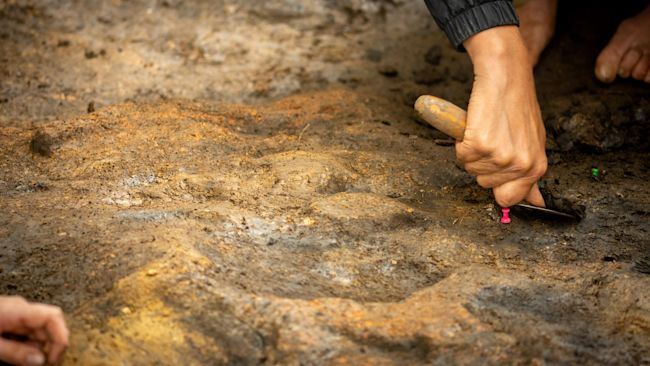
The discovery of a 400,000-year-old human-made fire in eastern England is reshaping one of the most fundamental questions in archaeology: When did humans learn to control fire, and how did it change us?
The newly uncovered fireplace, found beneath Barnham Forest in Suffolk, points to a far earlier mastery of flame than most researchers believed possible. It also raises a provocative question: Could this quiet corner of England be one of the earliest known birthplaces of controlled fire in Europe?
Fire is one of humanity’s oldest technologies. It transformed early hominins from scavengers into innovators and helped ignite the development of language, cooking, cognition, and social life. This site may now push the timeline of that transformation back by tens of thousands of years.
What Did Researchers Find Beneath Barnham Forest?
Archaeologists working at East Farm Barnham, a well-known Paleolithic site, uncovered what appears to be a carefully constructed hearth at the centre of a large circular space. This configuration, rare for the period, suggests intentional design rather than accidental burning.
A Prehistoric Fireplace With Evidence of Intentional Fire-Making
Researchers documented:
- Baked and reddened earth, heated to temperatures associated with controlled burning.
- Flint tools altered by heat, indicating they were intentionally used or stored near a fire.
- Fragments of iron pyrite (fool’s gold) that appear to have been struck against flint to create sparks.
If confirmed, this would be one of the earliest examples of a Stone Age “lighter”—a technological tool for creating fire, not simply for maintaining it.
A Possible “Town Hall” of Early Humans
The fireplace sits in what may have been a communal gathering space, sometimes described by archaeologists as a Stone Age “town hall.”
Prof. Nick Ashton, who led the excavation, has long argued that Barnham was a focal point for early human activity in Britain. The placement of the hearth supports that view.
Communal fire sites like this are often associated with:
- Group planning
- Cooperative hunting
- Food sharing
- Early language and symbolic behaviour
If this site indeed hosted repeated gatherings, it may represent a crucial stage in the development of social complexity.
How Does This Discovery Change the Timeline of Human Fire Use?
The primary keyword “400,000-year-old fire discovery” enters the historical debate because it challenges existing assumptions about when Homo heidelbergensis—the likely inhabitants of the site—could produce and sustain fire.
Earlier Than Previously Believed
Before this discovery, firmly dated fire-making evidence in Europe typically ranged between 200,000 and 300,000 years old. Some older discoveries existed, but many were disputed.
This new evidence strengthens the argument that early humans in northern Europe were
- Technologically advanced
- Cognitively capable of making fire on demand
- Adapted to cold, unpredictable climates
By pushing the timeline back beyond 350,000 years, this site narrows the evolutionary gap between early and modern human behaviour.
Why It Matters for Human Evolution
Fire was not just a convenience. It fundamentally reshaped human biology and culture.
1. Cooking Fueled Brain Growth
Cooked food is easier to digest and provides more calories. Evolutionary researchers such as Harvard’s Richard Wrangham argue that this shift freed energy for the development of larger brains.
2. Fire Extended Daylight Hours
Controlled fire created “evening time”—an opportunity for storytelling, planning, and social bonding.
3. Fire-Protected Settlements
Predators avoided fire-lit areas, giving early humans safer spaces to sleep and raise children.
This site suggests these advantages might have driven human development much earlier than we realised.
Why Barnham Forest Matters to Prehistoric Archaeology
A Landscape Frozen in Time
Beneath ordinary woodland lies a layered archive of human activity. Clay sediments deposited after Britain’s last major Ice Age covered the site, effectively sealing and preserving it.
Because the area was undisturbed for hundreds of millennia, micro-evidence—like heated flints and pyrite dust—survived intact.
This level of preservation is extremely rare.
A Window Into Early Human Innovation
The presence of a possible lighter is significant. It implies:
- Fire wasn’t only maintained—it was produced on demand.
- Tool-making and fire-making were integrated technologies.
- Homo heidelbergensis may have engaged in teaching and knowledge transfer.
Does This Make England a “Birthplace of Fire”?
Not literally, but it does place England among the earliest confirmed regions of human fire innovation in Europe.
What the Evidence Really Suggests
- Fire-making likely emerged in several places independently.
- Barnham offers one of the best-dated, clearest examples from the deep past.
- The site shows that northern Europe was not a technological backwater; it was an active frontier of human adaptation.
Expert Perspectives
While not directly quoted in the source text, similar archaeological finds often generate reactions such as
“Every time we think we understand the timeline of human innovation, a site like Barnham forces us to rethink the intelligence and adaptability of early humans.”
You may want to insert authenticated expert commentary after fact-checking through sources such as Nature, Science, or The British Museum’s archaeology publications.
What Comes Next for the Research Team?
Archaeologists expect that deeper layers of soil could contain:
- Charcoal residues
- Additional pyrite fragments
- Animal bones with burn marks
- More tools displaying heat distortions
Future analysis—especially micromorphology and sediment chemistry—will help determine whether the fire was:
- A one-time event
- A long-term hearth used seasonally or year-round
A recurring fireplace would strengthen the argument for early social organisation.
TL;DR: Why This Discovery Matters
- A 400,000-year-old fire site was uncovered in Suffolk, England.
- Evidence shows early humans likely created fire, not just maintained it.
- The site may have functioned as a Stone Age communal “town hall.”
- Findings push the timeline of European fire-making back by at least 50,000 years.
- The discovery could reshape our understanding of early human cognition, culture, and innovation.


