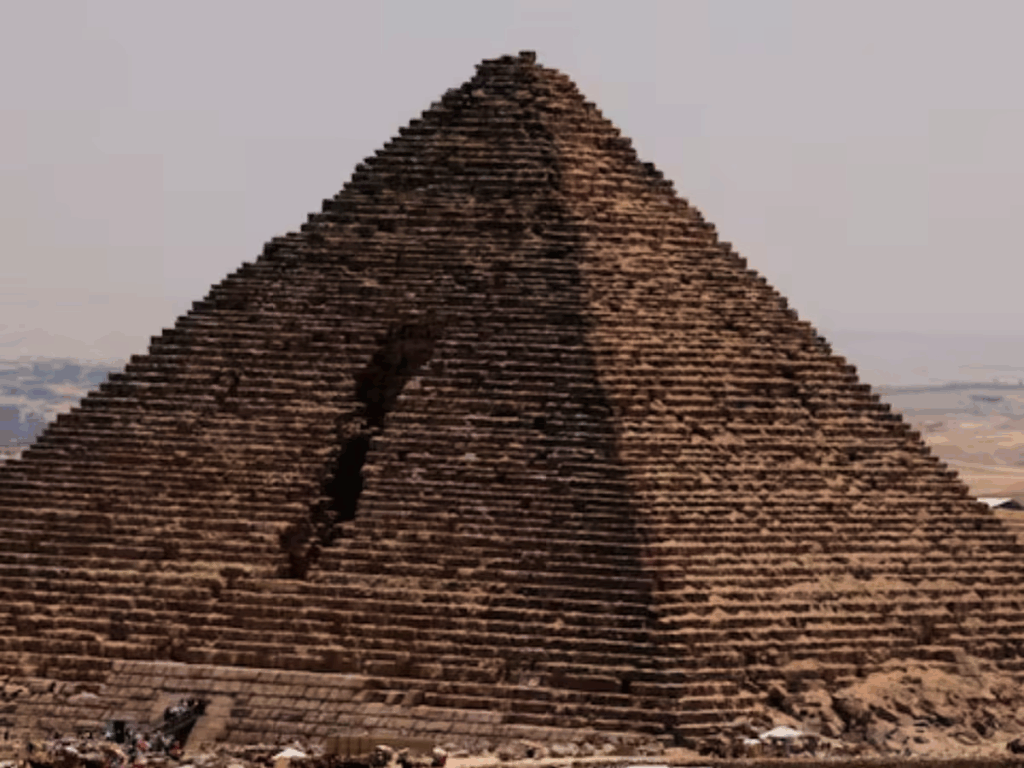
For more than 4,000 years, the pyramids of Giza have guarded their secrets with silent precision. Yet even after centuries of excavation, mapping, and debate, researchers continue to uncover surprises buried within their colossal stonework. The newest mystery comes from the pyramid of Menkaure—Giza’s third-largest pyramid—where scientists have detected two unexplained air pockets behind a granite casing. The unusual voids are unlike any previously documented structures in the monument and could mark the location of a long-lost second entrance.
This discovery raises fresh questions about the design and purpose of Menkaure’s pyramid, long considered the least studied of Giza’s major monuments. It also adds a new twist to the ongoing scientific race to understand how these ancient engineering masterpieces were constructed.
What makes the Menkaure pyramid’s air pockets so unusual?
The primary keyword appears here: Giza pyramid air pockets.
Researchers from Cairo University, led by Khalid Helal and Mohamed Elkarmoty, used a three-part scanning approach to peer behind the polished granite outer layer of the pyramid. Despite its prominent place in Giza, Menkaure has never received the same depth of investigation as Khufu’s or Khafre’s pyramids, making any new anomaly a significant step forward.
The team used:
- electrical resistivity tomography
- ground-penetrating radar
- ultrasonic testing
During these scans, they identified two small voids on the eastern face of the pyramid.
The findings include:
- The first void sits about 4.6 feet below the granite and measures roughly 1.5 meters by 1 meter.
- The second void lies slightly deeper at 1.1 meters under the granite, measuring about 0.9 meters by 0.7 meters.
- Both anomalies are inconsistent with natural joints between stones.
- The voids appear intentionally built rather than accidental gaps or collapse pockets.
Do the voids indicate a hidden entrance?
The big question driving international attention is whether these pockets could mark the location of a second entrance.
Here’s why researchers think that’s possible:
Similarity to existing structural patterns
The granite pattern covering the voids closely resembles the granite layout surrounding Menkaure’s known north entrance. This symmetry is unlikely to be coincidental.
Previous theories
In 2019, independent researcher Stijn van den Hoven proposed that Menkaure might have a second entrance on its eastern side. At the time, there was no evidence. Now, there is at least a structural anomaly consistent with that hypothesis.
Function-oriented voids
Unlike Khufu’s giant internal void discovered in 2017, which is believed to be a structural relieving chamber, these new voids are small, shaped, and oriented in ways that suggest more deliberate architectural intent.
The researchers now believe that cosmic-ray muography—an imaging technique used to map Khufu’s internal void—could help determine the full depth and geometry of the Menkaure anomalies. This approach is non-invasive and ideal for large stone monuments.
Why the Menkaure pyramid remains one of Giza’s great mysteries
Despite being the youngest of the three main Giza pyramids, Menkaure has the most unusual construction characteristics:
- Granite casing covers the lower section of the pyramid, leaving an unfinished, striking reddish facade.
- Its internal layout differs sharply from Khufu and Khafre, suggesting a different architectural philosophy.
- It has fewer documented chambers and tunnels than its neighboring pyramids.
- Its external damage, including medieval attempts to dismantle it, complicates modern study.
Because of these factors, the pyramid has not been studied as extensively as Khufu’s Great Pyramid. The new anomalies offer fresh motivation for Egyptologists to focus more attention on Menkaure, which may hide more architectural surprises.
What could the discovery reveal about ancient Egyptian engineering?
If confirmed as part of a hidden entrance system, the voids could offer new insight into Old Kingdom construction practices:
Navigational architecture
A second entrance could indicate that Menkaure’s builders planned multiple access points, possibly for ceremonial or structural reasons.
Construction sequences
Hidden cavities show how ancient engineers built the pyramid in stages—possibly leaving intentional gaps for maneuvering stones or redistributing weight.
Purpose and symbolism
Pyramids were not simply tombs. Entrances, pathways, and chambers often reflected complex religious beliefs. A secondary entrance could reshape how scholars understand Menkaure’s mortuary complex.
Why air-filled pockets matter in pyramid research
In ancient structures, voids can indicate intentional architectural features such as:
- relieving chambers
- hidden shafts
- sealing mechanisms
- secondary routes
- decoy passages
Because Menkaure’s voids lie directly behind polished granite blocks, they show signs of precise engineering. This makes them distinct from natural weaknesses or erosion cavities.
Researchers stress the importance of further imaging to determine if the voids connect to a tunnel or simply mark the beginning of a larger cavity.
What happens next?
The research team has recommended:
- using cosmic-ray muography to measure the depth and shape of the voids
- conducting further geophysical scans around the eastern face
- opening a broader Egyptological discussion on the significance of the anomalies
These findings come at a time when advanced imaging, AI pattern analysis, and non-invasive technologies are transforming archaeology. As techniques improve, even well-studied monuments like the Giza pyramids continue offering surprises.
The air pockets in Menkaure may be small, but they could lead to one of the most significant archaeological breakthroughs in recent decades.
TL;DR
- Scientists have discovered two air-filled voids behind the granite casing of the Menkaure pyramid.
- The voids are unexpected and structurally unique, suggesting they could mark the site of a hidden eastern entrance.
- Researchers used multiple scanning technologies to confirm the anomalies.
- The design resembles the layout around the pyramid’s known north entrance.
- Further analysis using cosmic-ray muography is expected.