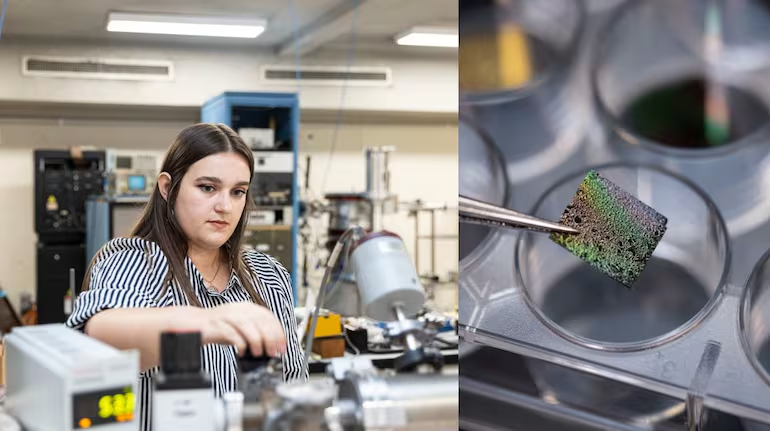
For decades, scientists have relied on telescopes, meteorites, and computer models to understand cosmic dust—the microscopic material that quietly shapes stars, planets, and possibly life itself. Now, for the first time, researchers have made something close to the real thing in a laboratory. In a breakthrough experiment at the University of Sydney, a PhD researcher has recreated cosmic dust using everyday gases and high-voltage electricity. The result is only a few milligrams of material—but its implications stretch across astrophysics, chemistry, and the study of life’s origins.
What Is Cosmic Dust, and Why Does It Matter?
Cosmic dust may sound insignificant, but it is anything but.
These particles, often smaller than a grain of smoke, are scattered throughout interstellar space, the vast regions between stars. They are also found in comets, asteroids, and the early building blocks of planets.
Why scientists care so much about cosmic dust
Cosmic dust plays several critical roles in the universe:
- Star formation: Dust helps cool collapsing gas clouds, allowing stars to form.
- Chemical factories: Dust grains act as surfaces where simple molecules combine into more complex organic compounds.
- Planetary building blocks: Dust aggregates over time to form pebbles, rocks, and eventually planets.
Many scientists believe that these particles helped produce amino acids, the building blocks of proteins, long before Earth was fully formed.
Why Studying Cosmic Dust on Earth Is So Difficult
Despite its abundance in space, cosmic dust is notoriously hard to study on Earth.
Most space-borne particles burn up as they pass through Earth’s atmosphere. The rare survivors that land as meteorites are:
- Difficult to locate
- Often contaminated by Earth’s environment
- Chemically altered by heat and impact
That means scientists rarely have access to “pristine” cosmic dust material in the same state it was in shortly after forming near stars or supernovae.
This limitation has left major gaps in our understanding of how organic chemistry evolves in space.
How Scientists Recreated Cosmic Dust in a Lab
That’s the problem Linda Losurdo set out to address.
Working with her co-author, David McKenzie, Losurdo designed a lab setup that mimics the extreme environments where cosmic dust forms.
The ingredients and setup
The experiment used:
- Nitrogen
- Carbon dioxide
- Acetylene
These gases were introduced into a sealed glass tube after the air had been removed. Researchers then applied 10,000 volts of electricity for about an hour.
What is “glow discharge”?
The electrical charge created a plasma state known as glow discharge, similar to conditions found near stars and supernova explosions. In that environment, atoms and molecules collide, break apart, and recombine, just as they do in space.
The result: a few milligrams of dusty nanoparticles that closely resemble newly formed cosmic dust.
How the Artificial Cosmic Dust Was Analyzed
Once formed, the dust particles were deposited onto a silicon wafer for close analysis.
This step allowed researchers to:
- Examine the chemical structure of the particles
- Compare them with known samples of cosmic dust
- Study their surface properties in detail
What makes this material especially valuable is its pristine nature. Unlike cosmic dust that travels through space and Earth’s atmosphere, these particles have not been altered by radiation, collisions, or chemical reactions inside comets or meteorites.
In other words, this dust looks much like cosmic dust right after it is born.
Why This Matters for Understanding the Origins of Life
One of the biggest unanswered questions in science is where life’s building blocks came from.
Did amino acids and other organic molecules form on early Earth, or were they delivered from space?
Losurdo argues that answering this question requires going back to the very beginning.
“When we’re looking at big questions like the origins of life, we have to look at where the building blocks started from.”
Lab-made cosmic dust gives scientists something they’ve never had before: a controlled, repeatable way to test how organic molecules form on dust grains under space-like conditions.
What researchers can now test
With artificial cosmic dust, scientists can explore:
- How organic molecules form on dust surfaces
- Which conditions favor complex chemistry
- Whether certain compounds form more easily in space than on Earth
Bridging the Gap Between Telescopes and the Lab
Until now, much of cosmic dust research has relied on indirect observation.
Astronomers use telescopes to detect dust clouds by how they absorb or scatter light. Chemists, meanwhile, run simulations and small-scale experiments that approximate space conditions.
This new work helps connect those two worlds.
By producing dust that closely resembles what telescopes observe in space, researchers can test whether existing models of cosmic chemistry actually hold up in the lab.
This approach could help refine our understanding of how organic matter evolves long before planets form.
What Comes Next for This Research?
The team is not stopping with one version of cosmic dust.
The next phase involves adjusting the experimental conditions—changing gas mixtures, voltages, and durations—to create a library of different dust types.
Long-term goals
Losurdo hopes that, one day, lab-made dust samples can be directly matched to:
- Specific meteorites
- Comet compositions
- Observations of distant star systems
If successful, this would allow scientists to trace the chemical history of cosmic material with far greater precision than ever before.
Why This Breakthrough Matters Beyond Astronomy
While the experiment focuses on space science, its implications are broader.
Understanding how complex chemistry emerges from simple ingredients could influence:
- Astrobiology and the search for life beyond Earth
- Materials science and nanotechnology
- Models of planetary formation across the universe
In a field where direct samples are rare and data is often indirect, creating cosmic dust on demand is a powerful new tool.
TL;DR
Scientists at the University of Sydney have recreated cosmic dust in a lab using gases and high-voltage electricity. This artificial dust closely resembles pristine cosmic material and could help answer one of science’s biggest questions: whether the building blocks of life formed on Earth, or arrived from space.