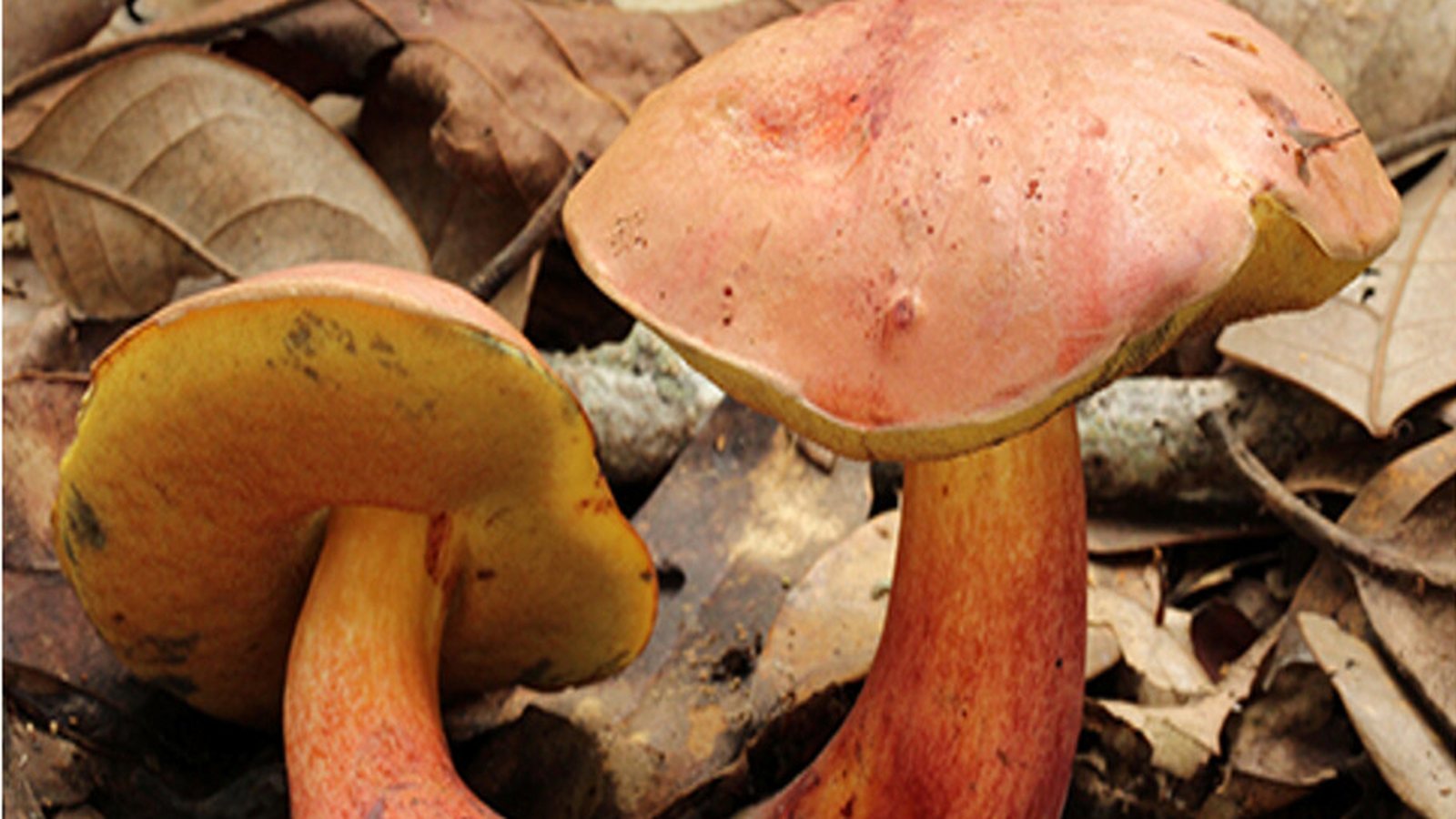
Some people who eat a certain wild mushroom undercooked in southwest China report the same odd thing. They see dozens of tiny people, a few inches tall, walking around the room.
University of Utah researchers say DNA shows that the mushroom behind matching reports in the Philippines is the same species, Lanmaoa asiatica. The chemistry is the strange part, because the mushroom contains no psilocybin or any other known mushroom psychedelic.
That points to a compound no one has identified. Doctoral student Colin Domnauer and mycologist Bryn Dentinger reported the work in the journal Mycologia on June 5. It drew new attention over the weekend after ScienceDaily republished the university’s account.
What people say they see on the mushroom
Doctors call these Lilliputian hallucinations, after the tiny islanders in “Gulliver’s Travels.” The details are oddly consistent from person to person.
“People pretty much always report seeing dozens or hundreds of little people, about 3 to 30 centimeters tall, in incredible detail, like they’re actually there,” Domnauer said in a University of Utah Q&A. That is roughly 1 inch to 1 foot. About 90% of people describe elves, clowns or other fairy-like figures in colorful clothes, he said.
The figures also obey gravity. “They’re not walking through walls or anything. They’re falling off the edge of tables, walking around objects,” Domnauer said.
In Yunnan the mushroom is a prized edible called jian shou qing. The name roughly means “turns blue in the hand,” for the way it bruises when touched. Market sellers there told Domnauer about their own run-ins with the little people.
Hospitals see the results. Emergency doctors at the First People’s Hospital of Yunnan Province studied 20 patients treated for L. asiatica poisoning from June to August 2024.
Fifteen had hallucinations, and symptoms began a median of four hours after the meal. Patients stayed a median of 24 hours. All had recovered at a one-month follow-up, the team reported in Food Science & Nutrition in 2025.
A mystery chemists gave up on in the 1960s
Western scientists first heard about “mushroom madness” from Papua New Guinea in 1934, according to the Utah account. Expeditions in the 1950s and 1960s narrowed the suspects to a few bolete mushrooms. Chemists found no active compound in the samples. Domnauer said even Albert Hofmann, the Swiss chemist who isolated psilocybin and discovered LSD, came up empty.
Researchers concluded the visions might be cultural rather than chemical, and the work stopped. Then in the 1990s, similar reports came from Yunnan after people ate bolete mushrooms. Mycologists suspected L. asiatica, which scientists had only recently described.
The third clue came in 2024. An Indigenous community in the Philippines’ Northern Cordillera region told Domnauer about a wild mushroom it calls Sedesdem. According to local knowledge, it sometimes brought visions of little people.
Domnauer collected specimens in Yunnan and the Philippines, and the DNA showed that jian shou qing and Sedesdem are both L. asiatica.
That surprised the team, because scientists had thought the species grew only in China. Dentinger also traveled to Papua New Guinea, but unusually dry weather meant he couldn’t collect specimens there. So the original 1934 mushroom remains unidentified.
What the DNA proves, and what it doesn’t
The DNA settles one question. Mushrooms tied to the same unusual visions by two independent cultures, in two countries, are one species.
It doesn’t, on its own, prove the mushroom causes the visions. That link rests on eaters’ accounts and hospital cases, which are strong but not a controlled experiment. Domnauer argues the pattern is hard to explain any other way: the visions “must have a shared underlying chemical and neurological basis,” he said.
The paper itself is mostly a family tree. The team sequenced the whole genomes of 53 specimens and recognized 17 species in the Lanmaoa genus, four of them new to science.
Two of the new species turned up in existing U.S. collections. The authors formally named two of them, Lanmaoa fallax and Lanmaoa carbonilivor.
For the hallucinations, the key line is in the study’s abstract on PubMed. Genome mining of L. asiatica “fails to detect canonical biosynthetic genes associated with psilocybin or ibotenic acid production, suggesting the presence of a novel psychoactive compound.” The team also tested the mushroom chemically and “found absolutely no trace” of known psychoactive mushroom compounds, Domnauer said.
Why brain researchers care about a mystery compound
The same tiny-people visions also show up, rarely, in alcohol withdrawal, dementia and macular degeneration, according to the university. Scientists don’t know what causes them in those cases.
Domnauer’s case is that a mushroom which triggers the effect reliably could become a lab tool. “If L. asiatica has some compound that can reliably induce these hallucinations, it could be a very powerful tool for understanding the mechanisms behind them,” he said. That would add to work on how the brain builds what we see.
None of this is a treatment, and no one has tested a purified compound in animals or people. Fungi have surprised researchers before, as with the gut fungus studied for radiation protection. This work is at the first step.
Isolating the molecule comes next
“Our next step is to isolate and identify that new psychedelic compound,” Domnauer said. The team is also building an evolutionary map of the genus to see how the trait arose and whether relatives make similar chemicals. The National Science Foundation funded the research.
The Yunnan cases are a reminder that L. asiatica is a poisoning risk, not a safe trip.
Anyone in the U.S. who feels sick after eating a wild mushroom can call Poison Control at 1-800-222-1222. The researchers haven’t given a timeline for naming the compound.