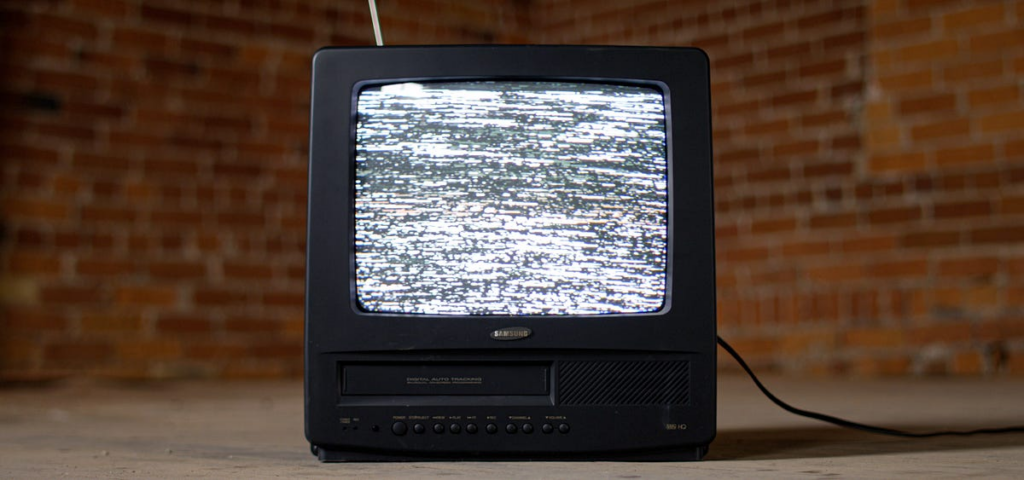
If you grew up with analog television, you probably remember the hiss and flicker that filled the screen when no channel was available. That white noise felt random, annoying, even. But here’s the part that still surprises physicists: a tiny fraction of that static carried a faint afterglow from the birth of the universe.
Roughly 1% of the snow on old analog TVs came from the Big Bang itself, in the form of cosmic microwave background radiation.
In a very real sense, anyone watching that static was looking at ancient light that began its journey 13.8 billion years ago.
What Was That TV Static, Really?
Before digital broadcasting, televisions relied on analog signals transmitted over the air. When no signal was available, the screen filled with visual “snow” and an audible hiss.
That static came from multiple sources:
- Electrical noise inside the TV
- Atmospheric interference
- Solar radiation
- Human-made radio signals
- And, crucially, background radiation from space
A small but measurable portion of it was the Cosmic Microwave Background (CMB), the faint radiation left over from the early universe.
The same background hiss could also be detected on analog radios.
What Is the Cosmic Microwave Background (CMB)?
The Cosmic Microwave Background is often described as the afterglow of the Big Bang.
It dates back to about 380,000 years after the universe began.
Why 380,000 years?
In the beginning, the universe was an extremely hot, dense plasma. Light couldn’t travel freely because photons constantly collided with charged particles.
As the universe expanded, it cooled. Eventually, it became cool enough for protons and electrons to combine into neutral hydrogen atoms. When that happened, photons were finally able to travel unimpeded through space.
Those photons are what we detect today as the CMB.
Today, that radiation has cooled to about 2.7 Kelvin (roughly -454.8°F), just above absolute zero.
It’s everywhere, filling all of space.
How Was the CMB Discovered?
The discovery story is one of the most famous accidental breakthroughs in science.
In 1964, astronomers Arno Penzias and Robert Wilson were working at Bell Labs in Holmdel, New Jersey. They were using a large horn antenna to study radio signals.
But they kept detecting a persistent background hiss.
No matter where they pointed the antenna, the noise remained.
They tried everything:
- Checking for interference from nearby cities
- Inspecting equipment for faults
- Even clearing out pigeons nesting in the antenna
The signal wouldn’t go away.
After nearly a year of investigation, they realized the noise wasn’t coming from Earth at all. It was coming from everywhere in the sky.
At the same time, physicist Robert H. Dicke and his team at Princeton University were searching for predicted radiation left over from the Big Bang.
When Penzias and Wilson connected with Dicke’s group, the pieces fell into place.
The hiss was the missing evidence.
Penzias and Wilson later received the Nobel Prize in Physics for the discovery.
Why Did This Prove the Big Bang?
Before the CMB was discovered, there were competing theories about how the universe began.
The detection of uniform microwave radiation across the sky strongly supported the Big Bang model.
Here’s why:
- The Big Bang theory predicts that the universe began hot and dense.
- As it expanded, it cooled.
- That cooling should leave behind residual radiation.
- The CMB is exactly that radiation.
It’s remarkably uniform in all directions, which supports the idea of a shared cosmic origin.
How Did Old TVs Pick Up the Big Bang?
Analog TVs used antennas designed to capture radio-frequency signals.
The CMB exists in the microwave part of the electromagnetic spectrum. While television antennas weren’t built to detect cosmic radiation, they were sensitive enough to pick up a faint portion of it.
About 1% of the static on an untuned analog television was attributed to the CMB.
The rest came from:
- Local electronic interference
- Earth’s atmosphere
- Emissions from the Sun
That means when your screen flickered with snow, a tiny fraction of that visual noise was ancient light from the early universe.
Did That Mean We “Time-Traveled”?
Not literally.
But in a poetic sense, yes.
When you detected the CMB, you were observing photons that began travelling 13.8 billion years ago.
Astronomy always looks backwards in time. When we see distant galaxies, we see them as they were millions or billions of years ago.
The CMB takes that idea to the extreme: it’s the oldest light we can observe.
So while you weren’t stepping into a time machine, you were witnessing a relic of the universe’s infancy.
Why Did the Static Disappear?
Digital broadcasting changed everything.
Modern TVs:
- Use digital signals
- Process data differently
- Filter noise more effectively
When digital transmission replaced analog, the familiar hiss largely vanished.
The CMB didn’t disappear; our devices just stopped displaying it as visible snow.
Today, scientists measure the CMB with highly sensitive instruments on satellites such as:
- COBE
- WMAP
- Planck
These missions mapped tiny temperature variations in the CMB, helping refine estimates of the universe’s age, composition, and expansion rate.
Why This Still Matters Today
The CMB isn’t just historical trivia.
It remains one of the strongest pillars supporting modern cosmology.
From it, scientists have determined:
- The universe is about 13.8 billion years old
- Ordinary matter makes up only about 5% of the cosmos
- Dark matter and dark energy dominate
Without the accidental discovery by Penzias and Wilson, modern cosmology would look very different.
TL;DR
- About 1% of analog TV static came from the Cosmic Microwave Background.
- The CMB is radiation left over from 380,000 years after the Big Bang.
- It was discovered accidentally in 1964 by Arno Penzias and Robert Wilson.
- The finding confirmed predictions of the Big Bang theory.
- Digital TVs no longer display that familiar hiss, but the radiation is still everywhere.
Final Thought
That fuzzy white screen wasn’t just technological noise.
It was a whisper from the beginning of time, ancient photons crossing billions of years to briefly flicker in your living room.
The universe has always been speaking.
For a while, our televisions let us hear it.