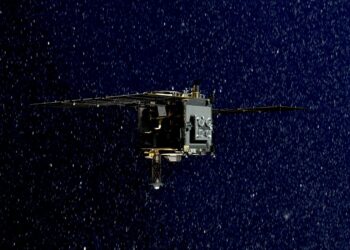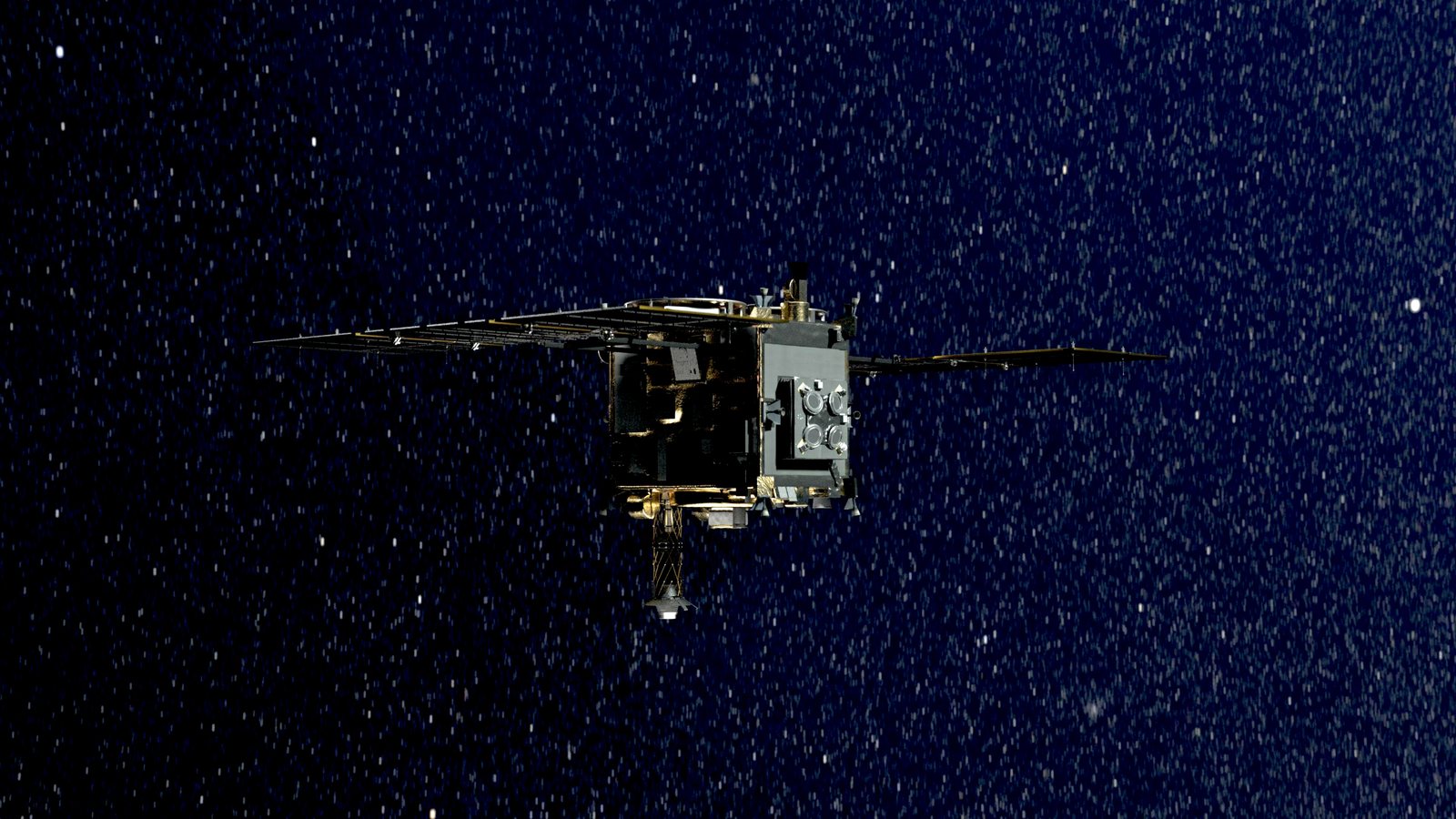
Japan’s space agency has dropped Hayabusa2’s 2031 visit to asteroid 1998 KY26, the 36-foot rock whose odd drift made headlines this week. The probe’s worn ion engines can no longer get it there. It will fly past another small asteroid, 2015 BM510, in April 2028.
The timing is awkward. Hayabusa2 was the one mission that could have settled up close what 1998 KY26 is. Newsweek framed the question as “dark comet or Soviet probe?” The published orbit work points to a plainer answer, but for now it stays a matter of telescopes and arithmetic.
Why JAXA gave up the 2031 rendezvous
JAXA told a Cabinet Office space subcommittee about the change on November 16, MediaDogs reported. It briefed reporters the next day in a session listed by JAXA’s space science institute. Team leader Yuya Mimasu said deterioration of onboard equipment was “becoming increasingly evident,” AFP reported via Phys.org. He told Nikkei his regret at abandoning the 2031 mission was “second to none” (our translation).
A Sept. 28 update on JAXA’s Hayabusa2 site explains the fault. On July 9, four days after flying past asteroid Torifune, the probe restarted its ion engines to set up a December 2027 Earth swing-by.
In mid-August, engine B, the last one working normally, began suffering repeated electrical discharges. It was the third bout, after 2021 and 2025. In late August, engineers found that the power supply feeding its ion source had failed.
They rigged a “cross operation” that pairs engine D’s ion source with engine B’s neutralizer. The first Hayabusa used the same trick to limp home.
MediaDogs reports it cannot supply the roughly 600 meters per second of extra speed the trip needed. JAXA now relies on chemical thrusters good for about 30 m/s, Mynavi reported.
The new target is a dark rock 17 to 74 meters across that spins once every 49 minutes. Mimasu called it “the best target object, miraculously discovered.”
What 1998 KY26 is, in numbers
Much of what JAXA knew when it picked the rock in 2020 has changed since. Figures are from JPL’s Small-Body Database and the papers it cites.
| Measure | Value | Source |
|---|---|---|
| Diameter | About 11 m (36 ft), give or take 2 m | JPL; Santana-Ros et al., 2025 |
| Spin | Once every 5.35 minutes | Same |
| JAXA’s 2020 figures | About 30 m; one turn every 10.7 minutes | JAXA, July 22, 2020 |
| Orbit | 498 days around the Sun | JPL |
| Distance today | About 186 million miles from Earth | JPL Horizons |
| Next close pass | May 24, 2039, about 10 million miles | JPL |
| Bulk density | 2.8 g/cm³ (range 1.8 to 4.4) | Farnocchia et al., 2025 |
| Out-of-plane push, 2023 fit | 0.64 billionths of a m/s² | Seligman et al., 2023 |
That last number is the whole mystery. By our arithmetic, it is about one ten-millionth of the Sun’s pull at Earth’s distance. It shows up only because astronomers have tracked the rock for 26 years.
How the “dark comet” push got explained
The label comes from a 2023 paper by Darryl Seligman, JPL’s Davide Farnocchia and colleagues. They found six small, inactive-looking objects drifting out of their orbital planes. No sunlight effect could push sideways that hard, they said, so they proposed tiny amounts of escaping water.
Among the six, 1998 KY26’s push sat mid-pack. It was below 2016 NJ33 and 2010 VL65, at about 1.7 and 1.8 billionths of a m/s².
Then the rock passed 2.85 million miles from Earth in June 2024. Observations showed it was a third of the assumed size and spun twice as fast. Keck and Gemini images found no dust, and a spectrum like Xe-type asteroids.
A month after the size result, Farnocchia’s team modeled sunlight pushing on, and heat radiating from, a squashed, fast-spinning rock. They report an excellent orbital fit with no hidden comet activity.
A November paper in Icarus by Georgia Tech’s Korbin Hansen and Masatoshi Hirabayashi found the rock averages about minus 53°F. That is far above the roughly minus 199°F needed to keep buried ice. NASA told Fox News that “solar radiation forces” drive its path.
Loeb’s Phobos 1 idea, and what would test it
Loeb and co-authors proposed in May that 1998 KY26 might be Phobos 1. The Soviet probe left for Mars in July 1988 and was lost two months later after a faulty command. A September follow-up says a spacecraft model matches eight light curves. “We predict that when they land on it, instead of seeing an iceberg, they will find the label ‘Made in the USSR,'” Loeb told Fox News.
NASA Administrator Jared Isaacman said on Fox & Friends that he had seen no evidence it is “anything other than an asteroid.”
The idea needs a lot to go right. To line the orbits up, the May paper needs two engine burns totaling 1.9 km/s. One, of 1.28 km/s, falls on May 19, 1996, nearly eight years after the probe went silent. The paper does not say what fired it, and it lists the rock’s concave, asteroid-like radar shape as evidence against.
The evidence in hand points the other way. The spectrum matches a type of asteroid, and the density is rock-like. A sphere that size at 2.8 g/cm³ would weigh roughly 2,000 tonnes, by our arithmetic. Phobos 1 weighed 6.2 tonnes at launch.
Loeb’s last claim like this cast 2005 VL1 as the Venera 2 probe. A later orbit analysis “decisively” ruled it out.
It belongs with other viral space claims we have checked, like the K2-155 radio tone. Asteroid trackers sort rock from hardware routinely, as they did with the mini-moon 2026 QQ8.
From 1998 discovery to a cancelled visit
| Date | Event |
|---|---|
| May 28, 1998 | Spacewatch finds 1998 KY26; it passes 500,000 miles from Earth on June 8. |
| July 22, 2020 | JAXA picks it as Hayabusa2’s extended-mission target. |
| 2023 | It is listed among six “dark comets.” |
| Sept.–Oct. 2025 | Studies cut its size to 11 m and explain the push with sunlight. |
| May 31, 2026 | Loeb’s team posts the Phobos 1 paper. |
| August 2026 | Hayabusa2’s last healthy ion engine fails. |
| Nov. 16–17, 2026 | JAXA switches targets. |
Loeb told Fox News a rock or ice found by Hayabusa2 would end his theory. That test is gone. The rock next comes within about 10 million miles of Earth in May 2039. Before then, Hayabusa2’s team plans telescope observations of 2015 BM510 in late 2026 and early 2027.