
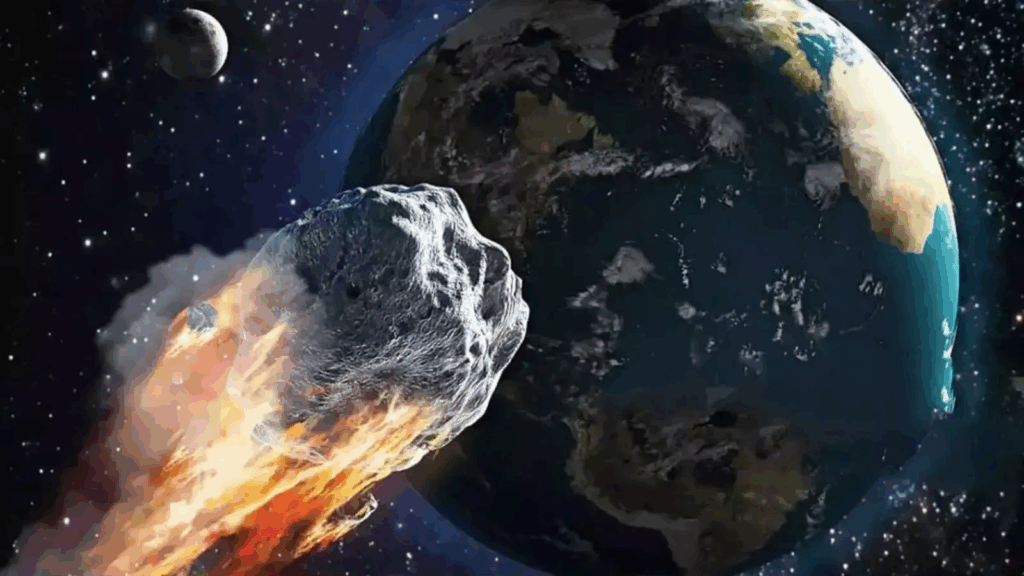
A 2,300-foot space rock hidden near the Sun has renewed global concern about so-called killer asteroids, a class of near-Earth objects astronomers struggle to detect due to the Sun’s overpowering glare. The newly identified object, named 2025 SC79, belongs to an extremely rare population known as Atira asteroids. Only 39 such bodies have ever been found, and scientists caution that the undiscovered ones pose one of the most dangerous natural risks to humanity. The discovery of this twilight asteroid has amplified a critical question: how many more of these invisible hazards are orbiting close to Earth without our knowledge?
What is the newly discovered twilight asteroid?
2025 SC79 is a near-Earth asteroid first spotted in September by astronomer Scott S. Sheppard at the Carnegie Institute for Science. Measuring roughly 2,300 feet (700 meters) in diameter, it is large enough to cause mass extinction-level devastation if it ever collided with Earth.
What makes 2025 SC79 particularly intriguing is its orbit. It is only the third-shortest-period asteroid ever detected, completing a full loop around the Sun in just 128 days. Its path lies entirely within Venus’s orbit and even crosses Mercury’s, placing it extremely close to the Sun for much of its trajectory.
This orbital behavior explains why astronomers missed it for so long.
Why are twilight asteroids so hard to detect?
The term “twilight asteroid” refers to objects that can only be observed during a brief period each day — the few minutes after sunset or before sunrise when the Sun is just below the horizon. During this twilight window, the Sun’s intense glare diminishes enough for telescopes to glimpse the space close to it.
The Sun’s brightness hides nearby threats
Objects within Earth’s orbit are essentially drowned out by sunlight. Traditional nighttime sky surveys cannot see them. As a result:
- They go unnoticed much longer than asteroids in the main belt.
- Their trajectories are harder to map because they are visible only in narrow time frames.
- Their close proximity to Earth increases the potential impact risk.
Sheppard, who discovered 2025 SC79 using the Dark Energy Camera on the National Science Foundation’s Blanco 4-meter telescope, has long warned that the most dangerous asteroids are the hardest to detect. His search program specifically targets the Sun-facing region of space where these objects hide.
How dangerous is 2025 SC79?
While there is currently no confirmed impact risk, the scale of potential devastation warrants attention.
Continental-level destruction
A 2,300-foot asteroid could:
- Release energy equivalent to millions of nuclear bombs.
- Flatten entire regions the size of countries.
- Trigger global climate effects by sending dust into the atmosphere.
- Kill billions of humans, animals, and ecosystems.
NASA classifies any asteroid above 460 feet (140 meters) as “potentially hazardous.” 2025 SC79 is five times that threshold.
Harder to track, harder to predict
Because twilight asteroids spend much of their orbit within the Sun’s glare:
- Data collection is limited.
- Orbital projections involve more uncertainty.
- Future close approaches can be difficult to forecast.
The asteroid will soon slip behind the Sun again, temporarily halting further analysis. Researchers will need future observation windows to measure its composition, density, spin, and exact trajectory.
How many killer asteroids remain undiscovered?
According to estimates from planetary-defense teams worldwide, roughly 39 Atira-class asteroids have been found so far — but many more could exist. These objects are rare not because they are few in number, but because they are nearly impossible to detect.
The hidden population near the Sun
Astronomers believe the inner solar system contains:
- Atira asteroids (orbit entirely inside Earth’s orbit)
- Interior Earth objects
- Vulcanoids (hypothetical bodies orbiting even closer to the Sun than Mercury)
These objects occupy an observational blind spot. The Sun is the single largest impediment to planetary-defense surveillance, and twilight searches are still in the early stages of development.
What tools are scientists using to find these hidden objects?
The discovery of 2025 SC79 relied on a combination of high-precision instruments:
Dark Energy Camera (DECam)
Mounted on the Blanco 4-m telescope in Chile, DECam was originally designed to study dark energy but has emerged as one of the world’s most powerful asteroid-hunting tools.
Gemini Observatory and Magellan Telescopes
These facilities confirmed the asteroid’s orbit and size shortly after Sheppard’s initial discovery.
Upcoming detection technologies
Future telescopes such as the Vera C. Rubin Observatory are expected to improve twilight detection dramatically. They will scan wider portions of the sky more frequently, boosting the odds of catching fast-moving objects near the Sun.
Why this discovery matters for planetary defense
The discovery of 2025 SC79 highlights a strategic vulnerability in Earth’s asteroid-detection system: the Sun-facing blind spot.
The stakes
Even a single undetected asteroid could cause catastrophic loss of life. The 2013 Chelyabinsk meteor — only 66 feet wide — injured over 1,500 people. A 2,300-foot twilight asteroid would be thousands of times more destructive.
The path forward
Improving twilight-focused detection is now a global priority. Planetary-defense agencies are working on:
- Faster-refresh sky surveys
- Infrared-based detection satellites placed away from Earth
- Computational systems to model hidden-orbit objects
The discovery of 2025 SC79 is both a scientific milestone and a warning. Humanity’s ability to detect objects near the Sun is improving, but the unknown population of killer asteroids remains one of the biggest natural threats to civilization.
TL;DR
- A newly discovered 2,300-foot twilight asteroid, 2025 SC79, orbits close to the Sun and is nearly invisible to traditional telescopes.
- Its size makes it capable of killing billions if it hit Earth, though no impact risk is currently confirmed.
- Twilight asteroids are extremely difficult to detect because the Sun hides them.
- Only 39 Atira-class asteroids are known, but many more may exist.
- The discovery underscores urgent gaps in global planetary-defense systems.