

Quick Summary
Astronomers recorded 249 fast radio bursts from deep space within minutes in 2024, using the MeerKAT telescope. The event, dubbed FRB 20240619D, is among the most active repeaters ever observed. Scientists suspect magnetars or binary star systems as possible origins, but the mystery continues. These repeating bursts offer vital clues about cosmic structures and extreme astrophysics.
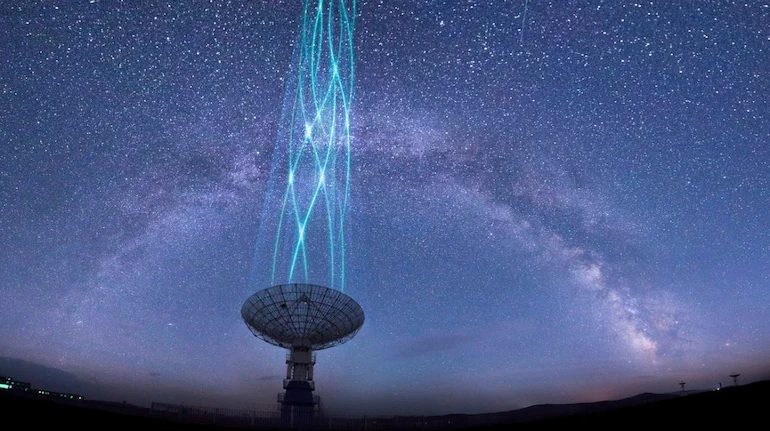
When 249 rapid-fire radio signals bombarded Earth within a matter of minutes, astronomers knew they were witnessing one of the most intense cosmic events ever recorded. The phenomenon, traced with South Africa‘s powerful MeerKAT radio telescope, has reignited the debate about the origins of fast radio bursts (FRBs)—enigmatic millisecond flashes from the distant universe.
What are fast radio bursts?
Fast radio bursts are short, intense pulses of radio waves that last only a few milliseconds but release as much energy as the Sun emits in days. Since their discovery in 2007, FRBs have become one of the most intriguing astrophysical mysteries.
Some FRBs are one-off events, while others repeat, often in clustered bursts. Their origins remain unsettled, but leading theories point to highly magnetized neutron stars (magnetars) undergoing starquakes or compact binary systems where extreme gravitational and magnetic interactions take place.
FRB 20240619D, the event detected in June 2024, now ranks among the most active repeaters ever seen.
How did scientists detect 249 signals in minutes?
Using the MeerKAT telescope array in South Africa, researchers tracked FRB 20240619D across multiple frequency bands. Initially, three bursts appeared within two minutes. To probe further, the team extended monitoring to higher and lower bands, including the ultra-high frequency, L-band, and S-band.
The result: 249 distinct bursts in rapid succession, a cosmic blitz unlike most FRBs studied before. The bursts were strongest around the L-band, with a clear frequency drift, revealing unusual structure and complexity in the emission zones.
This behavior, scientists say, hints that the FRB source may not be a simple compact object but rather a dynamic environment capable of shifting its emission profile.
Why are repeating FRBs important?
Most FRBs are single, non-repeating events. Repeating signals, however, offer a rare chance for extended observation, making them invaluable to astrophysics.
In this case, the sheer intensity and repeat rate of FRB 20240619D positions it among the most significant findings to date. Repeating bursts allow astronomers to:
- Test competing theories of origin (magnetars vs. binary systems).
- Compare emission across frequencies.
- Correlate radio bursts with potential optical or X-ray counterparts.
Although the MeerLICHT optical telescope was paired with MeerKAT during this event, no optical flashes were detected. However, parallel experiments are now pushing timing precision to the millisecond range, aiming to catch any fleeting light signatures that might accompany FRBs.
Where do most FRBs come from?
Despite more than a decade of study, no single explanation has solved the FRB puzzle. Theories currently fall into two camps:
- Magnetar Starquakes: Young neutron stars with ultra-strong magnetic fields crack under internal stress, releasing immense bursts of energy.
- Compact Binary Interactions: Systems with neutron stars or black holes produce FRBs during close orbital interactions or mergers.
FRB 20240619D’s activity may help scientists distinguish between the two. Its pattern—hundreds of bursts in minutes, with frequency drift—leans toward magnetar-driven mechanisms, but binary interactions cannot yet be ruled out.
What does this mean for Earth and astronomy?
For now, FRBs are not a danger to Earth. Their energy dissipates over billions of light-years, leaving only faint radio traces detectable with sensitive instruments.
But for science, they’re a goldmine. Each repeating signal helps map the intergalactic medium—the vast, diffuse plasma between galaxies—because FRBs disperse as they travel. This allows astronomers to probe cosmic structures otherwise invisible.
Some researchers even speculate that FRBs could someday serve as cosmic lighthouses, helping measure the expansion of the universe more precisely.
Could FRBs be artificial?
While most scientists attribute FRBs to astrophysical phenomena, the sheer precision and energy of these signals occasionally sparks speculation about advanced extraterrestrial technology. However, all observed properties of FRBs, including FRB 20240619D, are consistent with natural astrophysical processes rather than deliberate communication.
The unanswered questions
FRB 20240619D leaves researchers with more questions than answers:
- Why are some FRBs one-off events while others repeat?
- What causes frequency drifts and multi-component bursts?
- Do FRBs produce detectable light, X-rays, or gamma rays alongside radio waves?
- Could repeating FRBs like this one unlock new physics about extreme matter?
Future observatories, such as the Square Kilometre Array (SKA)—currently under construction in Australia and South Africa—promise to revolutionize FRB studies by detecting thousands per year across unprecedented frequency ranges.
